Some union leaders are warming to artificial intelligence as a tool to preserve jobs and raise productivity, but the backlash from rank-and-file workers shows the labor movement is still fighting over whether AI is a bargaining chip or a threat.
Microsoft, IBM face union pushback over AI adoption
That split matters economically because it goes to the heart of how quickly companies can deploy AI without triggering higher labor costs, work stoppages or political resistance. It also matters to investors because the market’s bet on AI has rested not just on faster growth, but on lower unit costs, wider margins and fewer constraints on adoption across white-collar workforces.
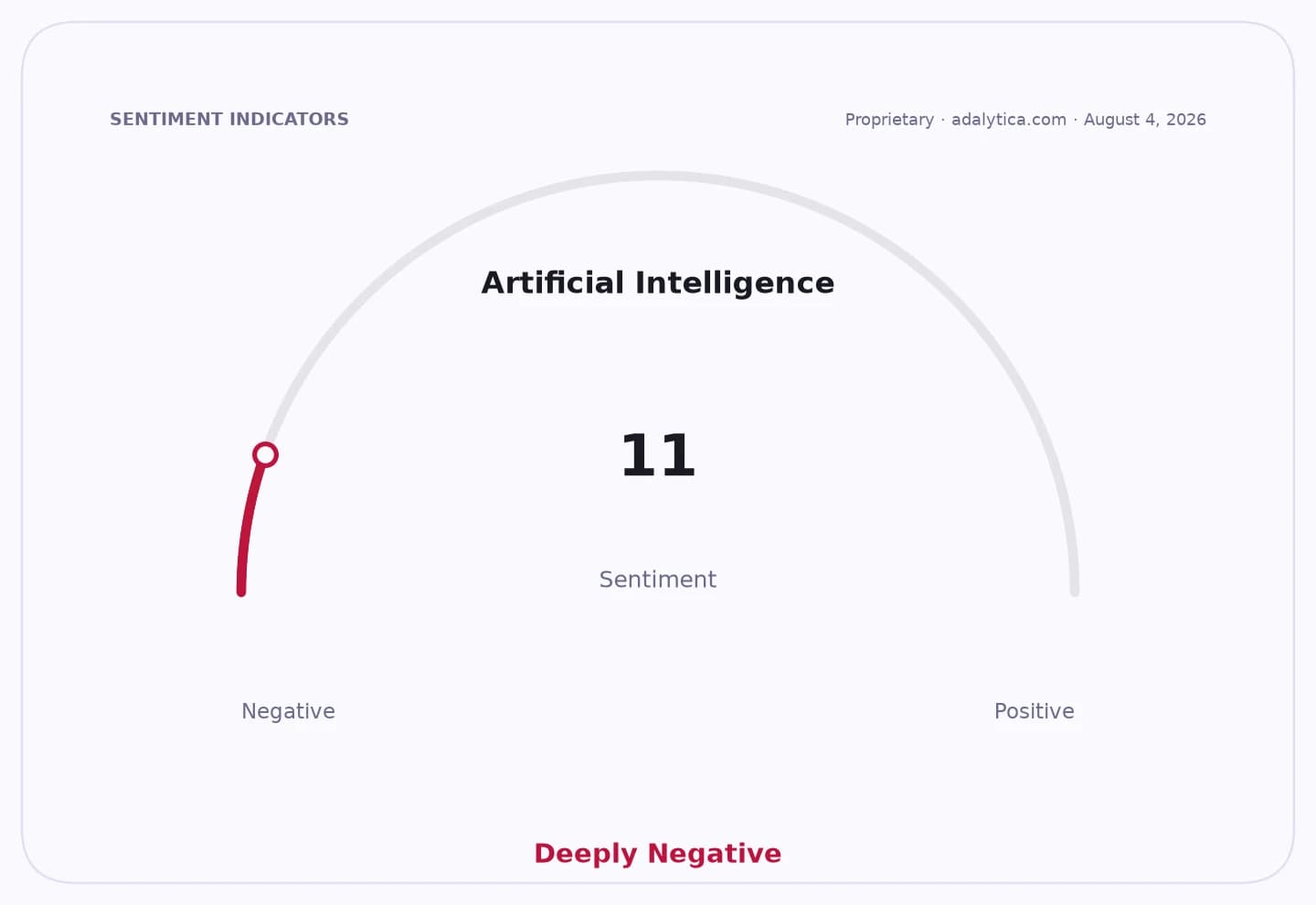
Sentiment IndicatorsⓘProprietary · adalytica.com · August 4, 2026
This is a snapshot — live sentiment, awareness and momentum for 130+ markets update continuously in the dashboard.Open AlphaPulse
The tension is playing out as the broader U.S. economy remains stable rather than overheated. The unemployment rate has held at 4.2% in June, with a forecast for 4.18% in July, while job openings are still elevated at 7.359 million. Industrial production has also stayed near cycle highs at 102.64 in June. In other words, employers are not facing a collapse in demand or a labor-market emergency that would force a rush into automation, but neither are they operating in a setting where workers feel secure enough to accept efficiency gains without pushback.
That helps explain why AI is becoming a flashpoint inside unions rather than a simple productivity story. For leaders under pressure to protect membership and win concessions, AI can be framed as a way to shift repetitive work, improve safety and preserve bargaining power. For many members, though, it looks like an accelerant for deskilling, headcount reductions and management control. The disagreement is especially acute in industries where AI can be introduced incrementally, making it harder for workers to organize around a single, visible threat.
The labor divide also lands differently across the corporate landscape. Microsoft shares were up to $496.84 in the latest session, and the stock has rebounded sharply from a June low near $352.83, with technical indicators showing a strong recovery: the share price is above the 50-day moving average, RSI is above 81, and MACD has turned firmly positive. Nvidia has also recovered to $212.85, with its own momentum indicators improving after a mid-summer pullback. Those moves reflect the market’s renewed confidence that AI spending will keep translating into revenue and cash flow.
But the labor question is a reminder that the path from AI investment to profit is not frictionless. Microsoft’s filings emphasize heavy spending on cloud, security and AI infrastructure, while IBM has pushed its watsonx platform as a governed, enterprise-ready AI stack built around control, sovereignty and performance. Both are effectively selling the idea that AI can be deployed safely inside large organizations. Union resistance complicates that pitch by raising the cost of implementation, extending deployment timelines and increasing the risk that productivity gains are shared more evenly with workers through wages, retraining or staffing guarantees.
That makes the current debate economically significant beyond the union movement itself. If labor leaders secure guardrails, AI adoption could proceed more slowly but with less disruption and a more sustainable social license. If rank-and-file opposition hardens, employers may face a longer cycle of negotiation, more public scrutiny and a tougher political environment for automation. Either way, AI is no longer just a technology issue; it is becoming a labor-relations issue that will influence margins, hiring and the pace of productivity growth.
For investors, the key question is whether AI can keep expanding into the core of corporate workflows without a broader backlash. The bullish case is that unions eventually help formalize the rules, making adoption smoother and more durable. The bear case is that labor friction slows rollout, raises compliance costs and narrows the margin expansion that has underpinned the AI trade. With sentiment around AI still extremely weak in Adalytica’s gauge despite strong awareness, the market is already showing signs that enthusiasm for the theme is colliding with real-world execution risk.
| Entity | Gains | Losses |
|---|---|---|
| Union leaders embracing AI | ▲Bargaining leverage | ▼Rank-and-file trust |
| Rank-and-file workers | ▲Training and safeguards | ▼Job security |
| Microsoft and IBM | ▲Faster enterprise AI adoption | ▼Higher labor friction |
| Investors in AI | ▲Productivity upside | ▼Margin-compression risk |