Middle East gas producers are warning that the region must invest more than $200 billion by 2030 to secure supply, build resilience and protect exports as geopolitical risk increasingly shapes the economics of energy.
Middle East gas producers warn on $200B security spending
Geopolitical Risk
That estimate from Crescent Petroleum Chief Executive Majid Jafar puts a hard price tag on a strategic shift already underway: the Middle East’s gas industry is moving from a growth story to a security story. For investors, that means higher capital spending, more infrastructure demand and a larger premium on projects that can withstand conflict, blocked transport routes and disruption around the Strait of Hormuz.
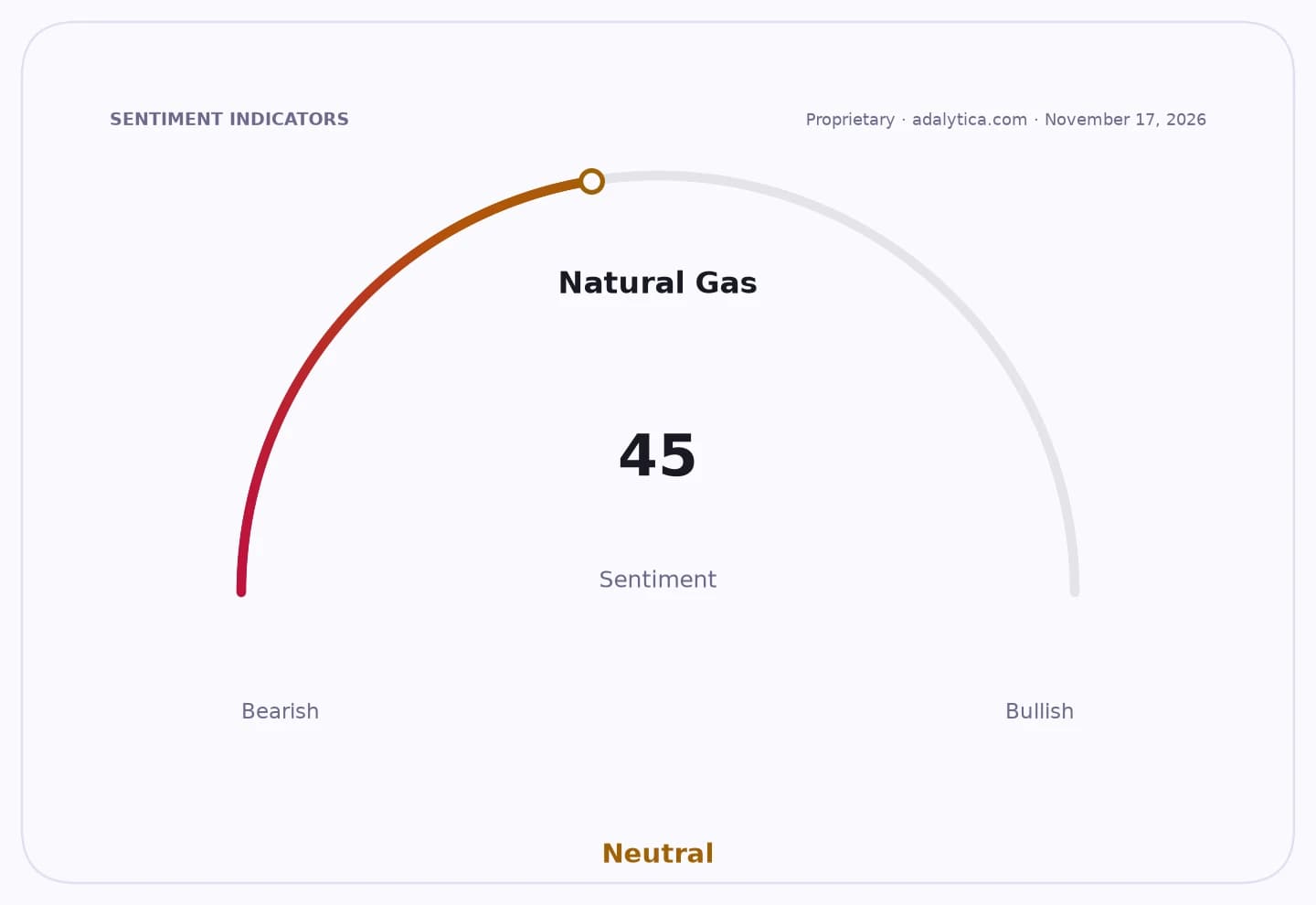
Sentiment Indicators
Jafar said the region’s roughly 40% share of global proven gas reserves gives it a central role in the energy system, but also makes it vulnerable to supply interruptions. He said new production, cross-border pipelines, export routes outside Hormuz and storage capacity would all require capital if the industry is to keep gas flowing during periods of tension.
“Add these together, and the investment required is well over $200 billion by 2030,” he told the Middle East Gas Conference, calling it the largest opportunity the industry has seen in a generation.
The scale of the spending need reflects a broader reassessment across the Gulf and wider Middle East, where gas is becoming more important both as a domestic fuel and as an export commodity tied to power generation, petrochemicals and LNG. The case for investment has strengthened as regional conflict raises the risk of supply shocks, while governments look to gas as a bridge fuel that can support industrial growth and electricity demand without the volatility of oil alone.
For bondholders and equity investors, the message is twofold. On one hand, the region’s gas assets may command a higher strategic valuation because they sit near major reserves and markets. On the other, the business now carries greater execution and security risk, which can lift financing costs and make resilient infrastructure more valuable than simple reserve size.
That tension was visible in Crescent Petroleum and Dana Gas’s recent $500 million bond issuance through Pearl Petroleum, which drew demand 1.7 times the offer size. The five-year senior secured note, carrying a 10.375% coupon and maturing in November 2031, suggests investors still want exposure to Middle East gas despite the geopolitical backdrop — but they are demanding a relatively high return.
Crescent and Dana have also spent more than $4 billion in Iraq’s Kurdistan region, the largest private gas investment in the country and the biggest from the GCC, underscoring how the region’s largest companies are betting that long-life gas projects can still generate returns even in unstable jurisdictions.
At the same time, the security premium is real. Dana Gas said earlier this month its Khor Mor facility was hit in a suspected drone attack that caused a fire before being brought under control, a reminder that production and infrastructure are now exposed to risks beyond the usual commodity cycle.
The investment case also lands against a macro backdrop that remains supportive for hydrocarbon projects. Brent crude has stayed near $90 a barrel, while U.S. 10-year Treasury yields around 5.2% keep financing conditions tight and raise the hurdle rate for capital-intensive energy projects. In that environment, large, secure gas assets with access to infrastructure and export routes may stand out relative to more marginal developments.
The bull case is that the Middle East can turn its reserve base into a long-duration cash flow engine if it builds the pipelines, storage and export capacity needed to reduce choke points. The bear case is that higher capital needs, conflict risk and the global energy transition could slow returns and leave some projects exposed if demand growth disappoints or financing becomes too expensive.
| Entity | Gains | Losses |
|---|---|---|
| Middle East gas producers | ▲Higher strategic value | ▼Bigger capex burden |
| Crescent Petroleum / Dana Gas | ▲Investor demand for projects | ▼Conflict and attack risk |
| EPCs and pipeline builders | ▲More project spending | ▼Execution and delay risk |
| LNG buyers and regional utilities | ▲More supply resilience | ▼Higher financing and gas costs |