Javier Milei’s promise to announce a Central Bank reform on national television matters because it goes to the core of Argentina’s most fragile macroeconomic problem: whether the government can credibly lock in disinflation without leaning on the monetary authority it has spent months attacking.
Milei Central Bank Reform Could Lift Argentine Assets
For investors, the issue is not the rhetoric but the institutional design that follows. Any move to reshape the Banco Central de la República Argentina could alter how the state finances itself, how fast inflation expectations reset and how much confidence foreign and local capital place in peso assets. In a country where policy credibility often changes faster than rates, that can be worth more than the details of the reform itself.
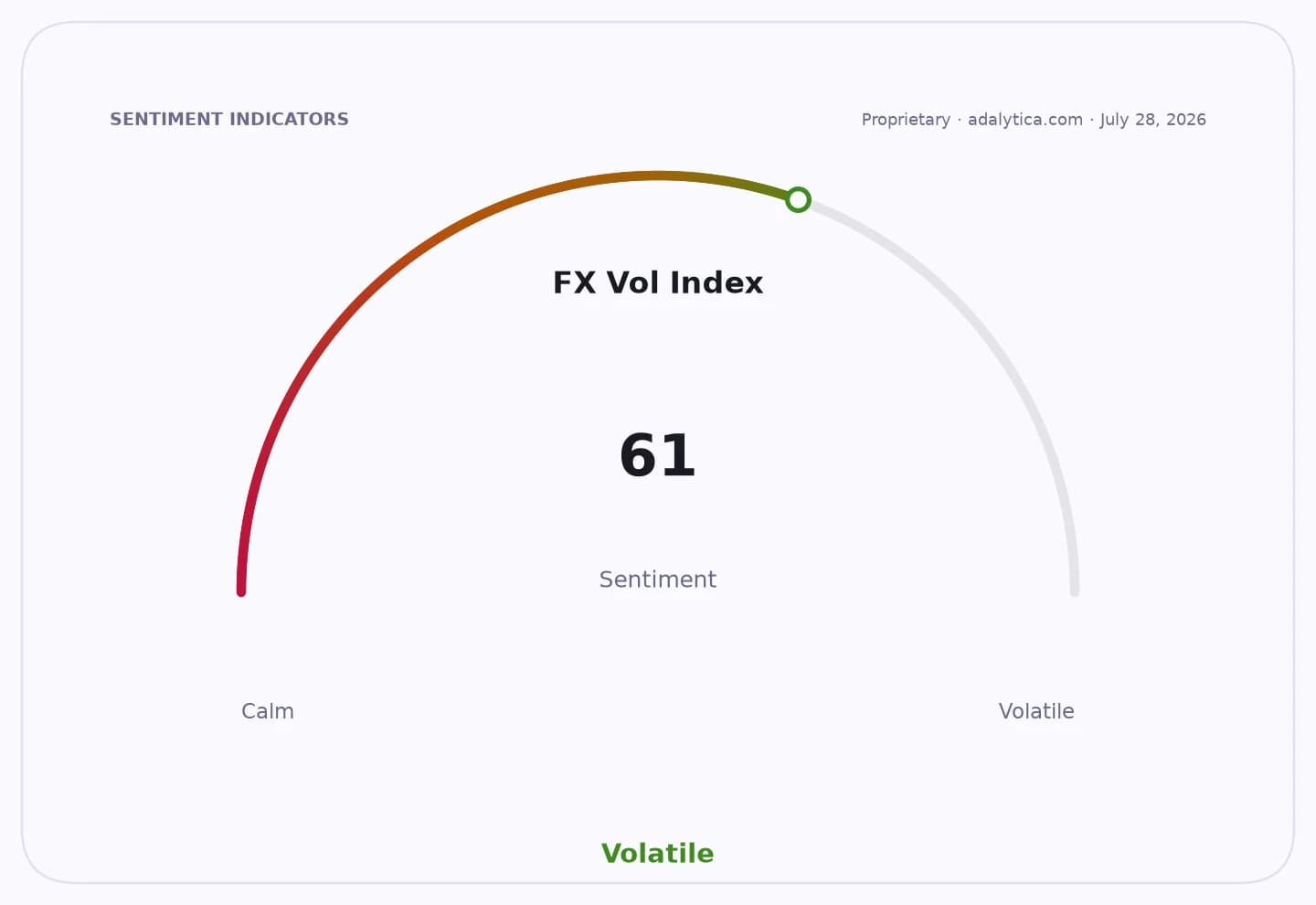
Sentiment IndicatorsⓘProprietary · adalytica.com · July 28, 2026
This is a snapshot — live sentiment, awareness and momentum for 130+ markets update continuously in the dashboard.Open AlphaPulse
The market backdrop suggests investors are watching closely but have not yet priced a decisive break. The Argentina ETF, ARGT, has held near $92.71, roughly in line with its 50-day average and above its 200-day average, a sign that the rally tied to Milei’s economic programme has not been fully unwound. Yet the ETF is still well below its recent peak near $96.39, and the 50-day trend has flattened, indicating caution rather than conviction. Technical readings such as RSI around 50 and a MACD line close to the signal line point to a market waiting for a policy catalyst.
That makes the Central Bank announcement economically significant beyond Argentina’s borders. A credible reform could strengthen the case for lower inflation, tighter fiscal-monetary coordination and eventually easier financing conditions for sovereign borrowers and banks. A weak or symbolic reform, by contrast, risks reinforcing the view that Argentina remains dependent on ad hoc fixes and political pressure rather than a durable monetary framework.
The stakes are especially high for local financial institutions. Argentine banks have benefited from the government’s broader stabilization effort, but they remain exposed to shifts in inflation, peso liquidity and regulation. Banco BBVA Argentina and Banco Macro, among others, would likely gain from lower inflation and a more predictable policy regime, while a disorderly reset could deepen volatility in deposits, funding costs and asset quality. The country’s banks also continue to carry meaningful exposure to sovereign risk, which means a credible central bank overhaul could improve balance-sheet resilience as much as it improves sentiment.
Global risk assets are giving only a mixed signal. Emerging-market vehicles such as EEM have weakened recently and remain below their 200-day average, reflecting broader caution toward developing-world growth and policy risk. China’s FXI has been firmer, underscoring that investors are rotating within emerging markets rather than embracing the asset class wholesale. Against that backdrop, Argentina’s reform story is a country-specific test of whether idiosyncratic policy gains can overcome weak global risk appetite.
The narrative connecting the facts is straightforward: Milei is trying to convert political shock therapy into institutional change. Markets have rewarded his fiscal austerity and anti-inflation stance, but the Central Bank remains the last major piece of Argentina’s old framework. If the reform strengthens independence or changes the bank’s mandate in a way that improves credibility, it could extend the rally in Argentine assets and support the peso. If it is perceived as a power grab or a cosmetic rebrand, investors are likely to demand a higher risk premium again.
What happens next will depend on the substance of the reform, not the television announcement. Investors will be looking for signs on reserve management, monetary financing, central bank governance and whether the government is preparing a more durable anchor for prices. For Argentina, the question is no longer whether Milei can shock the system. It is whether he can replace the system with one markets believe will last.
| Entity | Gains | Losses |
|---|---|---|
| Argentine government | ▲Policy credibility if reform is substantive | ▼Political capital if reform disappoints |
| Argentine banks | ▲Lower inflation and steadier funding | ▼Higher volatility if reform is vague |
| ARGT holders | ▲Upside from credibility gains | ▼Risk from policy missteps |
| Peso/savers | ▲Better inflation anchor | ▼Loss of confidence if reform is cosmetic |