Moldova’s corn exporters have already shipped more grain in the first nine months of 2026 than they did in the whole of 2025, underscoring how a delayed harvest last year pushed sales into this season and briefly tightened the market for old-crop supplies.
Moldova Corn Exports Top 2025 After Harvest Delay
The country exported 318,300 metric tons of corn from January through September, almost 97,000 tons more than the 221,300 tons sold abroad in all of 2025 and above the 305,800 tons shipped in 2024, according to an analysis by economist Iurie Rija. The surge matters because it reflects not just stronger trade flows, but a timing shift in agricultural supply that has pulled last year’s inventory into 2026 and left the market waiting for the new crop.
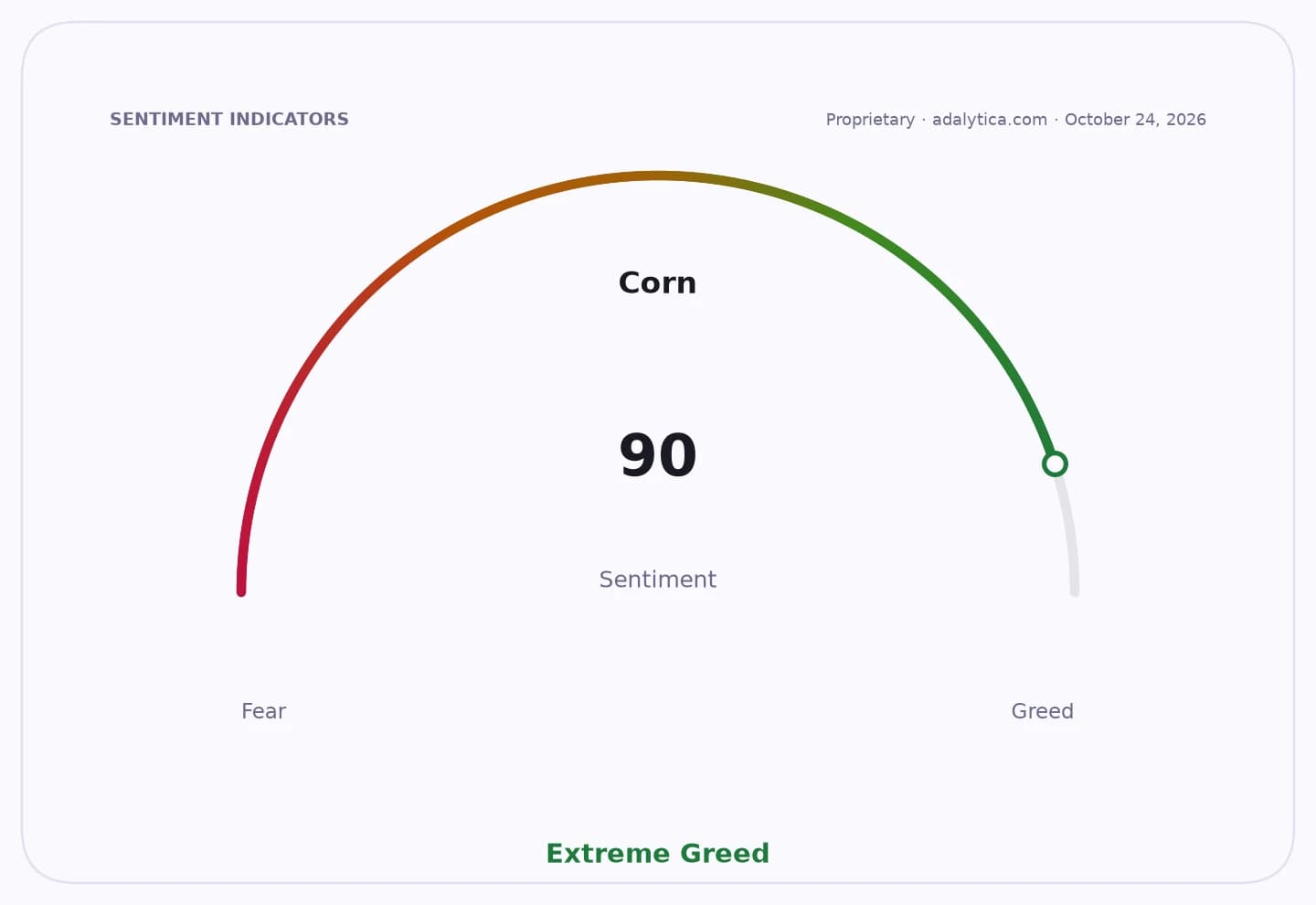
Sentiment IndicatorsⓘProprietary · adalytica.com · October 24, 2026
This is a snapshot — live sentiment, awareness and momentum for 130+ markets update continuously in the dashboard.Open AlphaPulse
The effect was most visible in the third quarter. July-September exports rose 28% from a year earlier to 28,216 tons, the strongest result for that period in four years. But the monthly pattern shows the old crop being worked through: exports reached 21,500 tons in July, then dropped to 3,400 tons in August and 3,300 tons in September.
Rija said the jump was driven by the late 2025 harvest, which delayed deliveries to foreign buyers. In practical terms, that means Moldova’s export pipeline was not expanding because of a sudden production boom, but because grain from the prior crop was released later than normal.
Higher prices also helped. The average export price in the July-September period reached 4.33 lei per kilogram, about 8% above the 4 lei/kg level a year earlier. For farmers and traders, that cushions revenue; for buyers, it points to firmer procurement costs even as global grain markets remain volatile.
Lebanon emerged as Moldova’s main outlet, taking 12,500 tons, or about 44% of third-quarter exports, at an average price of 4.44 lei/kg. Ukraine was the second-largest destination with 4,200 tons, though the grain was not consumed there domestically. Rija said the cargo was moved by rail to the port of Reni and re-exported onward, making Ukraine a transit corridor rather than a final market.
That concentration matters for investors and traders because it exposes Moldova’s corn sector to a narrow set of buyers and logistics routes. Any disruption in Black Sea transport, regional demand or re-export channels could quickly alter volumes and margins. Turkey, Greece and Cyprus also bought smaller quantities, but the export mix remains heavily dependent on a few destinations.
The trade is also concentrated among a small number of companies. OROM-IMEXPO SRL led with 6,208 tons, followed by ANCOM-AGRO SRL with 6,105 tons and RUSAGRO-PRIM SRL with 5,154 tons. Together, the top three exporters accounted for 62% of Moldova’s corn exports in the period, reinforcing the importance of scale, storage and logistics access in a market that is still relatively thin.
Transport patterns tell the same story. In July, corn moved by rail, road and ship, but by August and September shipments were almost entirely naval as inventories dwindled. Rija expects the same seasonal pattern to repeat, with October rains delaying field work and some of the 2026 crop potentially harvested only in winter. That would push the bulk of the next export wave into the first half of 2027.
For grain markets, the key takeaway is that Moldova’s export strength is real, but temporary in its composition: it is the result of a delayed old-crop release rather than a clean new-season pickup. Investors tracking Eastern European agricultural trade will be watching whether the new harvest restores volume, whether Lebanon remains the anchor market and whether logistics through the Black Sea corridor stay open enough to support prices.
| Entity | Gains | Losses |
|---|---|---|
| Moldovan corn exporters | ▲Higher volumes and prices | ▼Tighter old-crop stocks |
| Lebanon | ▲Reliable supply access | ▼Exposure to import dependence |
| Top exporters | ▲Greater market share | ▼Smaller rivals squeezed |
| Buyers/importers | ▲Steady grain availability | ▼Higher procurement costs |