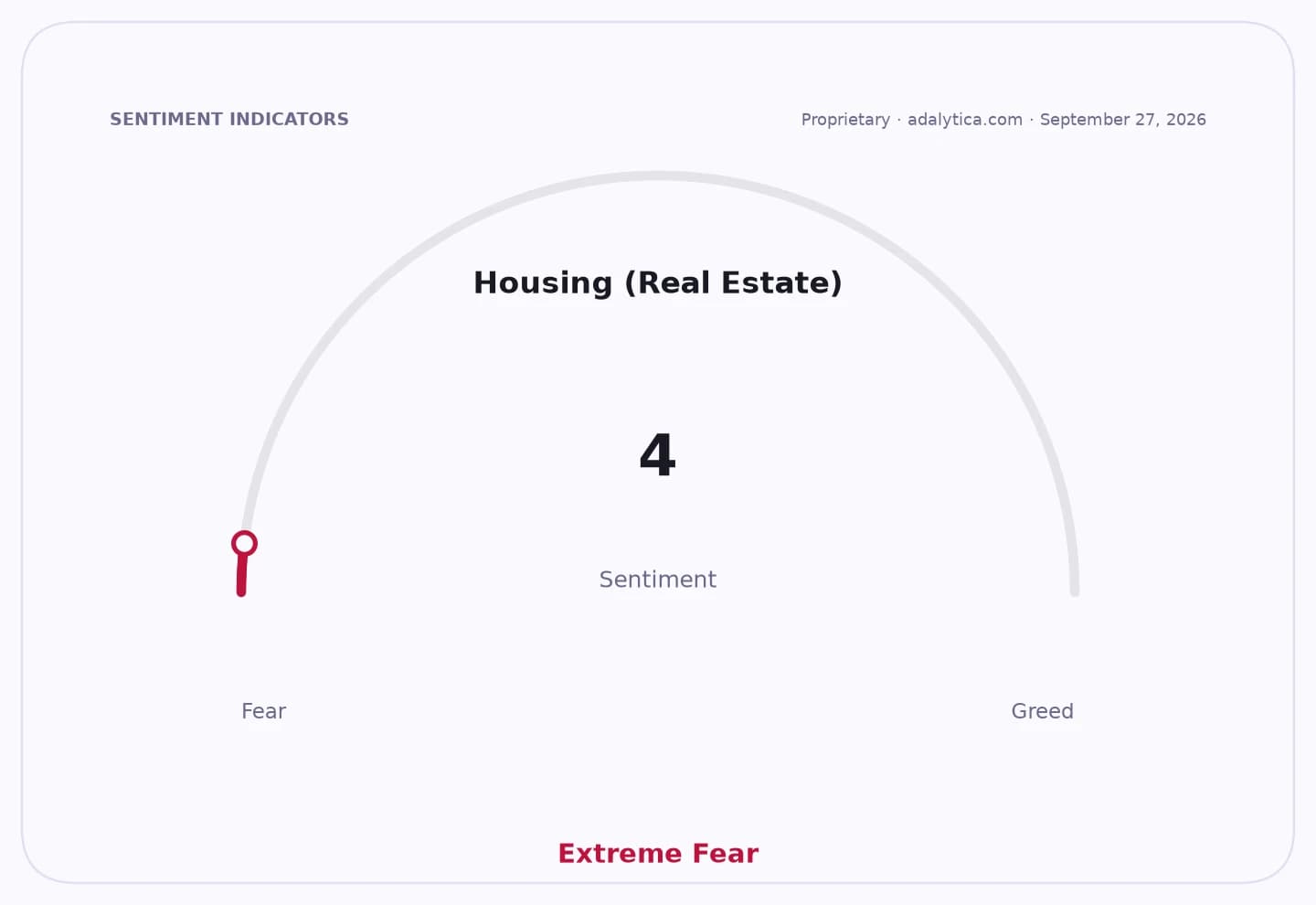
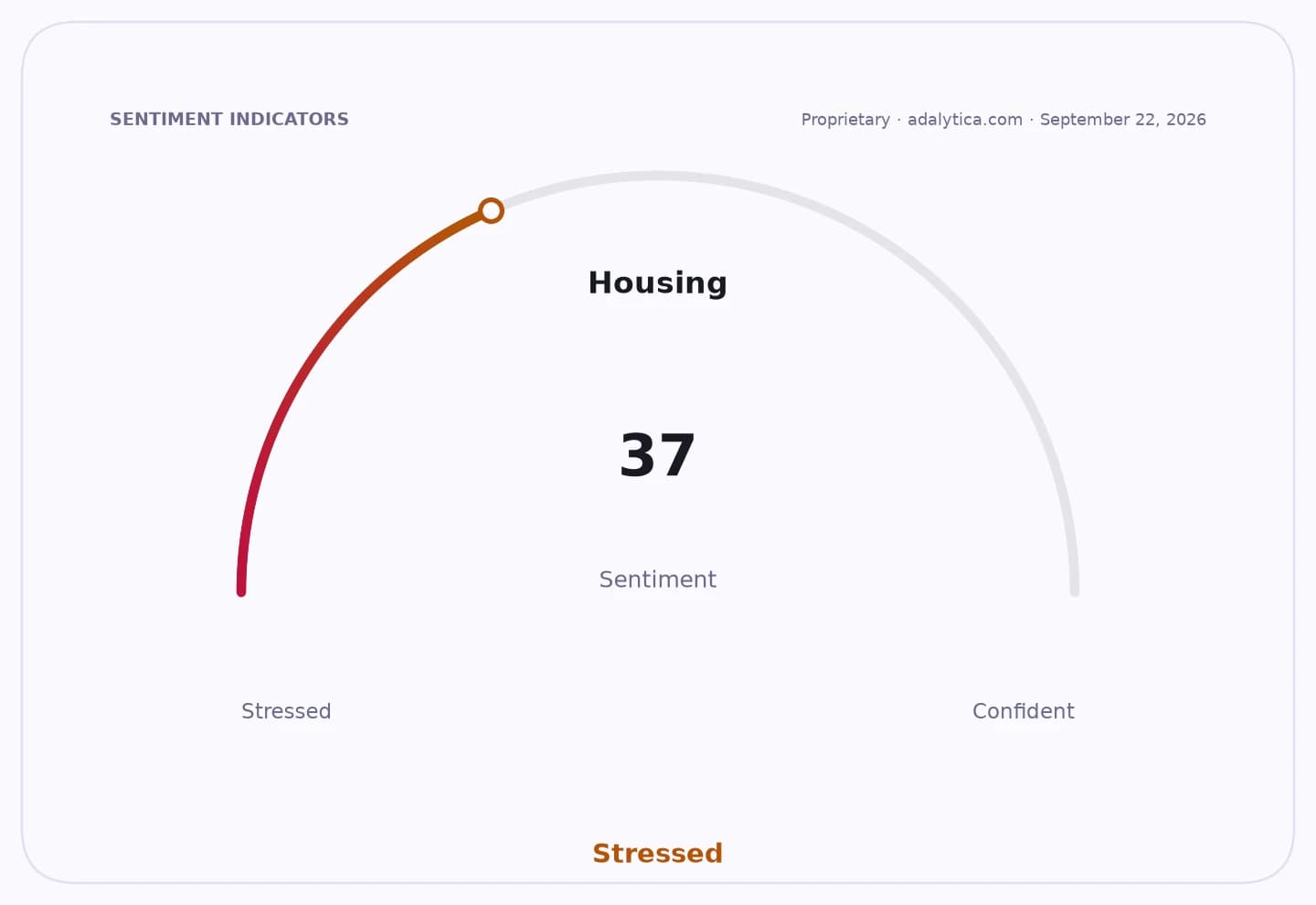
Mortgage rates have climbed back to levels not seen in nearly three years, and that matters because every extra tenth of a point makes homeownership more expensive and pushes more buyers to the sidelines.
Mortgage rates rise to 7.28% in Freddie Mac survey

The average 30-year fixed mortgage rose to 7.28% in Freddie Mac’s Oct. 1 survey, up from 7.03% a week earlier and the highest reading since late 2023. That is the biggest weekly jump since October 2022, and it translates into roughly $276 more a month on a $400,000 loan than the payment a borrower would have faced in February, when rates briefly dipped below 6%.
Sentiment IndicatorsⓘProprietary · adalytica.com · October 3, 2026
This is a snapshot — live sentiment, awareness and momentum for 130+ markets update continuously in the dashboard.Open AlphaPulse

For investors, the message is simple: housing is still trapped between stubborn financing costs and prices that have not fallen enough to restore affordability. That squeeze hits homebuilders, mortgage lenders, brokerages and transaction-heavy platforms, while giving sellers less pricing power and buyers a little more room to negotiate.
The rise in borrowing costs comes at a delicate moment. National existing-home sales fell 2% in August to an annualized pace of 3.98 million units, while the median U.S. existing-home price still stood at $429,100. In the Northeast, where prices are especially painful, the median used-home price reached $556,900, up 4.3% from a year earlier. In other words, rates are rising before prices have fully adjusted, making the affordability crunch worse rather than better.
DGS10 vs FEDFUNDS — macro contextadalytica.com
Explore this data interactively — full history, time series and cross-market comparisons.Open AlphaPulse
That is already showing up in demand. Mortgage applications dropped 6% in the latest weekly data, with purchase applications down 5% from the prior week and 14% from a year ago. Lisa Sturtevant of Bright MLS said higher fall rates are clearly pulling demand back, while sellers are responding with more concessions and softer pricing expectations. Lawrence Yun of the National Association of Realtors said the larger inventory pool is giving buyers more bargaining power, and that is true — but only at the margin.
The bigger picture is that this is not just a housing headline. Mortgage rates are effectively the transmission mechanism for the broader bond market into the real economy. The 10-year Treasury yield, a key benchmark for mortgages, has moved back above 5% in recent sessions, and the Federal Reserve’s policy rate remains restrictive. When financing costs stay elevated while home prices remain sticky, turnover slows, remodeling demand weakens and consumer wealth tied to housing grows less liquid.
That mix has direct implications for listed housing names. Builders such as Lennar and D.R. Horton can still lean on incentives and product mix, but their order growth depends on whether buyers can actually qualify. Mortgage originators like Rocket Companies and UWM Holdings benefit from volume when refinancing or purchase activity improves, yet a higher-rate backdrop usually means fewer closed loans and more pressure on pipeline value. Real estate marketplaces such as Zillow also feel the chill when transaction counts soften.
Still, there is one constructive wrinkle for long-term investors: stress in housing often creates opportunity for disciplined buyers. National inventory reached 1.62 million homes in August, or 4.9 months of supply, the highest in more than a decade. That gives patient shoppers leverage, and it may eventually force more price cuts or closing-cost help from sellers if rates stay above 7%.
For investors, the best response is not to chase every rate move, but to focus on businesses that can withstand a prolonged affordability squeeze. Housing demand does not disappear — it stretches out, shifts to lower-priced segments and rewards companies with strong balance sheets and efficient operations. For now, higher mortgage rates remain a headwind worth watching closely.
| Entity | Gains | Losses |
|---|---|---|
| Buyers | ▲More negotiation power | ▼Higher monthly payments |
| Sellers | ▲Faster deals only with concessions | ▼Pricing power |
| Homebuilders | ▲Incentive-led traffic | ▼Lower affordability |
| Mortgage lenders | ▲Refinance volatility | ▼Purchase demand |