U.S. natural gas futures have dropped to a three-month low as record production and a milder-than-expected weather outlook strip away the near-term demand support that had kept prices elevated.
Natural Gas Slides on Record Output and Mild Weather
The move matters because gas is a swing fuel for power generation, heating and industrial use, and the current setup points to looser balances just as traders had been positioning for tighter summer conditions. When supply is running at record levels, even a modestly warm weather outlook can fail to generate the storage drawdowns that usually lift prices.
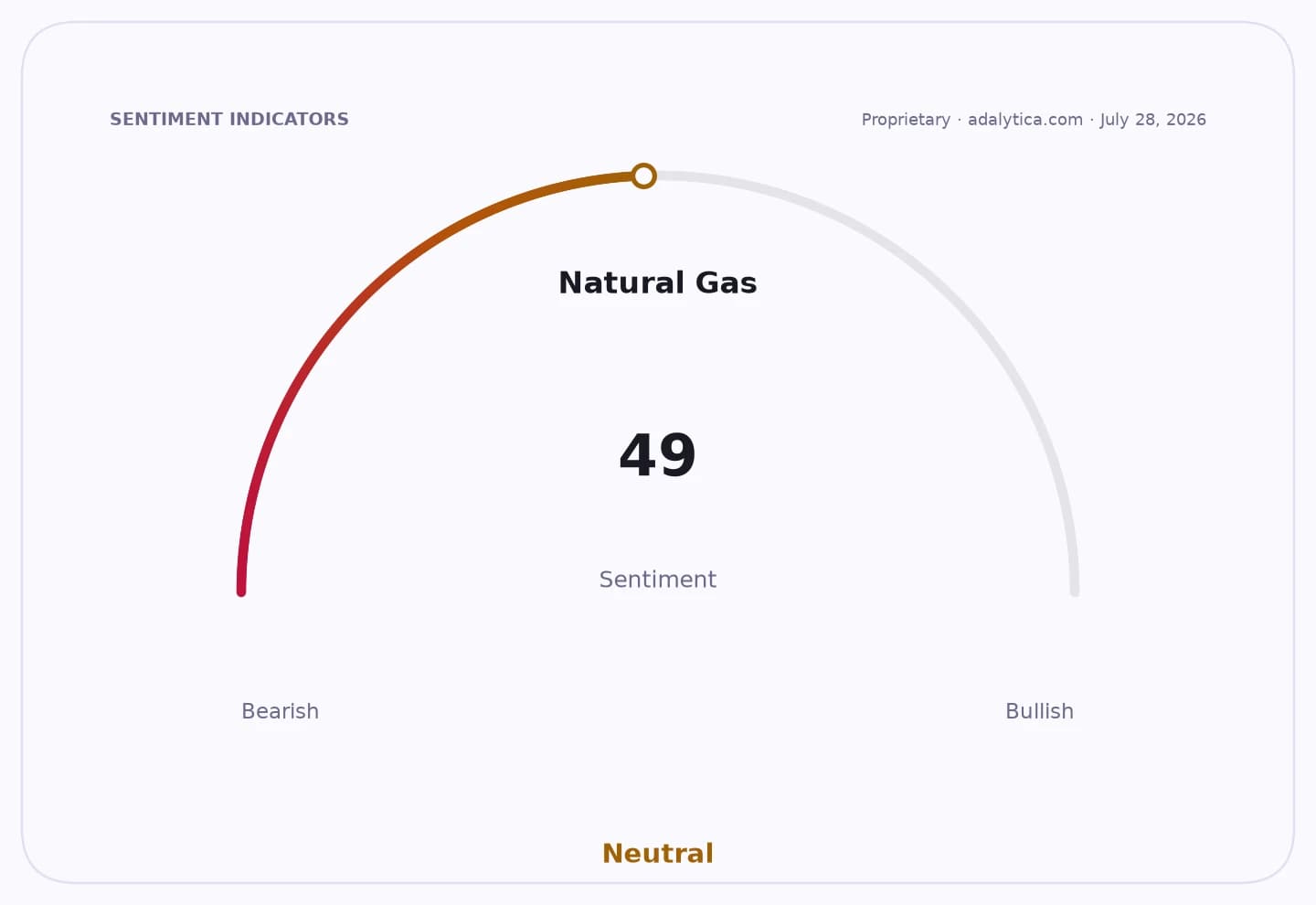
Sentiment IndicatorsⓘProprietary · adalytica.com · July 28, 2026
This is a snapshot — live sentiment, awareness and momentum for 130+ markets update continuously in the dashboard.Open AlphaPulse
Front-month U.S. gas futures have been sliding sharply in recent sessions, with the UNG natural gas ETF closing at $9.88 on July 28, down from $12.12 on June 4 and well below its 200-day moving average of $12.16. The bearish tone is showing up in BOIL, the leveraged bullish ETF, which fell to $19.77 from $22.59 on July 24, while the inverse KOLD climbed to $30.48 from $26.88 over the same period, a sign that traders are leaning harder against the gas rally.
Conventional technical indicators reinforce the pressure. UNG’s relative strength index sits at 20.3, a deeply oversold reading, while BOIL’s RSI is 21.0 and KOLD’s is 76.2, showing momentum has shifted decisively in favor of bears. Adalytica’s natural gas trade signals also show sentiment at 49, or neutral, even as awareness remains in “fear,” suggesting the market is still on edge despite the selloff.
The decline also lands against a broader energy backdrop that remains volatile. Oil sentiment is in “extreme fear” in Adalytica’s framework, underscoring how quickly commodity markets can move when supply, weather and geopolitics collide. But for gas specifically, the immediate driver is not a supply shock — it is the absence of one, with output at record levels and forecast demand failing to match it.
That combination has economic consequences beyond the futures tape. Lower gas prices can ease power costs and soften input pressure for manufacturers, but they also squeeze producers and reduce the cash flow support that has helped keep U.S. shale investment resilient. EQT, one of the sector’s biggest names, said in its latest filing that natural gas price volatility remains a major risk and noted it uses derivatives and curtailments to manage exposure.
For investors, the question is whether the current drop is a temporary weather-driven flush or the start of a deeper reset in gas pricing. If mild temperatures persist and production stays elevated, storage injections could remain heavy and keep pressure on front-month contracts, leaving producers and bullish gas funds vulnerable even if the broader energy complex remains choppy.
| Entity | Gains | Losses |
|---|---|---|
| Gas utilities and industrial users | ▲Lower feedstock costs | ▼None in the near term |
| U.S. natural gas producers | ▲None | ▼Softer realized prices, margin pressure |
| BOIL holders | ▲None | ▼Losses from falling gas prices |
| KOLD holders | ▲Gains from bearish trend | ▼None |