New York City’s one-year ban on student-facing generative AI in public schools through eighth grade is really a bet on what kind of skills children need most in the age of artificial intelligence.
New York City Schools Ban Generative AI in Grades K-8

The policy covers nearly 600,000 students and says schools should keep chatbot-style tools out of the classroom for younger children, while allowing limited, supervised use in high school. That matters well beyond one school district. New York is trying to draw a line between using AI to speed up schoolwork and using school to build the habits that actually compound over a lifetime: reasoning, writing, persistence and judgment.
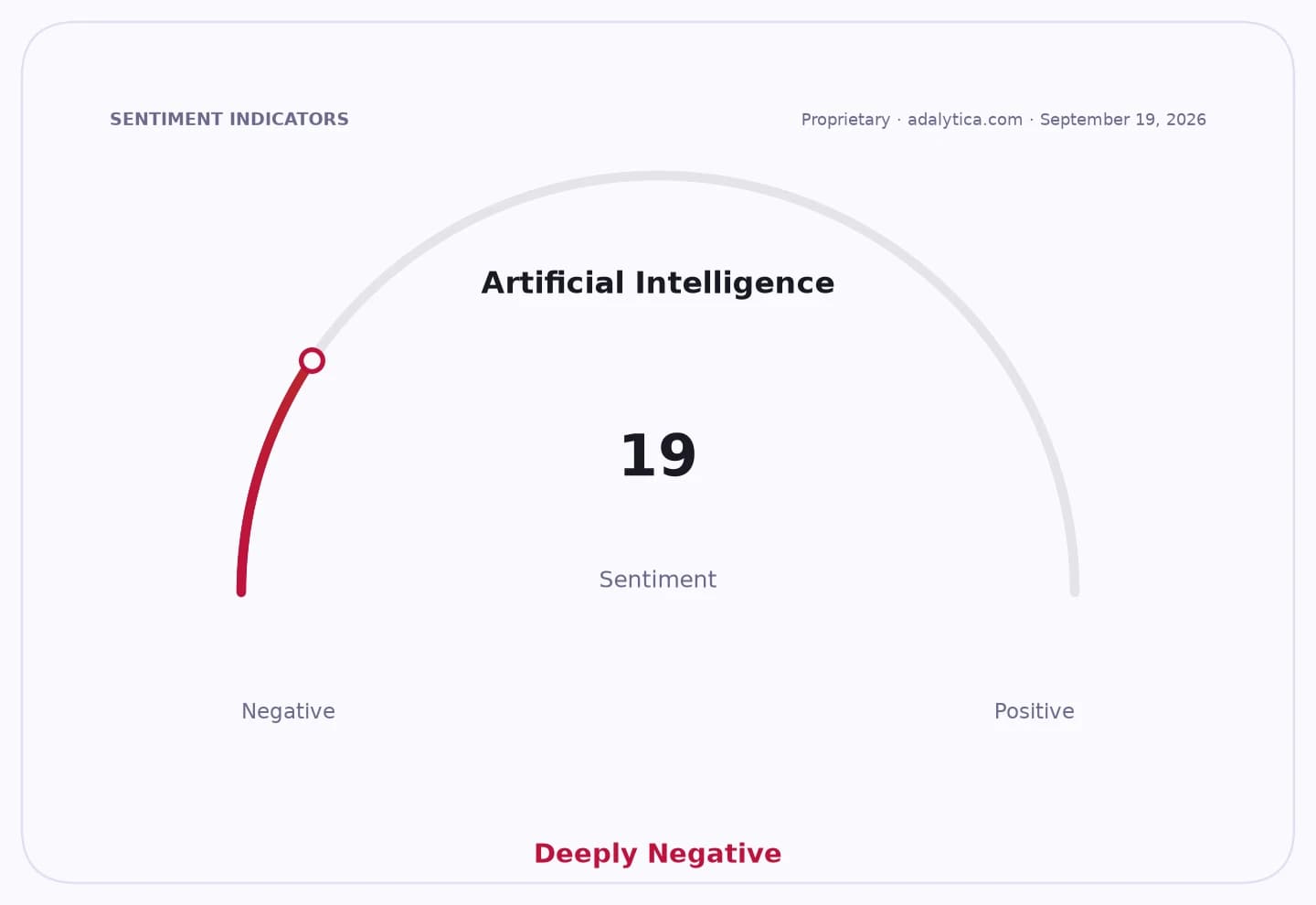
Sentiment IndicatorsⓘProprietary · adalytica.com · September 5, 2026
This is a snapshot — live sentiment, awareness and momentum for 130+ markets update continuously in the dashboard.Open AlphaPulse
That is the core economic issue. If students learn to lean on AI before they have built basic literacy and problem-solving skills, the long-term cost shows up later in the labor force. Employers do not just want workers who can prompt a chatbot. They want people who can spot errors, think independently and adapt when the technology fails. In that sense, the ban is less about rejecting AI than about protecting the human capital that makes AI useful in the first place.
There is a real trade-off, though. A blanket ban may keep students from learning how to work alongside AI responsibly, and that could leave them less prepared for universities and workplaces where these tools are already becoming commonplace. UNESCO has argued schools should teach AI competence, ethics and critical judgment rather than simply walling the technology off. New York’s move suggests policymakers are still searching for the right balance between access and discipline.
For investors, the message is not that AI adoption is slowing. It is that adoption will be uneven, regulated and shaped by trust. Companies selling AI software, cloud services and education technology still have a huge long-term market, but the winners will be the firms that can prove their products are safe, transparent and easy to control. That should favor the platform players with the deepest ecosystems — including Microsoft, whose AI push remains tied to the broader enterprise rollout — over vendors that rely on uncontrolled classroom usage.
The broader investment case for AI remains intact. Students will still meet these tools at university, in the workplace and in everyday life, and the companies building the infrastructure underneath them are still in the early stages of monetizing that shift. But this policy is a reminder that the next decade of AI growth will not be a straight line. It will be shaped by regulation, local politics and public anxiety about children, privacy and cheating.
For long-term investors, that usually argues for patience, not panic. AI is still a secular trend, but the path to profits will be decided by who can earn trust and build durable moats around software, cloud and data. This is worth watching, especially for investors who want exposure to AI without betting on any single classroom use case.
| Entity | Gains | Losses |
|---|---|---|
| Students in early grades | ▲More time on core skills | ▼Less exposure to AI tools |
| Teachers and schools | ▲Clearer classroom boundaries | ▼More burden enforcing rules |
| Microsoft and other AI platforms | ▲Longer runway for supervised adoption | ▼Slower classroom penetration |
| Long-term investors | ▲Better focus on durable AI moats | ▼Less hype around quick school adoption |