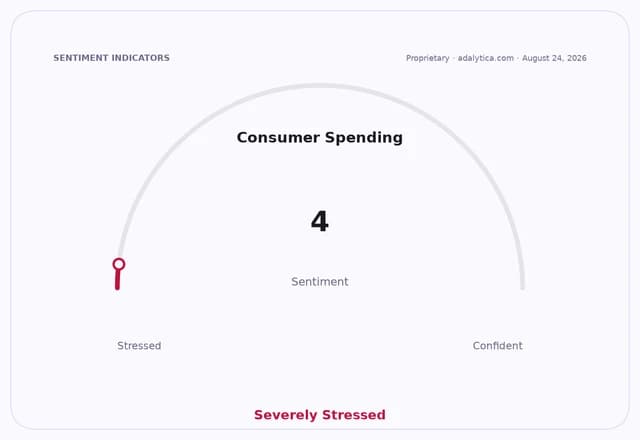
New Zealand consumer spending weakened in the June quarter as retail sales volumes fell 0.5%, with a sharp drop in fuel purchases doing most of the damage.
New Zealand Retail Sales Volumes Fall 0.5% in June

That matters because retail sales are one of the clearest reads on household demand, and weaker volumes suggest consumers are pulling back just as the economy is still trying to regain momentum. For a small, import-dependent economy like New Zealand, softer spending can quickly feed through to growth, business revenues and the labour market, especially when households are already facing higher living costs and tighter budgets.
Sentiment IndicatorsⓘProprietary · adalytica.com · August 24, 2026
This is a snapshot — live sentiment, awareness and momentum for 130+ markets update continuously in the dashboard.Open AlphaPulse
Fuel was the main drag, tying the spending drop to the recent move higher in global oil prices after US-Iran tensions heightened geopolitical risk in the Middle East. Brent-linked and WTI crude benchmarks have been volatile, and the latest oil shock has kept energy costs elevated enough to curb discretionary spending. New Zealand households are particularly sensitive to petrol prices because transport takes a meaningful share of weekly outlays and higher fuel bills leave less room for dining, retail and household goods.
The weakness comes against a backdrop of a deteriorating trade balance, which widened sharply to a NZ$1.95 billion deficit in July from a NZ$23 million surplus previously. That shift underscores the pressure from imported energy and other foreign goods, and it raises the risk that higher import costs will continue to squeeze domestic demand. It also complicates the policy outlook: if consumer spending remains soft, the Reserve Bank of New Zealand may face less pressure to tighten, but imported inflation from energy can still keep a floor under prices.
For investors, the read-through is two-sided. On one hand, weaker retail volumes are a negative for domestically oriented retailers, transport-related businesses and consumer-facing names that depend on discretionary traffic. On the other, the drop in fuel purchases reinforces the earnings leverage for energy producers and sector funds as crude prices remain elevated; US energy equities, for example, have been trading stronger alongside the oil move, with the XLE ETF near recent highs. The risk for markets is that a sustained rise in fuel costs can turn a commodity shock into a broader demand slowdown, hitting both consumption and corporate margins.
The key question now is whether June was a one-off hit from fuel volatility or the start of a more durable slowdown in household spending. If oil prices stay high, New Zealand consumers are likely to remain cautious, limiting the pace of any rebound in retail activity and keeping pressure on growth heading into the second half of the year.
| Entity | Gains | Losses |
|---|---|---|
| NZ households | ▲temporary relief if fuel eases | ▼higher living costs |
| New Zealand retailers | ▲resilient essential sellers | ▼discretionary sales volumes |
| Energy producers | ▲stronger fuel margins | ▼demand-sensitive consumers |
| Reserve Bank of New Zealand | ▲less domestic demand pressure | ▼imported inflation risk |