China’s biggest internet companies have ordered more Nvidia chips than the company can realistically ship, turning a reported $35 billion backlog into a test of how much of that demand can ever reach revenue.
Nvidia China chip orders top 6 million units

Reuters reported that ByteDance, Alibaba and Tencent have placed orders for more than 3 million Nvidia RTX PRO 5500 workstation graphics cards, with total Chinese customer orders topping 6 million units. At roughly $11,400 apiece, the orders are valued at more than $35 billion at list price, but Nvidia has told customers it cannot guarantee fulfillment.
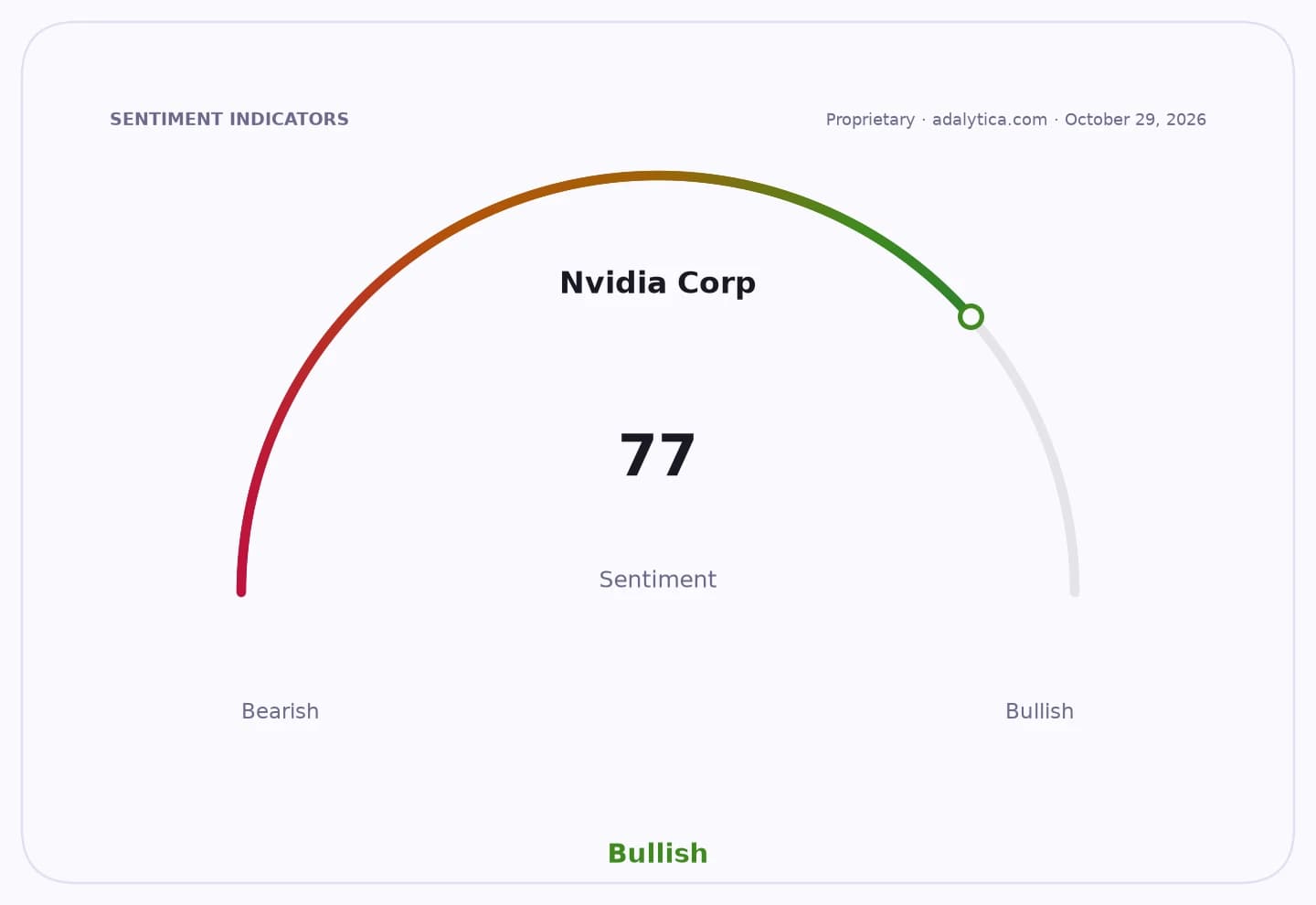
Sentiment Indicators
That matters because the demand surge is arriving well ahead of supply and outside Nvidia’s current earnings outlook. The company’s latest guidance for the quarter, at $108 billion plus or minus 2%, excludes China data center compute revenue, and the reported Chinese orders sit outside any disclosed contract or booked sales.
The production picture looks even tighter. The reports say early samples are due in December, with commercial deliveries starting only in the first quarter of 2027, while TSMC is said to be reserving most 2027 wafer capacity for Nvidia’s next-generation Rubin chips. That leaves only a sliver of the requested volume likely to be filled in the near term, with some estimates pointing to just 5% to 10% of the 6 million units ordered.
For investors, the story is less about an immediate revenue jump than about optionality. Any shipments confirmed later would land as upside to guidance, while the backlog also underscores how central China remains to Nvidia’s growth narrative even as export controls and manufacturing constraints keep near-term sales capped.
Shares barely moved on the report, with Nvidia closing Oct. 20 at $216.47, down 0.29%, after a 5.27% weekly slide through that date. The muted reaction suggests traders are treating the orders as demand proof, not deliverable revenue.
The bigger read-through is to the semiconductor supply chain. If Nvidia cannot fill Chinese orders quickly, the shortfall shifts demand further into 2027 and keeps pressure on advanced foundry capacity, especially at TSMC. That supports the bullish case for chipmakers broadly, but it also means China’s largest tech firms may have to wait longer for the hardware they need to keep building AI systems.
With Nvidia due to report earnings on Nov. 18, investors will be watching for any sign that China demand can move from headline backlog into recognized revenue.
| Entity | Gains | Losses |
|---|---|---|
| Nvidia | ▲Demand visibility | ▼Near-term revenue recognition |
| ByteDance, Alibaba, Tencent | ▲Future AI chip access | ▼Immediate delivery certainty |
| TSMC | ▲Wafer allocation leverage | ▼Spare capacity flexibility |
| Short sellers / skeptics | ▲Supply constraints keep risk high | ▼Upside from confirmed shipments |