Nvidia is winding down mass production of its GeForce RTX 5090 and shifting its top consumer graphics capacity toward a new RTX 5080 with 24GB of memory, a move that could tighten supply at the high end of the gaming market while reinforcing the company’s push to prioritize higher-value RTX Pro and super-tier products.
Nvidia RTX 5090 Production and 5080 24GB Shift
The change matters because it effectively marks the retirement of Nvidia’s current halo GeForce card at a time when the RTX 5090 is already scarce and retail prices have climbed to around $5,000 in the US and above €5,000 in Europe, with some European listings nearing €5,500. If Nvidia stops sending new GB202 chips to the consumer 5090 line, the shortage would likely deepen, preserving the card’s status as a luxury product and limiting any chance of meaningful price normalization.
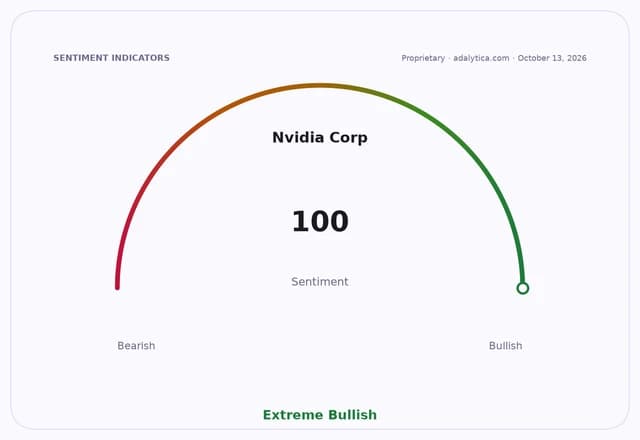
Sentiment IndicatorsⓘProprietary · adalytica.com · October 13, 2026
This is a snapshot — live sentiment, awareness and momentum for 130+ markets update continuously in the dashboard.Open AlphaPulse
For investors, the bigger signal is not the loss of one gaming SKU but Nvidia’s willingness to reallocate silicon toward product lines with stronger pricing power and potentially better margins. The reported plan to replace a 16GB RTX 5080 with a 24GB version gives Nvidia a way to preserve performance leadership in consumer graphics without keeping the most expensive chip tied up in a segment that may not justify the same production economics. That fits a broader portfolio strategy in which scarce, high-end die capacity is directed toward professional RTX Pro cards and future “Super” refreshes, rather than maximizing volume in a gaming market that remains cyclical.
The consumer GPU market is increasingly defined by segmentation rather than outright speed leadership. A 24GB RTX 5080 would become Nvidia’s strongest mainstream gaming option, while the RTX 5090 effectively shifts into a collector’s-item category. That could support pricing across the stack, but it also risks frustrating enthusiasts and channel partners who depend on flagship supply to drive upgrade cycles. A cutback in the RTX 5070 Ti line, also reported in recent leaks, would reinforce the idea that Nvidia is trimming today’s lineup to make room for late-year RTX 5080 Super, RTX 5070 Ti Super and RTX 5070 Super models.
The equity backdrop suggests investors are still treating Nvidia as a momentum story, even as the stock has moved sharply and technical readings have cooled from overbought levels. Nvidia’s shares last closed at $226.32, above both the 50-day and 200-day moving averages, but its RSI has eased to 46.4 from an overbought 60.9 earlier in October, implying the market is no longer pricing the same near-term enthusiasm it showed during the recent run-up. That makes product-cycle execution important: any sign Nvidia can preserve gaming margins while shifting capacity toward higher-return segments would likely be viewed positively.
At the same time, gaming is no longer the company’s main valuation driver. Nvidia’s core thesis remains centered on AI data-center demand, and recent sentiment readings from Adalytica show extreme greed around the name, underscoring how much of the stock’s appeal is tied to AI, not consumer graphics. Still, the GeForce franchise remains strategically useful: it sustains brand dominance, keeps developers and gamers in Nvidia’s ecosystem, and creates spillover demand for CUDA-aware software and RTX features that can support higher-end professional and workstation sales.
The bear case is that shrinking the flagship GeForce supply could hand some share of the enthusiast market to AMD or push buyers to delay purchases altogether. AMD’s stock has already had its own violent swings as investors reprice GPU-related optimism, and Intel remains a distant factor in discrete graphics. But given the pricing already visible on the RTX 5090, Nvidia appears less concerned with maximizing units than with protecting economics and redeploying capacity where returns are better.
If the production shift is confirmed, investors should watch whether the RTX 5080 24GB lands as a true replacement for the 5090’s halo role or simply as a more efficient, more accessible premium offering. The key question is whether Nvidia can keep the consumer line aspirational while reserving its best silicon for products that align with the company’s broader move toward professional graphics, AI infrastructure and defense-linked applications.
| Entity | Gains | Losses |
|---|---|---|
| Nvidia | ▲Higher-margin allocation | ▼Flagship GeForce volume |
| RTX 5080 24GB buyers | ▲More memory, lower entry price | ▼No true 5090 substitute |
| RTX 5090 owners/resellers | ▲Scarcity premium | ▼Future supply and resale liquidity |
| AMD and other rivals | ▲Potential enthusiast spillover demand | ▼Harder to match Nvidia’s halo positioning |