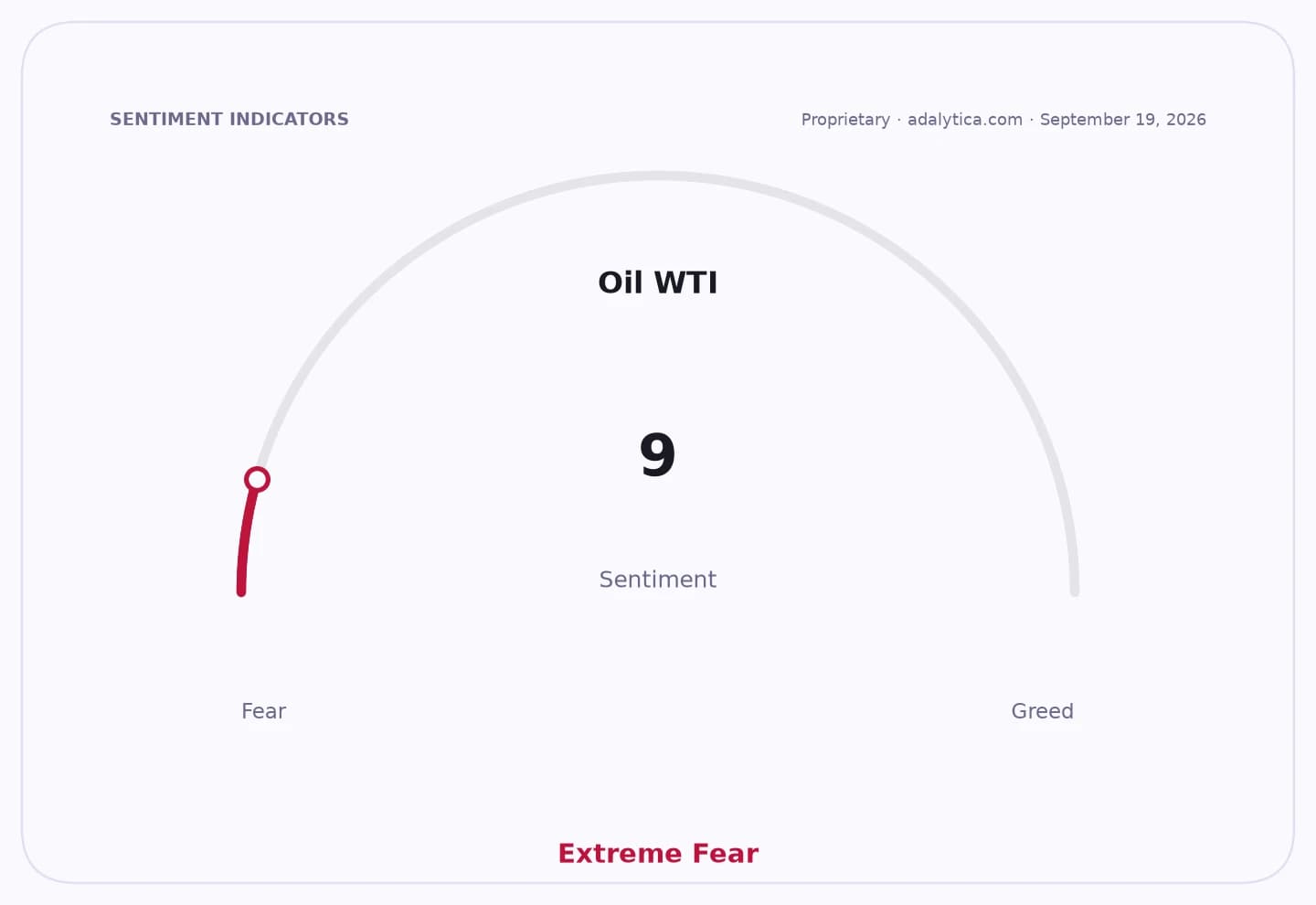
Oil prices are holding above $101 a barrel while natural gas remains stuck near $10.45 per MMBtu, underscoring how the energy market is still being pulled in three directions at once: securing supply, containing inflation and financing the shift to cleaner power.
Oil Holds Above $101, XLE Stays Strong

That tension matters because energy still feeds directly into growth and price pressures. Brent-linked crude has climbed back above the $100 mark in recent sessions, with West Texas Intermediate at $101.09 on Thursday, while the U.S. 10-year Treasury yield sits at 5.0%, leaving policymakers and investors little room for error if higher fuel costs bleed into inflation and borrowing costs.
Sentiment IndicatorsⓘProprietary · adalytica.com · September 17, 2026
This is a snapshot — live sentiment, awareness and momentum for 130+ markets update continuously in the dashboard.Open AlphaPulse

The gap between oil and gas is also reshaping capital allocation. The Energy Select Sector SPDR Fund, XLE, closed at $64.18, well above both its 50-day moving average of $60.98 and 200-day average of $55.22, showing investors are still rewarding the cash-generating parts of the sector. By contrast, the United States Natural Gas Fund, UNG, closed at $10.45, below its 200-day average of $11.57, reflecting persistent skepticism about a durable gas recovery despite recent stabilization.
The move comes as industrial production in the U.S. is forecast to edge up to 103.34 in August from 102.99 in July, suggesting demand is not collapsing even with restrictive rates and tighter financial conditions. But with WTI up sharply from $85.91 in April and the dollar flashing extreme-greed readings in Adalytica’s trade signals, energy is increasingly acting as both an inflation driver and a macro hedge.

For investors, that keeps the trade split between producers and consumers. Integrated oil and energy equities retain pricing power and stronger free-cash-flow visibility, while transport, manufacturing and other fuel-sensitive industries face a margin squeeze if crude stays elevated. Renewable projects also remain in the frame: Toyota and YPF Luz’s expanded alliance in Argentina shows automakers and utilities are still pushing clean-energy integration, even as high fossil-fuel prices keep traditional energy assets in favor.
The key question now is whether crude can hold above $100 without triggering demand destruction or renewed policy pressure, and whether gas can recover enough to narrow the gap. With the Federal Reserve still facing inflation risk and energy markets volatile, the next catalyst is likely to come from U.S. inventory data, OPEC+ supply discipline or any sign that higher oil is starting to slow growth.
| Entity | Gains | Losses |
|---|---|---|
| Oil producers | ▲Higher realized prices | ▼Demand destruction risk |
| Energy equities | ▲Stronger cash flow expectations | ▼Rate-sensitive pullbacks |
| Fuel users | ▲Temporary hedging window | ▼Margin pressure from crude |
| Clean-energy partners | ▲Long-term transition momentum | ▼Short-term capital rotation away |