Oil prices hovering below $92 a barrel, Bitcoin’s jump back above $84,000 and fresh comments from Ukrainian President Volodymyr Zelenskiy on attacks on energy facilities are pointing to the same market story: investors are pricing a world where geopolitics is once again driving cross-asset volatility.
Oil Bitcoin and Gold Rise on Geopolitical Risk

That matters because energy is feeding directly into inflation expectations, currency moves and risk appetite. When crude holds near elevated levels, it keeps pressure on transport, manufacturing and consumer costs, while also supporting cash flows for oil producers and related service companies. At the same time, a sharp bid in gold and a recovery in Bitcoin suggest that some investors are reaching for alternative stores of value as they hedge against conflict, policy uncertainty and swings in growth.
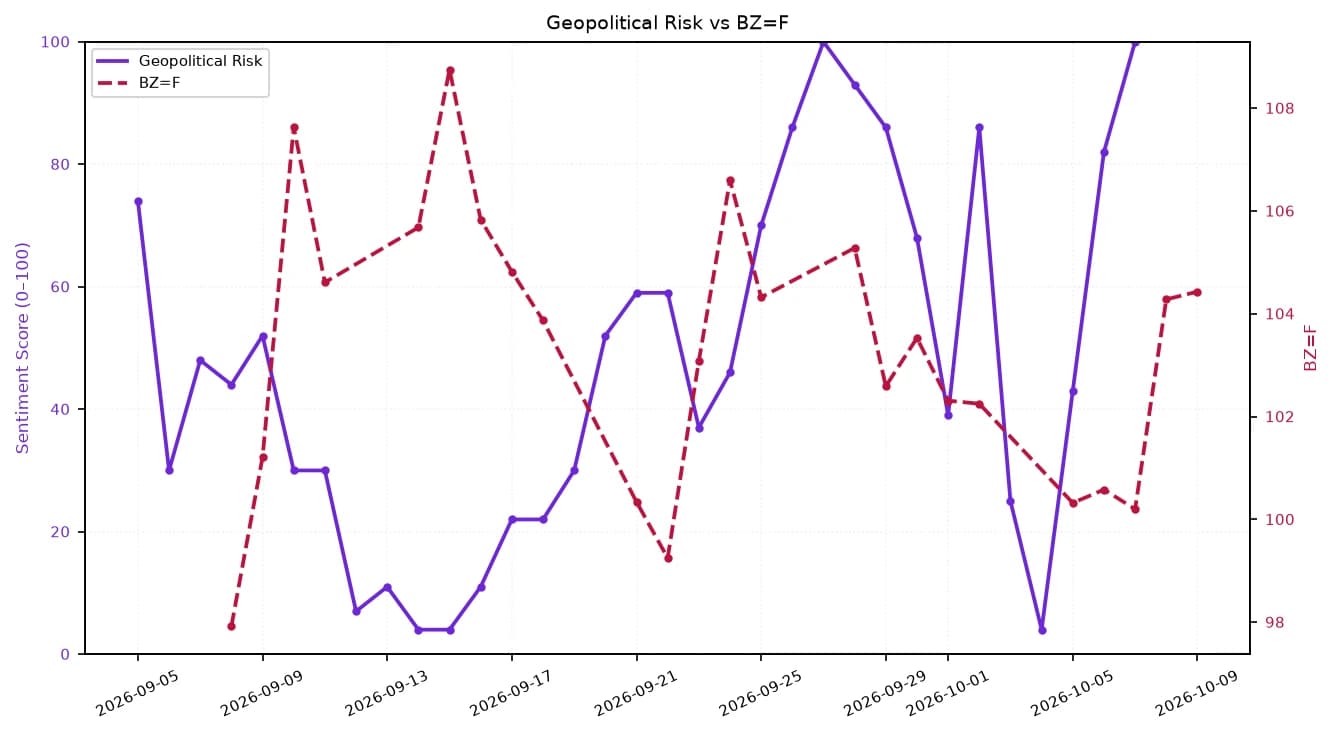
Sentiment IndicatorsⓘProprietary · adalytica.com · October 13, 2026
This is a snapshot — live sentiment, awareness and momentum for 130+ markets update continuously in the dashboard.Open AlphaPulse

The latest oil move comes as the market absorbs escalating geopolitical risk around Russia, Ukraine and the Middle East. Zelenskiy said Ukraine has stopped striking Russian energy facilities under what he described as an “energy ceasefire” coordinated with the United States, but accused Moscow of continuing to target Ukraine’s power and infrastructure network. That keeps the energy complex vulnerable to supply interruptions and to any reversal in the fragile de-escalation. Separate attacks involving Yemen’s Houthi movement and the Saudi-led coalition are adding another layer of risk for crude flows and shipping routes.
For oil-linked equities, the backdrop is constructive. The Energy Select Sector SPDR fund has remained firm, reflecting expectations that even a modestly softer crude market can still leave producers with healthy margins after the 2026 price spike. Chevron and Occidental have both said commodity prices remain central to earnings and capital plans, while the WTI benchmark averaged $92.79 a barrel in the second quarter at Occidental — a level that still supports strong upstream returns. But the bear case is that if geopolitical premiums fade or global demand cools, highly cyclical energy names can unwind quickly, especially after a year of outsized moves.

Bitcoin’s rebound above $84,000 tells a different part of the story. The token had slipped below $81,000 less than a day earlier, underscoring how fragile the move remains even after a roughly 8% gain over the past 30 days. Technical readings also show the market is far from euphoric: Bitcoin finished near $83,041, still below its recent highs, with its 50-day average around $81,104 and RSI readings in the high-40s, which is consistent with a market trying to stabilize rather than break into a sustained rally.
The bigger point is sentiment. Adalytica’s Bitcoin Fear & Greed Index sat at 8, deep in “Extreme Fear,” even after a one-day uptick, while global crypto liquidations topped 170,000 positions in 24 hours. That suggests the latest move higher is being driven less by broad conviction than by short covering and opportunistic buying. For investors, that raises the risk that Bitcoin remains a trading vehicle rather than a clean macro hedge, even though its narrative as a geopolitical pressure valve has strengthened in periods of stress.
Gold’s surge above $4,200 an ounce fits the same pattern of defensive positioning. When investors buy gold alongside oil and Bitcoin, it usually means they are seeking protection from either geopolitical escalation or policy missteps that could keep inflation sticky and central banks on edge. That is not necessarily bearish for all risk assets, but it does imply tighter financial conditions for longer and more uneven performance across sectors.
The near-term market question is whether the current jump in geopolitical risk becomes a durable inflation shock or remains a series of localized disruptions. If oil stays near current levels or pushes higher, energy stocks and inflation hedges should keep outperforming. If tensions ease, crude could slip back toward the low-90s or below, easing pressure on consumers but also removing support from the energy complex and exposing how much of the recent rally was built on risk premiums rather than demand.
| Entity | Gains | Losses |
|---|---|---|
| Oil producers | ▲Stronger cash flow | ▼Demand-sensitive sectors |
| Energy stocks | ▲Higher margins | ▼Fuel-intensive industries |
| Bitcoin traders | ▲Volatility rebound | ▼Leveraged longs |
| Consumers/importers | ▲Potential fuel relief | ▼Inflation hedgers |