Oil’s latest surge is turning from a market story into a macroeconomic threat, with Wellington Management warning that sustained energy prices could shave as much as two percentage points off global growth while forcing central banks to stay tighter for longer.
Oil Rally Raises Growth and Inflation Risks
That is the key takeaway for investors: expensive crude does not just hit fuel bills, it reshapes the entire policy and earnings backdrop. Higher energy costs squeeze households, narrow corporate margins and raise the odds that the Federal Reserve and its peers will keep rates elevated even as growth cools. In an economy already leaning on AI spending and still-accommodative fiscal policy, that makes oil one of the most powerful swing factors for 2026 and beyond.
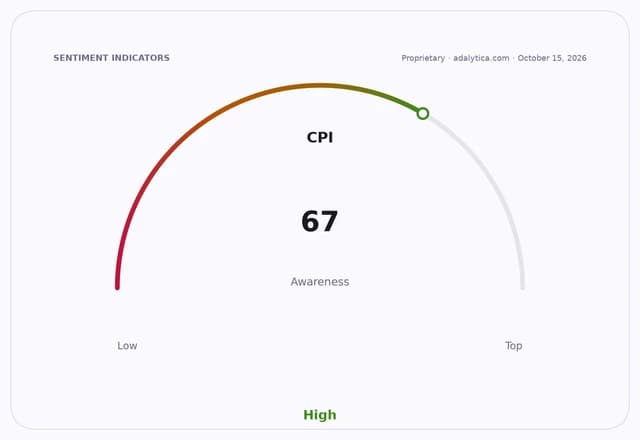
Sentiment IndicatorsⓘProprietary · adalytica.com · October 15, 2026
This is a snapshot — live sentiment, awareness and momentum for 130+ markets update continuously in the dashboard.Open AlphaPulse
Eoin O’Callaghan, macro strategist at Wellington, said in a note titled “Resilient growth, rising risks: Investing through the energy shock” that at current oil prices the shock could subtract between 1.5 and 2 percentage points from economic growth. He still expects the world economy to slow in late 2026 and early 2027 without necessarily dropping below trend, but he also warned that the longer energy prices stay elevated, the more they risk spilling into broader inflation.
That matters because markets are already pricing a more aggressive policy response. Investors are effectively anticipating about 100 basis points of tightening across the G10, a level O’Callaghan does not fully endorse but which underscores how quickly an oil spike can change the rate outlook. If inflation proves stickier, bond yields can stay higher, duration assets can rerate, and risk appetite can fade fast.
DCOILWTICO vs DGS10 — macro contextadalytica.com
Explore this data interactively — full history, time series and cross-market comparisons.Open AlphaPulse
The pressure is already visible in the numbers. US inflation accelerated to 3.7% in September, driven largely by fuel costs, while oil benchmarks remain well above the levels that prevailed earlier in the year. The USO crude ETF has been volatile, but it still closed at 153.56 on Oct. 14, far above its 200-day moving average of 118.36, showing that the energy shock has not yet fully unwound. The energy sector ETF XLE has also stayed strong, ending at 67.63, while the exploration and production ETF XOP closed at 197.84, both reflecting the market’s continued willingness to pay for oil exposure.
But the bigger investment point is that oil’s strength is a tax on everyone else. Consumers are already drawing down savings to keep spending after losing purchasing power at the pump. If wages and employment fail to keep up, consumption can weaken quickly. Governments are also entering the next phase of the cycle with less fiscal support: Wellington expects the G10 fiscal impulse to turn from a 0.6% of GDP boost in 2026 to a slight drag in 2027, with the US doing much of the damage.
That combination is why this oil rally matters far beyond the energy trade. France, the UK and the US all look more exposed if investors decide debt trajectories are not being controlled and inflation is not being contained. Higher borrowing costs for sovereigns would crowd out policy flexibility just as growth softens, creating the kind of feedback loop markets tend to underestimate until it is too late.
The one area still offering offset is artificial intelligence investment. Capex tied to AI has been a real support for growth and productivity, and a powerful one for data center infrastructure, power, networking and semiconductor supply chains. If that spending holds up, it can cushion the macro hit from dearer energy. If it slows, the global economy loses one of its most important secular growth engines at exactly the wrong moment.
For investors, the setup is clear: oil producers, refiners and the infrastructure names tied to energy security remain the clearest near-term winners, while consumer discretionary, duration-sensitive assets and highly leveraged sovereign credits look more vulnerable if crude stays elevated. The market is not just trading a barrel of oil here — it is repricing the odds of slower growth, stickier inflation and a more defensive world. I believe the best strategy is to stay long the beneficiaries of energy scarcity and AI infrastructure, and to avoid assuming the inflation scare will pass quickly.
| Entity | Gains | Losses |
|---|---|---|
| Oil producers | ▲Higher realized prices | ▼Cyclical demand risk |
| Refiners/energy ETFs | ▲Wider spread capture | ▼Demand destruction |
| Consumers | ▲Temporary none | ▼Higher fuel and living costs |
| Bond-heavy sovereigns | ▲None | ▼Higher yields, tighter financing |