Iran’s war has pushed back OPEC+’s review of member production capacity, a delay that could shape how the alliance allocates oil quotas for 2027 and sharpen tensions between states seeking higher output and those likely to be constrained.
OPEC+ Delays Capacity Review to Mid-November
The review, originally due by the end of September 2026, is meant to determine how much crude each member can sustainably pump and form the basis for quota talks. According to Reuters sources, the assessment is now expected around mid-November because conflict-related disruption has slowed capacity-expansion projects and left some members without the data OPEC+ needs.
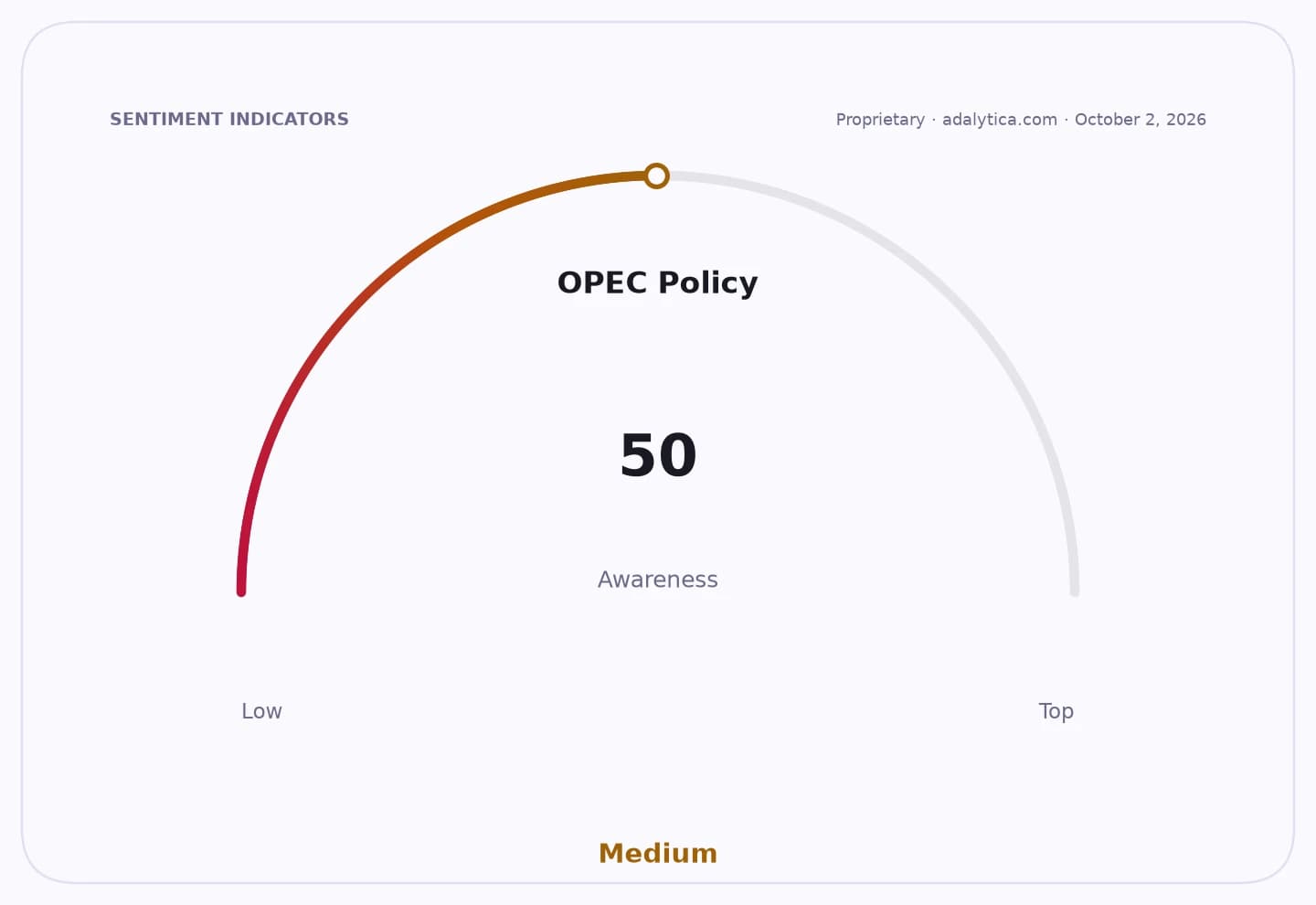
Sentiment IndicatorsⓘProprietary · adalytica.com · October 2, 2026
This is a snapshot — live sentiment, awareness and momentum for 130+ markets update continuously in the dashboard.Open AlphaPulse
That matters because quota fights in OPEC+ are ultimately fights over revenue and market share. Countries that can prove higher capacity want larger production targets; those whose output potential is judged lower face pressure to accept smaller quotas. A delayed and incomplete review raises the risk that the 2027 negotiation lands with more uncertainty and more political bargaining.
The timing is also sensitive for energy markets, which remain on edge over supply routes in the Middle East. Attacks on shipping in the Strait of Hormuz and broader Red Sea security concerns have kept traders focused on geopolitical risk, while the alliance is still trying to manage supply in a market that has swung sharply on war headlines and reserve-release speculation.
Oil-linked funds have already reflected that volatility. USO, the oil ETF, trades at $147.14, well above its 50-day moving average of $137.36 and its 200-day average of $115.17, though its relative strength index has eased to 41.3 from overbought levels earlier in the year. XLE, the energy sector ETF, closed at $62.74, also above both its 50-day and 200-day averages, while XOP, which tracks oil and gas producers, ended at $184.80, still far above its 200-day average of $162.36.
Reuters said some members have not yet provided the information required for the capacity review, adding to the difficulty of setting a benchmark that can be defended inside a cartel built on compromise. The longer the delay lasts, the more likely it is that quota talks will be driven by short-term politics rather than a clean reading of field capacity.
For investors, that keeps a floor under geopolitical risk premia in crude and extends the uncertainty around OPEC+ supply discipline heading into next year’s quota negotiations. The next catalyst is whether the alliance can complete the review by mid-November and whether the war’s disruption spreads further into shipping, production projects or intra-OPEC bargaining.
| Entity | Gains | Losses |
|---|---|---|
| OPEC+ quota hawks | ▲More time to bargain | ▼Less clarity on 2027 shares |
| Capacity-rich members | ▲Case for higher quotas | ▼Risk of delays and scrutiny |
| Oil producers | ▲Support from tighter policy risk | ▼Volatility from unresolved supply questions |
| Consumers/importers | ▲Brief hope for supply flexibility | ▼Higher price-risk uncertainty |