China’s newest open AI systems are forcing Silicon Valley to defend a business model built on proprietary software, with Nvidia, Microsoft and other U.S. tech giants caught in a race that is becoming as much about control as capability.
Open AI Pressures Software, Boosts Compute Demand

The immediate significance is that open-source-style models from China are making advanced AI cheaper to deploy, easier to copy and harder to monetize through the closed platforms that have powered U.S. leadership so far. That puts pressure on the pricing power of American AI vendors even as it expands demand for the chips and cloud infrastructure needed to run these models at scale.
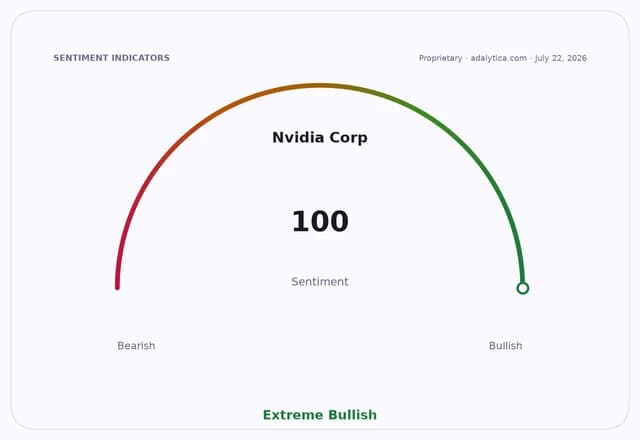
Sentiment IndicatorsⓘProprietary · adalytica.com · July 22, 2026
This is a snapshot — live sentiment, awareness and momentum for 130+ markets update continuously in the dashboard.Open AlphaPulse

The dispute has sharpened after accusations that Chinese startup Moonshot illegally copied Anthropic’s advanced model, Fable, to build its own system, Kimi K3. Washington is now weighing sanctions, underscoring how quickly a product fight has turned into a geopolitical one over intellectual property, export controls and who sets the global standard for generative AI.
For investors, the risk is that China’s open model push compresses software margins while keeping hardware spending high. Nvidia has been one of the biggest beneficiaries of the AI buildout, and its shares have rebounded to $212.80, above the 50-day moving average of $209.60, with technical indicators showing momentum turning positive again. Adalytica’s NVIDIA Earnings Sentiment is at 100, or “Extreme Greed,” reflecting just how tightly the stock is tied to expectations for demand.
Artificial Intelligence vs NVDAadalytica.com
Explore this data interactively — full history, time series and cross-market comparisons.Open AlphaPulse
Microsoft is more exposed on the software and cloud side. Its shares recently fell to $388.95, still below the 50-day moving average of $400.15 and well under the 200-day average of $436.08, after a sharp swing in sentiment around AI profitability and competitive pressure. The company has warned in filings that AI competition and deployment risks could hurt results, a reminder that faster model commoditization can squeeze returns even as customers buy more compute.
Baidu illustrates the other side of the trade. Its stock has slipped to $107.56 from a recent peak above $150 as investors reassess the durability of China’s AI advantage, even though its broader push into AI remains central to the country’s strategy. Open models may help Chinese firms gain adoption at home and abroad, but they also invite scrutiny from U.S. regulators and the possibility of new trade restrictions.
The macro backdrop is not helping either side. The 10-year Treasury yield is around 4.58%, keeping valuation pressure on growth stocks, while U.S. industrial production is forecast to edge up only 0.3% in July, reinforcing a picture of slower expansion and selective capital spending. That makes the AI winners harder to distinguish, especially if open models reduce the need for multiple layers of paid software.
The next catalyst is policy. Any U.S. sanctions move against Moonshot or broader action over model copying would escalate the standoff, while the next wave of earnings will show whether cloud and chip demand can offset rising pressure on AI software economics.
| Entity | Gains | Losses |
|---|---|---|
| Nvidia | ▲Higher compute demand | ▼Pricing pressure if models commoditize |
| Microsoft | ▲Azure AI usage growth | ▼Software margins and moat |
| Baidu | ▲Domestic AI adoption | ▼U.S. scrutiny and trade risk |
| U.S. policymakers | ▲IP enforcement leverage | ▼Risk of deeper tech bifurcation |