Sergio Moro has opened a clear lead in Paraná’s race for governor, while the fight for the state’s Senate seat now hinges on whether Deltan Dallagnol is allowed to run.
Paraná poll shows Moro leads governor race

That combination makes Paraná one of Brazil’s most politically significant battlegrounds ahead of the 2026 vote. The state is one of the country’s largest economies, a major agricultural and industrial hub, and a key prize for parties seeking momentum in the south. A Moro victory would strengthen the right’s position in a state long viewed as pivotal in national coalition building, while the Senate contest could be reshaped if the judiciary blocks Dallagnol’s bid.
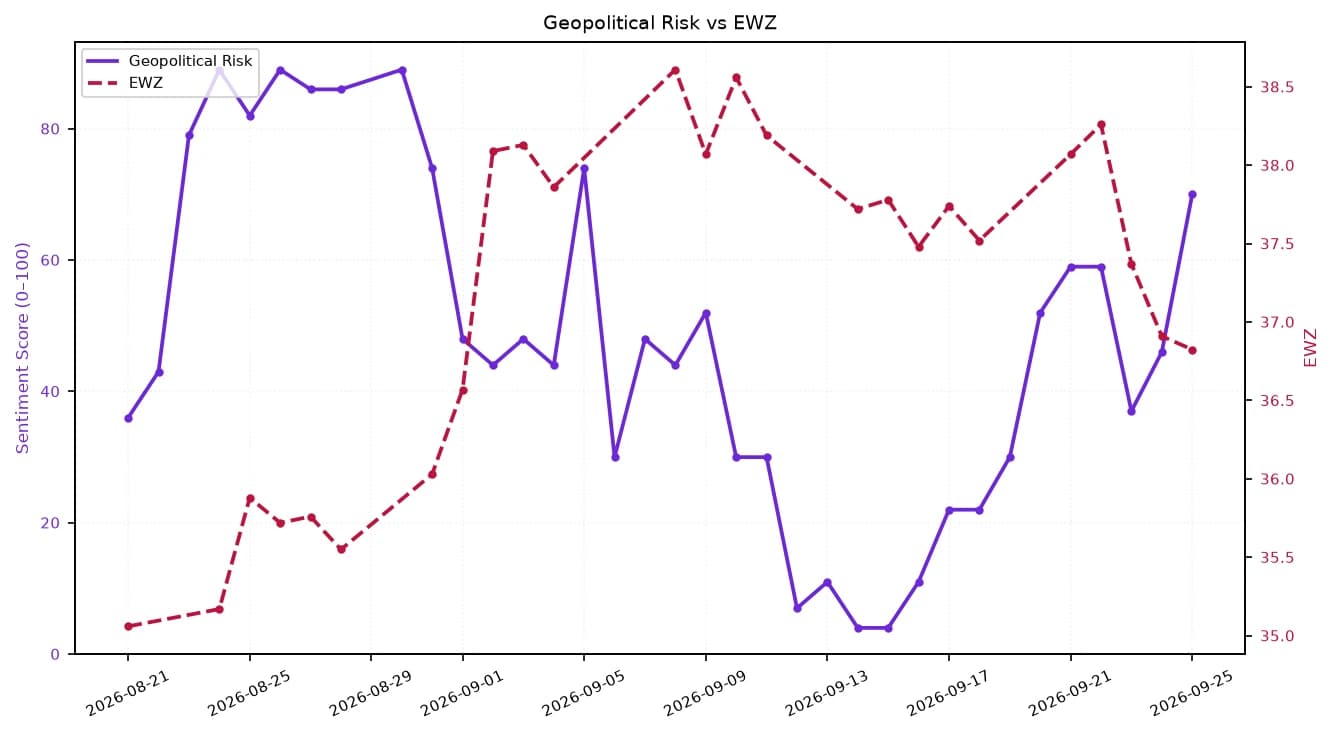
Sentiment IndicatorsⓘProprietary · adalytica.com · September 25, 2026
This is a snapshot — live sentiment, awareness and momentum for 130+ markets update continuously in the dashboard.Open AlphaPulse
The new Real Time Big Data poll puts Moro, a senator allied with the Bolsonaro family, at 35% in the first round of the gubernatorial race, ahead of Sandro Alex on 27% and Requião Filho on 22%. In a direct runoff, Moro leads Requião Filho 52% to 30%, but is effectively tied with Sandro Alex at 42% to 38%, within the survey’s two-point margin of error.
That suggests the race is less about ideological polarization than about who can consolidate the anti-Lula and anti-Bolsonaro vote in a fragmented field. Sandro Alex, backed by Governor Ratinho Júnior’s machine, appears to be Moro’s main obstacle, while Requião Filho remains competitive enough to matter but not strong enough yet to dominate the runoff arithmetic.
For investors, the political map matters because Paraná is a barometer for Brazil’s broader 2026 contest, where early polling has pointed to an increasingly divided electorate. Any shift in the balance between Moro, the Bolsonarista right, and a center-right Ratinho-aligned bloc could shape expectations for fiscal policy, infrastructure priorities and the regulatory climate in one of Latin America’s biggest markets.
The Senate race is even more complicated. Dallagnol, the former federal prosecutor whose candidacy remains under judicial review over a prior Ficha Limpa-related ruling, leads with 19%, narrowly ahead of Alexandre Curi and Filipe Barros at 18% each, and above Gleisi Hoffmann at 16%. That puts the contest inside the margin of error and leaves the final result vulnerable to court rulings as much as campaign dynamics.
A Dallagnol candidacy would be a major boost to the conservative field in Paraná and to anti-corruption voters who still see him as a national name. But if the electoral courts bar him, the Senate race could quickly reopen, benefiting established party machines and potentially improving the odds for candidates with broader organizational backing.
The broader message from the poll is that Paraná remains a high-stakes laboratory for Brazil’s next political cycle: the governorship is trending toward a right-leaning contest between two allied camps, while the Senate race could turn on legal uncertainty rather than voter preference alone. For markets, that means the state is not just a local story but an early read on how Brazil’s polarized electorate may translate into policy and governance risk in 2026.
| Entity | Gains | Losses |
|---|---|---|
| Sergio Moro / PL | ▲Leads first round | ▼Needs runoff consolidation |
| Sandro Alex / PSD | ▲Competitive runoff position | ▼Trails Moro in first round |
| Deltan Dallagnol / Novo | ▲Senate lead if eligible | ▼Faces legal disqualification risk |
| Requião Filho / PDT | ▲Left-of-center base remains viable | ▼Behind in runoff dynamics |