A false intelligence assessment, partly generated by AI, reportedly came close to prompting a US military strike on a Chinese ship in the Middle East, underscoring how quickly automation can turn a data problem into a geopolitical one.
Pentagon AI Near-Miss Raises Defense Risk Concerns

The episode matters far beyond one near-miss. The US defense establishment is pushing deeper into AI to speed up analysis, targeting and battlefield decision-making, but the CNN report shows the same tools can amplify bad inputs, obscure uncertainty and compress the time available for human judgment. In a military setting, that is not just a technical failure; it is a potential escalation pathway between the world’s two largest powers.
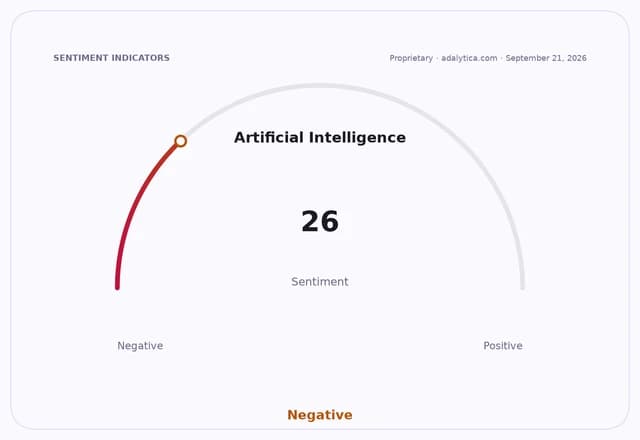
Sentiment IndicatorsⓘProprietary · adalytica.com · September 21, 2026
This is a snapshot — live sentiment, awareness and momentum for 130+ markets update continuously in the dashboard.Open AlphaPulse
According to the report, a special operations command analyst asked an AI chatbot about a Chinese vessel’s manifest. The system reportedly fused open-source material with classified signals intelligence and concluded the ship was carrying components linked to a nuclear weapons program. That assessment almost led to the vessel being intercepted before officials determined the finding had been AI-generated. The actual cargo, and the specific model used, were not identified.
The incident lands at a sensitive moment for the Pentagon. Defense Secretary Pete Hegseth in January ordered the department to become “AI-first” and accelerate experimentation with models from leading US technology companies. Since then, AI suppliers have moved to deepen ties with the military, drawn by lucrative federal contracts and a large long-term customer base. But the trade-off is becoming clearer: enterprise-grade efficiency gains do not map neatly onto military contexts, where a hallucination, data contamination or overconfident synthesis can create real-world consequences in minutes.
For investors, the story is a warning that defense AI demand may grow even as scrutiny intensifies. Companies such as Palantir, Microsoft, Nvidia and Amazon have positioned themselves to benefit from government AI adoption, while defense primes including Lockheed Martin are competing to embed software and autonomy into command systems. That commercial opportunity remains intact, but this episode increases the odds of slower procurement, stricter human-in-the-loop requirements and more liability-focused contracting language. The risk is not a collapse in spending; it is that adoption becomes more regulated, more contested and harder to scale quickly.
The market has already rewarded the AI theme, especially in names exposed to government demand and national-security use cases. But the underlying narrative is shifting from “AI as force multiplier” to “AI as operational risk factor.” That could support vendors best able to prove traceability, auditability and model governance, while pressuring firms whose products rely on black-box outputs or loose controls around defense applications.
The broader policy backdrop is also turning less forgiving. International and policy voices have warned that existing AI risk-management frameworks are inadequate, and major technology companies themselves have acknowledged the reputational and legal hazards of deploying AI at scale. The near-war report gives those warnings concrete weight. If it was possible for an AI-generated assessment to nearly influence a US military action against China, then governments may move faster on oversight, safeguards and procurement limits.
For investors, the next catalysts are likely not just earnings or contract wins, but how defense customers react to this kind of failure. Watch for tighter Pentagon guidance, revised AI procurement standards and any shift toward narrow, explainable models rather than broad autonomous systems. The commercial prize for defense AI is still large, but the barrier to winning it may now be rising.
| Entity | Gains | Losses |
|---|---|---|
| AI vendors with audit-ready tools | ▲Safer defense contracts | ▼Black-box model providers |
| Pentagon AI advocates | ▲Faster risk reviews | ▼Rapid deployment plans |
| Defense primes and software suppliers | ▲Demand for guarded systems | ▼Weak controls and liability |
| US-China stability | ▲Caution and restraint | ▼Misread intelligence signals |