The Philippines risks becoming a proxy battleground in the US-China rivalry unless it builds more room to maneuver through diplomacy, regional ties and economic resilience, a warning that lands as tensions in the South China Sea remain a live market and security risk.
Philippines Faces US-China Proxy Risk, PH ETF Holds

That message matters because the country sits on one of Asia’s sharpest geopolitical fault lines, where any miscalculation between Washington and Beijing could hit trade, tourism, investment and shipping routes far beyond the disputed waters. The argument also cuts against a simple alliance strategy: Mahbubani’s point is that security guarantees from a major power are not a substitute for strategic autonomy.
Sentiment IndicatorsⓘProprietary · adalytica.com · October 19, 2026
This is a snapshot — live sentiment, awareness and momentum for 130+ markets update continuously in the dashboard.Open AlphaPulse
For investors, the issue is not abstract. Philippine assets, including the iShares MSCI Philippines ETF, have moved within a wide range this year, with PH closing at 967.93 on Monday, above its 50-day and 200-day moving averages, but still far from this year’s peak. The ETF had recovered from a September low near 934, yet it has not escaped the broader market’s sensitivity to shifts in US-China relations, maritime tensions and regional risk appetite.
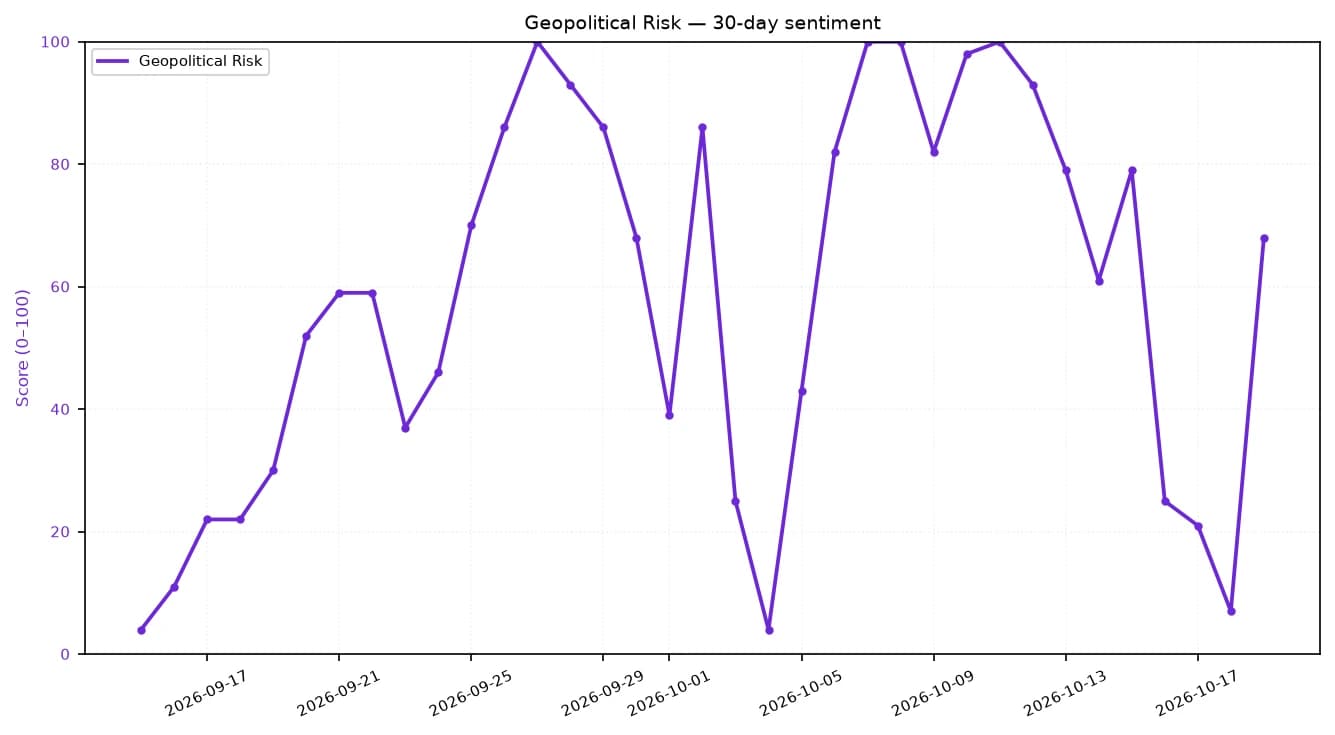
The latest readings from Adalytica’s US-China Relations Sentiment gauge show greed at 79 even as awareness sits at an extreme-fear level of 4, underscoring a market still pricing rivalry without fully discounting escalation risk. That combination helps explain why regional investors are watching the Philippines not just as a frontier market story, but as a potential pressure point in a larger strategic contest.
US-China Relations — 30-day sentimentadalytica.com
Explore this data interactively — full history, time series and cross-market comparisons.Open AlphaPulse
Mahbubani’s central warning is that smaller states can pay the highest price when great powers use them as arenas for competition while remaining insulated from the damage. He pointed to Ukraine as the cautionary example, and his broader point is that legal arguments, while important, do not replace deterrence, diplomacy and economic self-help.
For Manila, the practical answer is less about choosing sides than preserving options. That means maintaining working ties with both Washington and Beijing, leaning on Asean to keep dialogue open and reducing dependence on any single external protector. The risk for markets is that any move toward a more binary stance in the rivalry could quickly reprice Philippine risk assets, especially if South China Sea tensions flare again.
| Entity | Gains | Losses |
|---|---|---|
| Philippines | ▲strategic autonomy | ▼proxy-war exposure |
| Asean | ▲regional diplomatic relevance | ▼pressure to split blocs |
| US-China rivals | ▲influence in the region | ▼room for unilateral control |
| Investors in PH assets | ▲clarity if tensions ease | ▼volatility if rivalry escalates |