Plaud’s new Note Pro is pushing the AI note-taking category beyond novelty and into a contest over whether a dedicated device can outperform phones and apps at capturing conversations people actually want to keep.
Plaud Note Pro and AI note-taking competition
That matters because the market for AI productivity tools is shifting from broad general-purpose chatbots toward narrow, high-frequency use cases where users will pay for reliability. Note-taking is one of the clearest examples: the value proposition is not creativity, but memory, speed and workflow integration. If Plaud can convince users that a pocket-size recorder produces cleaner transcripts, better summaries and less friction than a smartphone app, it can carve out a defensible niche in a crowded AI hardware market.
Sentiment Indicators
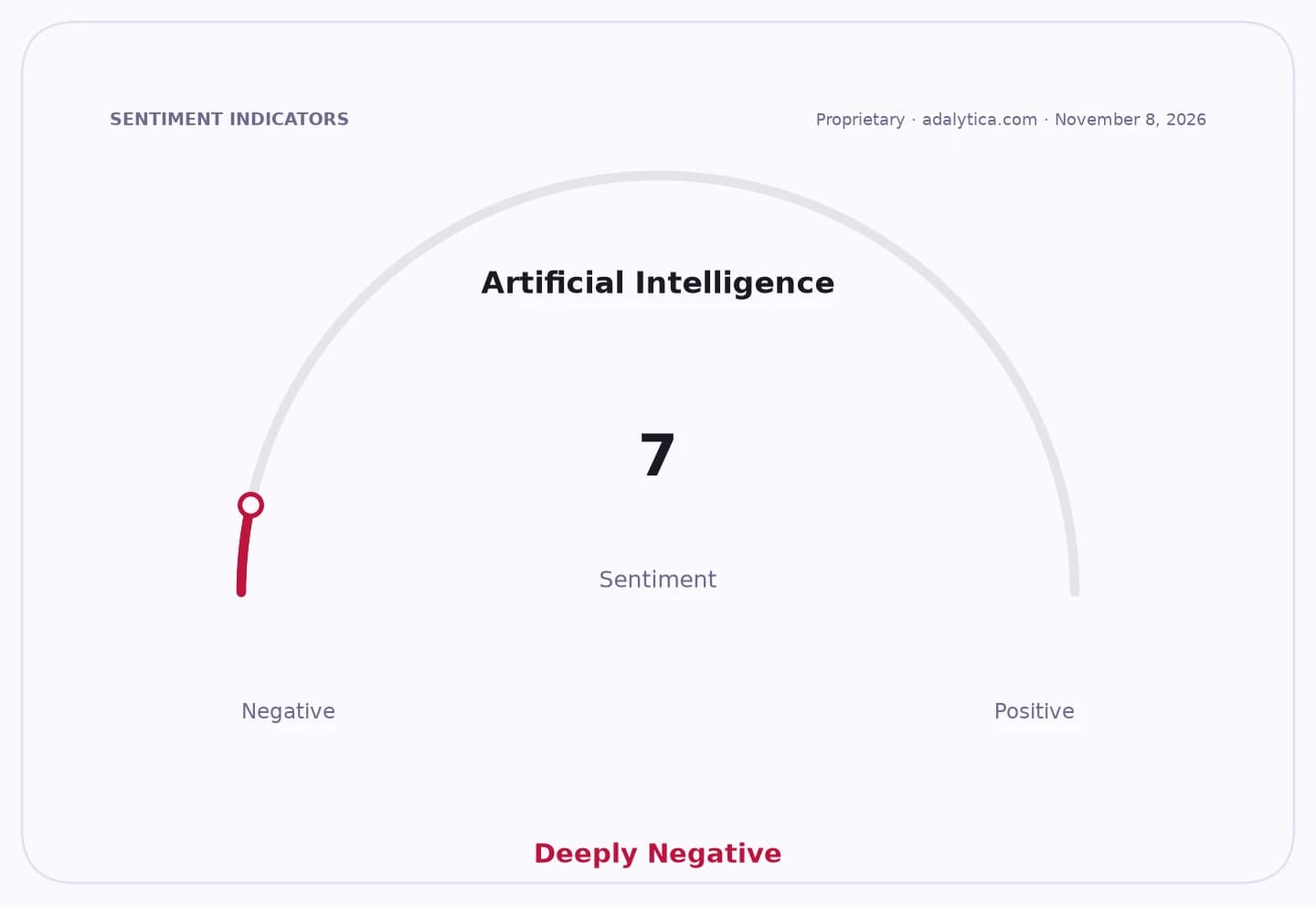
The timing is favorable. Investor appetite for AI remains elevated — sentiment on Adalytica’s AI gauge stands at 71, in “Greed” territory — even as awareness is stuck at 4, in “Extreme Fear,” suggesting the category attracts attention but still faces skepticism over practical utility. That split captures the challenge for Plaud and similar products: enthusiasm for AI is high, but buyers still demand proof that the technology is dependable enough to become part of daily work.
A review-focused product like Note Pro is therefore being judged on more than design. What investors and consumers will care about is whether the device can produce accurate, searchable records of meetings, interviews and lectures without the privacy concerns, battery compromises and workflow interruptions that come with general-purpose devices. In a market where AI models are improving quickly but remain uneven across real-world tasks, execution matters more than claims.
Artificial Intelligence — 30-day sentimentadalytica.com
Explore this data interactively — full history, time series and cross-market comparisons.
The competitive backdrop is also important. Meta’s recent launch of new advanced AI models underscores how fast the underlying technology is moving, and how quickly software capabilities can be copied or commoditized. That raises the bar for hardware makers: a sleek form factor alone is not enough if the core transcription and summarization layer can be replicated elsewhere. The winners will be companies that combine hardware, software and user trust into a sticky workflow, not just a clever gadget.
For investors, the broader implication is that AI hardware is entering a selection phase. The bull case is that purpose-built tools like Note Pro create a premium category for professionals who value accuracy and convenience. The bear case is that dedicated devices remain a niche, with the real value accruing to larger platforms that control the models and ecosystems underneath them. The next test is whether products like Plaud’s can convert early curiosity into repeat usage — the point at which AI note-taking stops looking like a demo and starts behaving like a business.
| Entity | Gains | Losses |
|---|---|---|
| Plaud | ▲Premium niche demand | ▼Feature parity pressure |
| AI note-taking buyers | ▲Better workflow, accuracy | ▼Privacy and subscription risk |
| Platform AI giants | ▲Data and model distribution | ▼Hardware differentiation |
| Smartphone apps | ▲Broader adoption channel | ▼Dedicated-device competition |