Poland’s decision to join the European program is more than a diplomatic headline — it signals a country determined to turn security fears into long-term economic and strategic leverage, and that matters for investors watching Eastern Europe, defense spending and the broader risk premium on the region.
Poland’s Strategic Role Supports Defense-Linked Assets

The big picture is simple: Poland is trying to move from frontline state to main player. That is economically important because countries that anchor Europe’s eastern flank often end up with outsized influence over infrastructure, defense procurement, industrial policy and cross-border capital flows. In a region where geopolitical risk has been rising, Poland’s willingness to deepen its role in Europe can support investment, attract political backing and strengthen the case for persistent defense outlays.
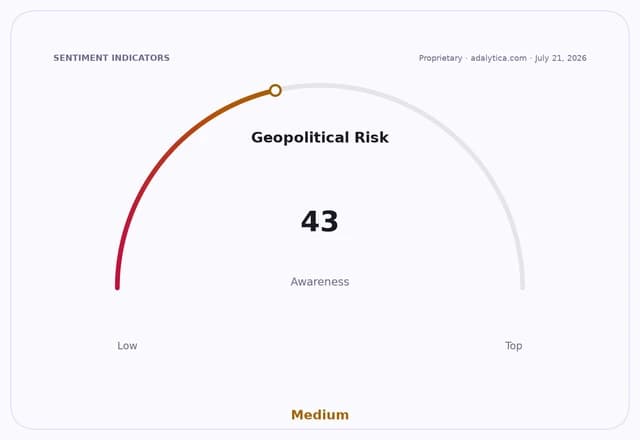
Sentiment IndicatorsⓘProprietary · adalytica.com · July 21, 2026
This is a snapshot — live sentiment, awareness and momentum for 130+ markets update continuously in the dashboard.Open AlphaPulse
That backdrop helps explain why the market has kept a close eye on Poland-related assets even as global risk appetite wobbles. The iShares MSCI Poland ETF, EPOL, has climbed back above both its 50-day and 200-day moving averages, a sign that investors are still willing to pay up for Polish exposure despite periodic volatility. On the latest readings, EPOL traded at 40.45, above its 50-day average of 39.54 and its 200-day average of 36.25, while volume remained healthy. That does not prove a straight line higher, but it does suggest the market is treating Poland as a resilient long-term story rather than a short-term trade.
And there is a reason for that resilience. Poland sits at the center of Europe’s security dilemma. The region has faced falling irregular crossings from Belarus, more expulsions of foreign nationals and repeated warnings from Poland and the Baltic states about possible Russian hybrid provocations. That mix usually pushes governments to spend more on borders, defense and logistics, not less. For investors, the implication is that the companies and funds tied to military readiness, industrial capacity and regional infrastructure may benefit from a sustained policy tailwind.
The investment angle is not limited to defense alone. When a country gains stature inside a European framework, it can also improve its bargaining power over funding, supply chains and capital allocation. That is especially relevant for a market like Poland, where long-term returns may come less from dramatic headline growth and more from steady compounding across banks, industrials, energy and exporters that benefit from a stronger strategic role in Europe.
Still, investors should keep the risks in view. The geopolitical backdrop remains fragile, and the recent deterioration in global stability sentiment underscores how quickly regional risk perceptions can change. Anti-Ukrainian sentiment, border tensions and the threat of Russian disruption all argue for patience rather than chasing every rally. For long-term investors, the better question is not whether Poland will be volatile — it will be — but whether its strategic importance inside Europe is rising. On that count, the answer looks increasingly like yes.
If Poland can convert this moment into deeper integration, firmer security backing and a more durable investment climate, the payoff could last for years. For investors building diversified portfolios, Poland is worth watching as a regional beneficiary of Europe’s new security order — and possibly as one of its most important long-term winners.
| Entity | Gains | Losses |
|---|---|---|
| Poland | ▲Bigger strategic role | ▼Higher security burden |
| European program partners | ▲Stronger eastern flank | ▼More funding commitments |
| Defense and infrastructure investors | ▲Longer spending cycle | ▼Higher volatility risk |
| Russia and hybrid-pressure tactics | ▲Less room to intimidate | ▼Stronger regional pushback |