Erewhon’s latest $12 bottle of “sacred water” is not just a viral indulgence — it is a clean read on where premium consumer spending still works, and where it does not.
Premium Grocery Pricing Power Still Intact
The economics matter because the grocery aisle is splitting in two. At one end, price-sensitive shoppers are trading down and forcing mainstream chains to defend share with discounts. At the other, a small but stubbornly affluent customer base is still paying up for branded wellness, exclusivity and social-media cachet. That makes luxury grocery one of the few corners of retail where pricing power still looks intact, even as the broader consumer backdrop softens.
Sentiment Indicators
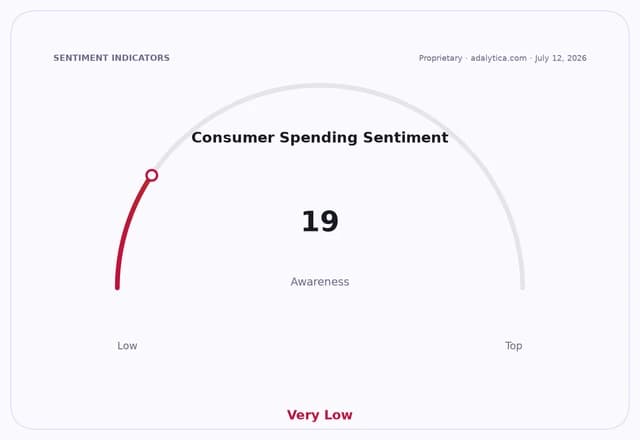
That tension is showing up in the data. Consumer sentiment has slid to 44.8 in May from 49.8 in April and 53.3 in March, a sign that households are becoming more cautious even as consumer spending sentiment remains elevated at 89 on Adalytica’s gauge. In other words, shoppers may be uneasy, but they are not behaving uniformly. Some are hunting value; others are still willing to pay for identity, convenience and aspiration.
For investors, that divergence is the opportunity. The market underestimates how much money can be made in premium food retail when the product is not merely food but a lifestyle signal. Erewhon’s economics are built on high gross-margin, low-volume theatrics: premium private-label items, curated assortments and the halo effect that turns basic consumables into status objects. The $12 water bottle is absurd on its face — and precisely why it works. It reinforces the brand’s power to charge more, not less.
The bigger trade is in the suppliers and enablers of this premiumization wave. Specialty distributors, premium private-label manufacturers, niche food brands and logistics providers serving high-end grocery all benefit when consumers keep paying for “better,” not cheaper. Innovative Food Holdings, which distributes gourmet and specialty products, sits in the middle of that ecosystem. Its share price has been battered, with technical readings showing the stock below both its 50-day and 200-day moving averages and RSI readings still subdued, but that also means the market is pricing it like a commodity distributor rather than a premium-supply platform with optionality tied to high-end food demand.
That disconnect is why the story matters beyond the meme. Luxury grocery is not about one overpriced bottle. It is about the persistence of bifurcated consumer demand, where value chains win volume and premium chains win margin. As long as wealthy consumers keep treating shopping as self-expression, companies with differentiated assortment and brand heat can defend pricing even in a weak sentiment backdrop.
The takeaway: the market is focused on grocery inflation and discount wars, but the asymmetric opportunity is in premiumization. Investors should look for the toll roads of upscale food — specialty suppliers, premium brands and selective operators with true pricing power — because that is where the next leg of profit growth can still come from.
| Entity | Gains | Losses |
|---|---|---|
| Erewhon | ▲Pricing power | ▼Value shoppers |
| Premium food suppliers | ▲Higher margins | ▼Commodity grocers |
| Consumer discounters | ▲Traffic gains | ▼Luxury retailers |
| Innovative Food Holdings (IVFH) | ▲Premium demand upside | ▼Weak technical momentum |