Private healthcare is taking a larger share of spending because public systems are no longer absorbing rising demand, and that shift is creating winners in the U.S. managed-care and hospital chains even as it exposes structural cracks in access and staffing.
Private Healthcare Shift Favors CVS and Insurers
The most important development in the data is not just that patients are paying more out of pocket for healthcare, but that the private sector is increasingly becoming the default backstop when public capacity fails. The result is a quiet transfer of demand — and pricing power — from under-resourced state systems to private operators, insurers and specialty providers. In Poland, where the seed headline points to the “silent privatization” of healthcare, the economic logic is familiar across developed markets: when waiting times lengthen and specialist shortages intensify, households spend more to secure timely care. That makes healthcare less of a public entitlement and more of a consumer market.
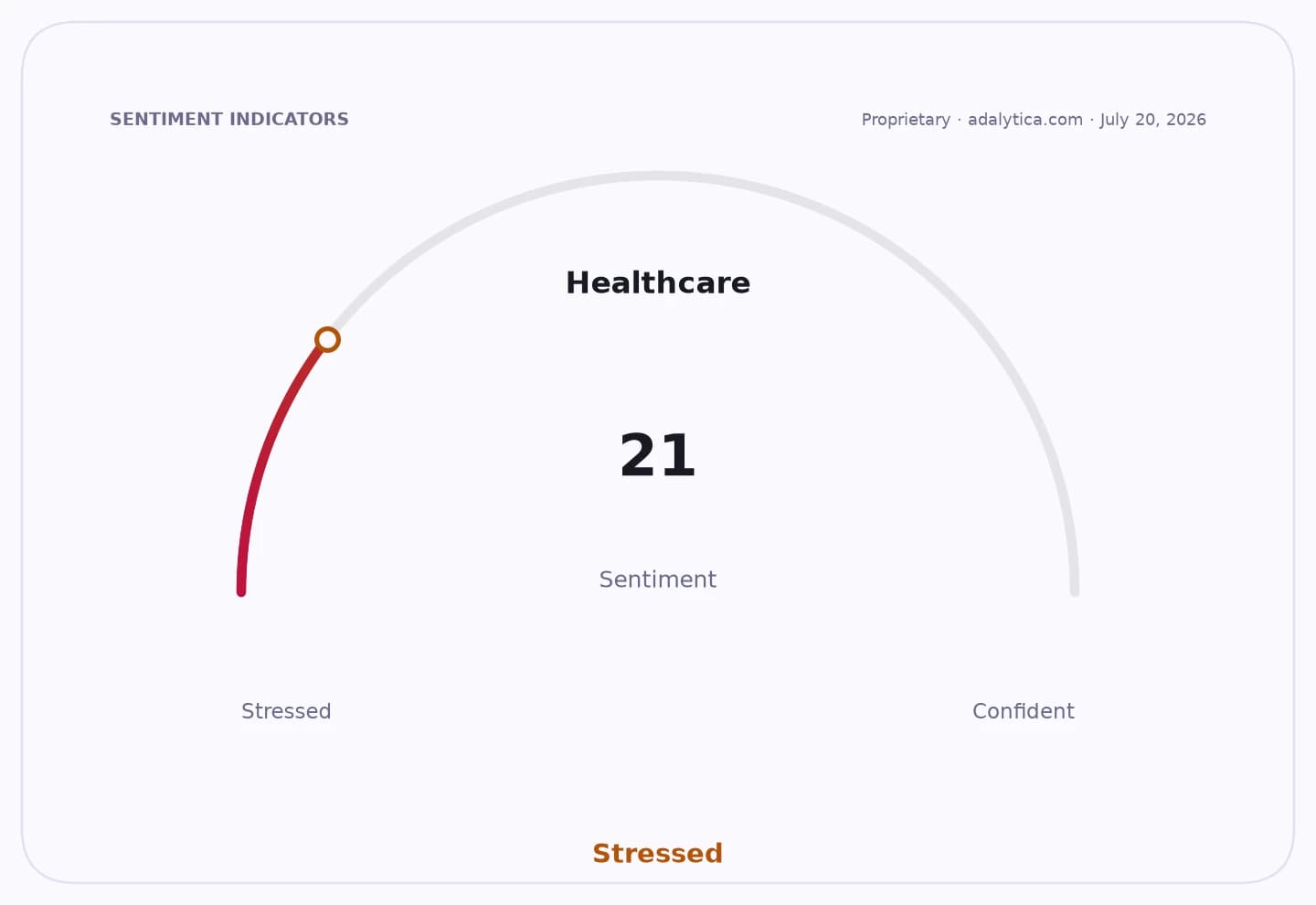
Sentiment IndicatorsⓘProprietary · adalytica.com · July 20, 2026
This is a snapshot — live sentiment, awareness and momentum for 130+ markets update continuously in the dashboard.Open AlphaPulse
Adalytica’s Healthcare Spending Sentiment gauge is now in “Fear,” with awareness still only neutral, suggesting the issue is beginning to register as a systemic affordability problem rather than a short-term service disruption. In practical terms, that matters because fear around access tends to pull spending toward the private channel faster than nominal income growth would suggest. The immediate effect is stronger demand for elective procedures, diagnostics, and insured or self-funded specialist care. The broader effect is a widening two-tier system, with better access for those who can pay and longer delays for everyone else.
The market reaction in U.S. healthcare names reflects that dynamic. CVS, which straddles insurance, pharmacy and care delivery, has rallied sharply from below $70 late last year to about $107, while HCA has climbed back near $371 after a much deeper drawdown earlier in the year. UnitedHealth has also rebounded to about $426 after a violent selloff in January. Those moves suggest investors are rewarding scale and pricing resilience in companies positioned to capture private demand, even as they remain wary of margin pressure, regulation and reimbursement risk.
The technical backdrop is constructive for CVS and mixed for UNH and HCA. CVS trades above both its 50-day and 200-day moving averages, with momentum still positive despite a recent consolidation. UNH remains well above long-term trend, but its RSI has eased back toward neutral and the stock is drifting lower from recent highs, implying investors are taking some profit after the rebound. HCA is still below its 200-day moving average, which tells a different story: the hospital group has recovered from oversold levels, but the market has not yet fully repriced the sector’s earnings power after the earlier shock.
That split matters because the privatization theme does not benefit all healthcare businesses equally. Insurers and integrated distributors can gain from higher utilization and more services flowing through the private system. Hospitals can gain if volumes rise, but they remain exposed to labor costs, capital intensity and political scrutiny. In Poland and other systems under strain, private clinics and diagnostics providers benefit most directly from unmet public demand, while public hospitals and lower-income patients bear the cost of the gap.
The supply side is the real constraint. The Brisbane breast-screening closure, triggered by a shortage of specialist radiologists, is a reminder that private healthcare cannot simply scale by demand alone. When skilled labor is scarce, private providers can end up rationing care just as public hospitals do. That creates an economic ceiling on privatization: price can rise faster than capacity. For investors, that means revenue growth in healthcare does not automatically translate into margin expansion if staffing, specialty access and regulatory pressure intensify.
Still, the direction of travel is clear. Aging populations, long waiting lists and persistent workforce shortages are pushing households toward private spending in markets from Poland to Australia and the U.S. The bullish case is that this supports a durable shift in demand toward private hospitals, pharmacies, insurers and specialty networks. The bearish case is that political backlash will eventually force reimbursement changes, tighter oversight or new public funding, limiting pricing power and compressing multiples.
For investors, the key question is not whether healthcare is becoming more private, but who captures the economics of that shift. Companies with scale, integrated distribution and negotiating leverage are best placed to benefit. Those dependent on labor-heavy capacity or vulnerable to policy intervention face a more uneven payoff.
| Entity | Gains | Losses |
|---|---|---|
| Private insurers and care managers | ▲Higher utilization | ▼Reimbursement scrutiny |
| Private hospitals and clinics | ▲More patient volume | ▼Labor cost pressure |
| Public health systems | ▲Less immediate demand pressure | ▼Lost market share |
| Patients with means | ▲Faster access | ▼Higher out-of-pocket costs |