AI is moving from a productivity promise to a labor-market reality, and that is forcing companies to rethink how many people they need to do the same amount of work.
Qantas cuts 850 jobs amid AI adoption
Qantas said it will eliminate 850 jobs, blaming the speed and scale of AI adoption, a sharp reminder that automation is no longer confined to factories or back-office pilots. It is reaching into service industries and corporate operations, where software can now handle tasks that once required teams of employees. For investors, that is the central question of the AI era: not whether technology can lift profits, but who captures those gains and who is left exposed.
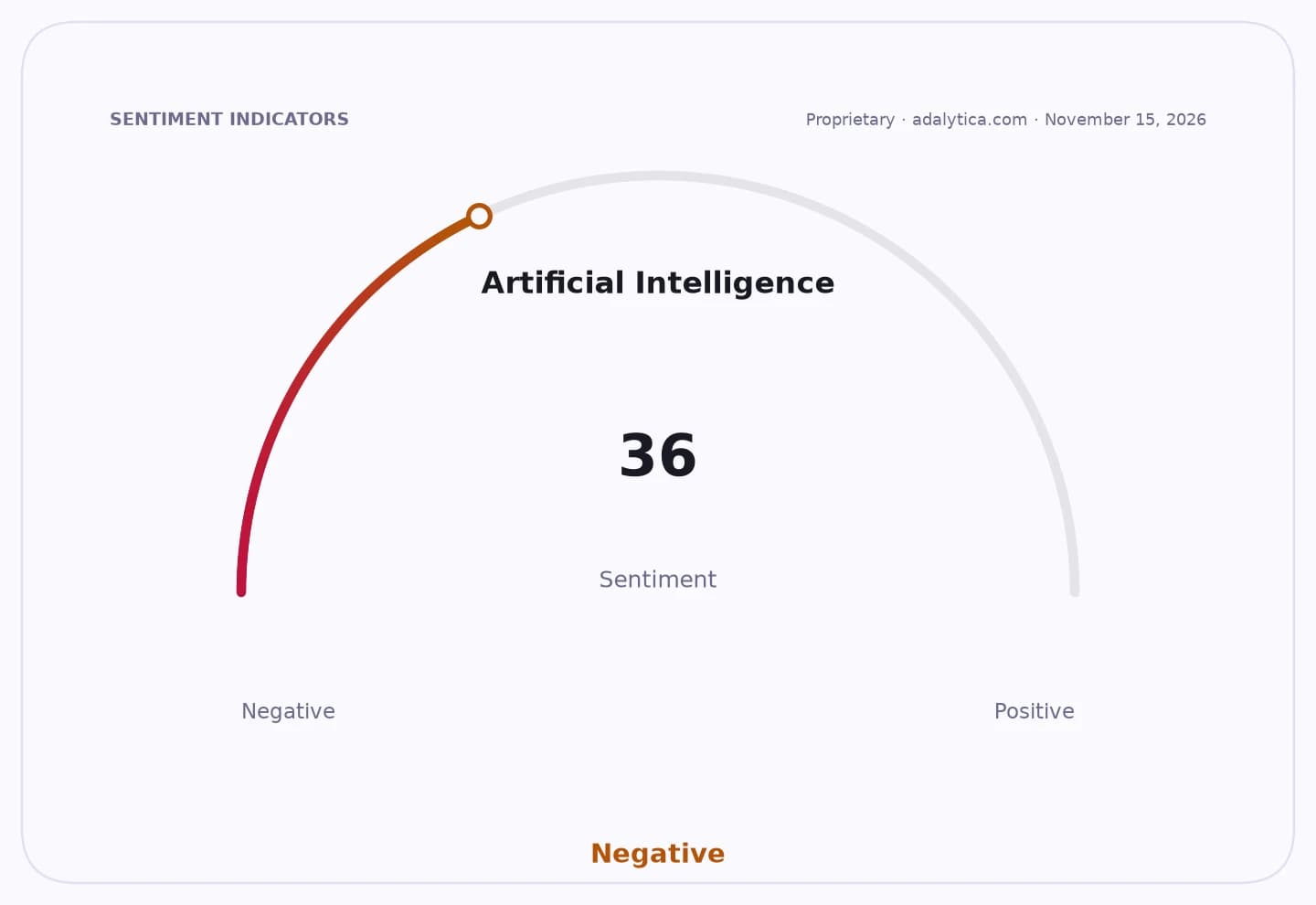
Sentiment Indicators
The economic significance goes well beyond one airline. When companies use AI to reduce headcount, they can improve margins, protect cash flow and, in some cases, reallocate spending toward software, data centers and higher-value work. That may help listed businesses support earnings even in a slower-growth world. But it also raises a harder issue for policymakers and households: if productivity gains accrue mainly to shareholders and highly skilled workers, wage growth can weaken for everyone else, reinforcing inequality and keeping pressure on consumption.
The data point to a labor market that is already splitting in two. Demand for skilled programmers in the U.S. has risen nearly 15%, showing that AI is not simply destroying jobs — it is changing which jobs matter. The tougher part is that the benefits are not evenly shared. Younger workers and those without experience are facing fewer openings, while companies increasingly want employees who can design, supervise and integrate AI systems rather than perform routine work. In other words, AI is making human labor more valuable in some roles and less necessary in others.
That is why the market reaction around AI names remains so important. Microsoft and Nvidia have both seen big swings in recent months, even as their long-term business cases remain tied to the same secular force: enterprise spending on AI infrastructure and applications. Microsoft’s 50-day moving average sits just above its latest close, while Nvidia’s share price has fallen well below its 50-day and 200-day moving averages, a sign that investors are still arguing over how much of the AI boom is already priced in and how quickly monetization will broaden beyond hardware. Amazon, meanwhile, has held up better, helped by its cloud and AI exposure, underscoring that the best-positioned firms are not always the ones with the loudest AI story, but the ones with the deepest customer relationships and operating leverage.
Adalytica’s AI sentiment snapshot also shows a market that remains interested in the theme even as awareness is described as extreme fear. That combination is classic late-cycle uncertainty: enthusiasm about the technology, anxiety about the social cost. For long-term investors, the lesson is not to chase every AI headline, but to own the companies with durable moats, recurring revenue and the scale to convert automation into free cash flow.
The broader work-force story is likely to unfold over years, not quarters. Some jobs will disappear, others will be redesigned, and many more will be created for people who can work with AI rather than compete against it. That makes this less a temporary disruption than a structural shift in how value is created. Investors should watch for businesses that use AI to expand productivity without damaging retention, culture or customer service. Those are the companies most likely to turn the nature of work in the AI age into lasting shareholder returns.
| Entity | Gains | Losses |
|---|---|---|
| AI-first employers | ▲Lower labor costs | ▼Bigger worker pushback |
| Skilled programmers | ▲Higher demand, better pay | ▼Limited entry-level openings |
| Younger workers | ▲New AI-enabled roles over time | ▼Fewer traditional opportunities |
| Shareholders in efficient platforms | ▲Wider margins, stronger cash flow | ▼Risk of valuation volatility |