Rising interest rates are still pressuring property markets, but that may be exactly why long-term investors should be paying closer attention to real estate now.
REITs Face Pressure as Select Sectors Hold Up

The basic math is unchanged: higher borrowing costs make homes less affordable, slow transaction volumes and raise the cost of refinancing for real estate companies. The 10-year Treasury yield is holding around 5.23%, while the Fed funds rate sits near 3.75%, a combination that keeps financing conditions tight even after the worst of the inflation spike. Yet REITs and real estate ETFs have already absorbed a lot of bad news. VNQ and IYR both traded down from recent highs, while XLRE has slipped back toward levels that suggest investors are pricing in more pain than opportunity.
Sentiment IndicatorsⓘProprietary · adalytica.com · October 12, 2026
This is a snapshot — live sentiment, awareness and momentum for 130+ markets update continuously in the dashboard.Open AlphaPulse
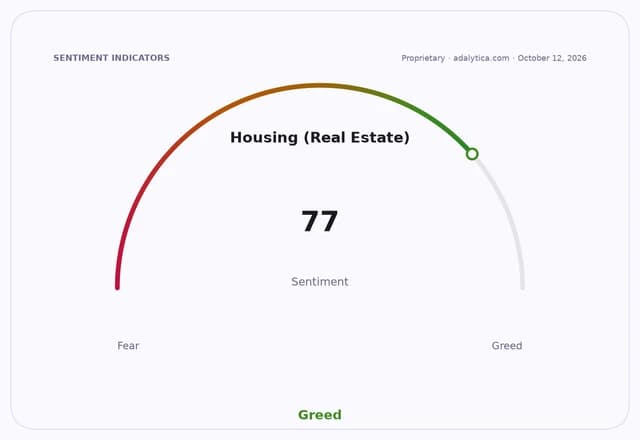
That matters because real estate is not one monolithic trade. The market is still treating the sector as if every landlord faces the same destiny, when in reality the winners and losers are diverging fast. Senior housing is one of the clearest examples. Ventas has said it expects the segment to benefit from strong demand growth and low supply growth, a setup that can support occupancy, pricing power and cash flow even in a difficult rate environment. Data centers, meanwhile, continue to benefit from secular demand tied to cloud computing and artificial intelligence, where the need for power, storage and connectivity can overwhelm short-term interest-rate worries.
For investors, that creates an interesting asymmetry. The broad sector may remain under pressure as elevated mortgage rates weigh on housing activity and credit stays tight, but the valuation reset is also creating entry points in subsectors with durable demand and limited new supply. Recent sentiment around housing has swung sharply, with Adalytica’s Housing Fear & Greed Index showing greed even as awareness remains in extreme fear territory, a sign that many investors are still hesitant despite improving long-term setups in select areas.
Housing (Real Estate) vs VNQadalytica.com
Explore this data interactively — full history, time series and cross-market comparisons.Open AlphaPulse
The technical picture also suggests caution, but not despair. VNQ has fallen below its 50-day moving average and is hovering not far from its 200-day line, while IYR and XLRE have also pulled back from their spring and summer highs. That kind of price action usually tells you expectations have been cut back aggressively. For patient investors, that is often where future returns are built, not when optimism is already widespread.
Of course, this is not a call to buy every real estate stock. Highly leveraged owners, weaker apartment markets and rate-sensitive homebuilders can still struggle if borrowing costs remain elevated. But for investors willing to be selective, the combination of higher rates, lower valuations and strong fundamentals in niches like senior housing and data centers is exactly the kind of environment that can reward a long-term, diversified approach. The best real estate opportunities now may not be in the obvious places. They may be in the businesses with pricing power, supply constraints and cash-flow visibility that can compound through the rate cycle — worth watching, and potentially worth buying for the long run.
| Entity | Gains | Losses |
|---|---|---|
| Senior housing REITs | ▲Demand and occupancy | ▼Borrowing-cost pressure |
| Data center landlords | ▲AI and cloud demand | ▼Valuation multiple compression |
| Long-term investors | ▲Lower entry prices | ▼Near-term volatility |
| Rate-sensitive homebuilders | ▲None | ▼Affordability and demand |