The long-running reset in real estate investment trusts is approaching a turning point as 10-year Treasury yields hover near 4.8% and 30-year mortgage rates stay stuck above 6.7%, keeping property valuations pressured even as occupancy and rent trends remain resilient.
REITs Face Rate Pressure as VNQ Holds 96

That mix matters because REIT pricing is still being driven less by cash flow deterioration than by the cost of capital. Public REITs, as tracked by the VNQ ETF, have already recovered from earlier lows but remain below recent peaks, with the fund closing at 96.02 on Sept. 4 after a sharp summer pullback and a relative-strength index of 36.4, a level that points to subdued momentum rather than collapse. The 50-day moving average at 98.25 now sits above the price, while the 200-day average at 93.0 suggests the broader uptrend is intact.

For investors, that leaves the sector in a classic transition zone. If bond yields stabilize or ease, the discount rate applied to property income could start to compress, lifting net asset value estimates and reopening the gap between public REIT prices and private-market property values. If rates stay high, the repricing could drag on, but the upside case remains tied to a simple shift in financing costs rather than a rebound in operating fundamentals.
The interest-rate backdrop is still mixed. The 10-year Treasury finished at 4.77% on Sept. 3 and was forecast at 4.802% for Sept. 4, while the 2-year note was at 4.34% and projected to edge back to 4.375%. Mortgage rates were even less cooperative, with the 30-year fixed rate at 6.71% on Sept. 3, near multi-month highs and little changed from the prior week.
DGS10 vs DGS2 — macro contextadalytica.com
Explore this data interactively — full history, time series and cross-market comparisons.Open AlphaPulse

Commercial REITs are already showing the strain and the resilience of that environment. Realty Income slipped to $61.25 on Sept. 4, below its 50-day average of $62.86 and with RSI at 41.6, while Prologis ended at $137.34, also under its 50-day average of $142.07. Both names remain above their 200-day averages, a sign that long-term investors have not abandoned the sector even as near-term sentiment has cooled.
By contrast, the broader REIT complex is still attracting capital into the parts of property markets that can command growth. Keppel DC REIT’s $1.2 billion purchase of two Tokyo data centers highlights continued demand for infrastructure tied to digital workloads, underscoring how some subsectors are still getting rerated on growth rather than rate sensitivity.
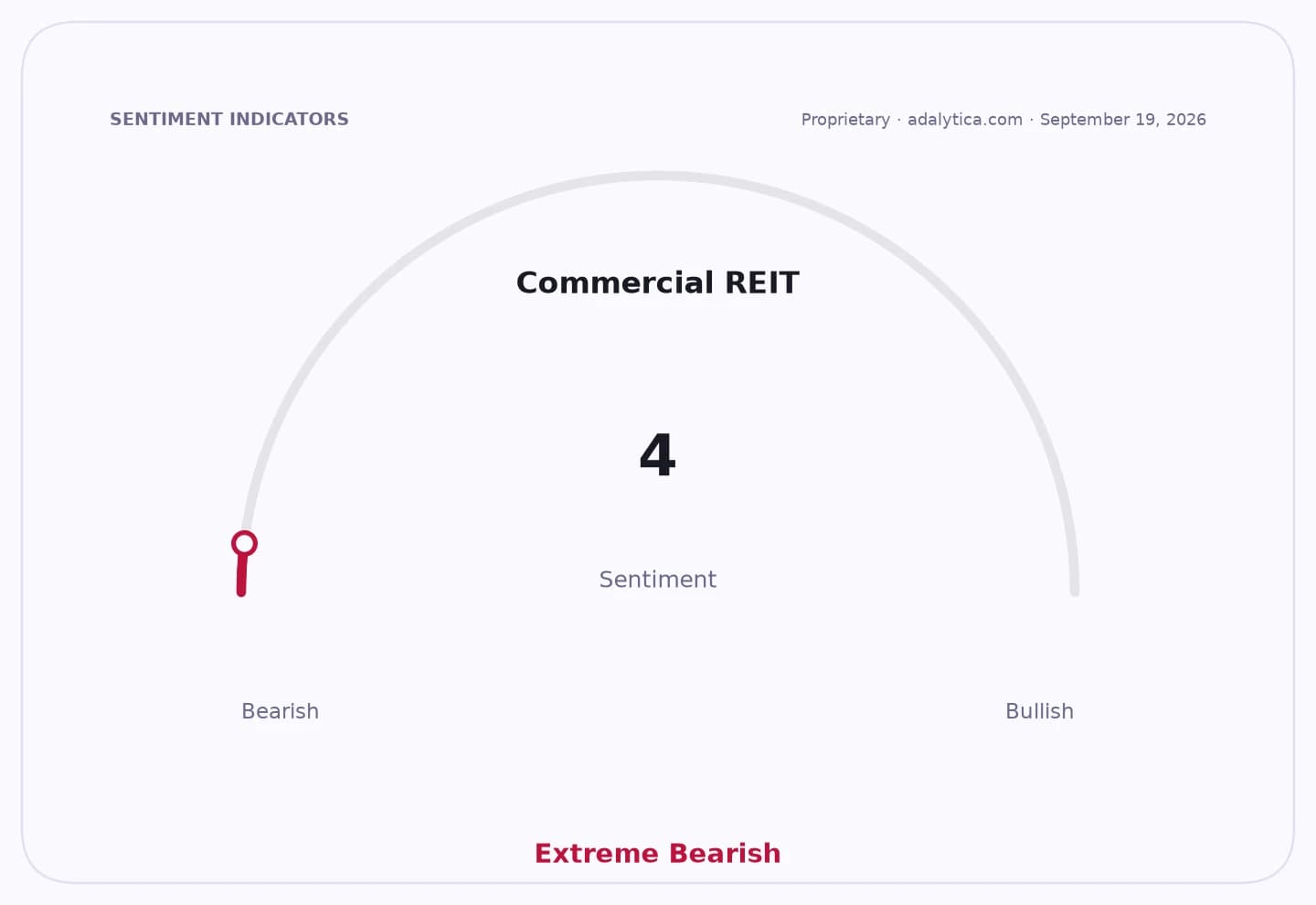
Adalytica’s commercial REIT sentiment gauge has swung sharply, dropping to 23 on Sept. 3 before recovering to 42 by Sept. 5, a move that reflects how quickly expectations are shifting around rates and valuation. For investors, the key catalyst now is whether Treasury yields and financing costs begin to ease enough to turn a valuation story into a sustained public-market rerating.
| Entity | Gains | Losses |
|---|---|---|
| REIT investors | ▲Lower discount rates, NAV upside | ▼Prolonged rate pressure |
| Public REITs | ▲Repricing if yields ease | ▼Cost of capital stays high |
| Bondholders | ▲Higher current yields | ▼If yields fall, less income |
| Data center REITs | ▲Secular demand, growth premium | ▼Rate-sensitive valuation drag |