Republicans are beginning to distance themselves from Donald Trump as the midterms turn against them, a sign that the party’s strongest political asset may now be becoming its biggest liability.
Republicans Distance Themselves From Trump

That shift matters because it is happening at the point when control of Congress appears up for grabs. With Democrats increasingly favored to win one or both chambers, GOP lawmakers are no longer just defending Trump’s agenda — they are trying to survive it. The stakes are economic as much as political: markets, businesses and voters are all reacting to policy moves on tariffs, Iran and inflation that are feeding a fresh wave of uncertainty.
Sentiment IndicatorsⓘProprietary · adalytica.com · October 3, 2026
This is a snapshot — live sentiment, awareness and momentum for 130+ markets update continuously in the dashboard.Open AlphaPulse
The clearest warning is coming from inside the Republican Party itself. Sen. John Kennedy criticized taxpayer-funded Trump messaging on CBS, saying public money should not be used to promote the president. Sen. Bill Cassidy called the same ads offensive and said they looked political. House Speaker Mike Johnson, meanwhile, has shifted from backing Trump’s military action in Iran to saying the conflict now has to be brought to a resolution.
That is not normal behavior for a party built around Trump loyalty. But the political incentives are changing fast. Polling cited by campaign handicappers shows Republicans losing ground even in places that should be safe — the Midwest and red states such as Texas, Florida, Ohio and Mississippi. As gas prices climb and consumer confidence weakens, vulnerable Republicans are being pushed to explain why voters feel poorer while the White House remains defiant on trade and foreign policy.
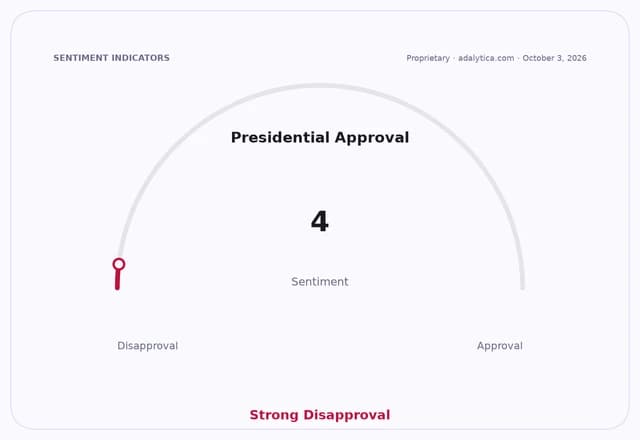
The economic backdrop is doing as much damage as the optics. Trump’s tariff push and the Iran conflict are the kinds of second-order shocks markets hate because they hit confidence, raise costs and complicate the Federal Reserve’s inflation path. That is why the squeeze is showing up not just in politics but in investor sentiment: Adalytica’s U.S. presidential approval gauge is in “Extreme Fear” at 4, while its global stability reading has fallen to 25, underscoring how rapidly geopolitical stress is feeding through to broader risk appetite.
For investors, the message is straightforward: divided government is no longer a tail risk, it is becoming the base case. That should matter to sectors exposed to tariff policy, defense appropriations, energy volatility and consumer spending. If Democrats take Congress, the legislative agenda shifts toward oversight, spending fights and limits on unilateral executive action, while Trump-aligned policy bets become harder to price with confidence.
The market is still underestimating how quickly political weakness can turn into policy paralysis. For now, the most important trade is not on Trump himself but on the fallout from a Republican Party that is beginning to hedge against him. Investors should look for beneficiaries of a more gridlocked Washington — and be wary of names that need a clean, pro-growth policy runway to keep outperforming.
| Entity | Gains | Losses |
|---|---|---|
| Democrats | ▲Higher odds of congressional control | ▼None |
| Vulnerable Republicans | ▲Less exposure to Trump backlash | ▼Party unity |
| Defense and policy-oversight themes | ▲More congressional scrutiny demand | ▼Executive freedom |
| Tariff-sensitive importers | ▲Potential relief from policy reversal | ▼Trump trade agenda |