Russia’s current account swung to a $3.3 billion surplus in August, a sign that stronger export receipts are still giving the economy foreign-currency support even as services imports and external obligations rise.
Russia current account surplus rose to $3.3 billion
The Central Bank of Russia’s preliminary balance-of-payments estimate shows the August surplus compared with a revised $1.6 billion in July and a $0.5 billion deficit in August 2025. For January through August, the current account surplus widened to $35 billion from $21 billion a year earlier, mainly because of higher export value, while the goods trade surplus increased to $91.6 billion from $73.3 billion.
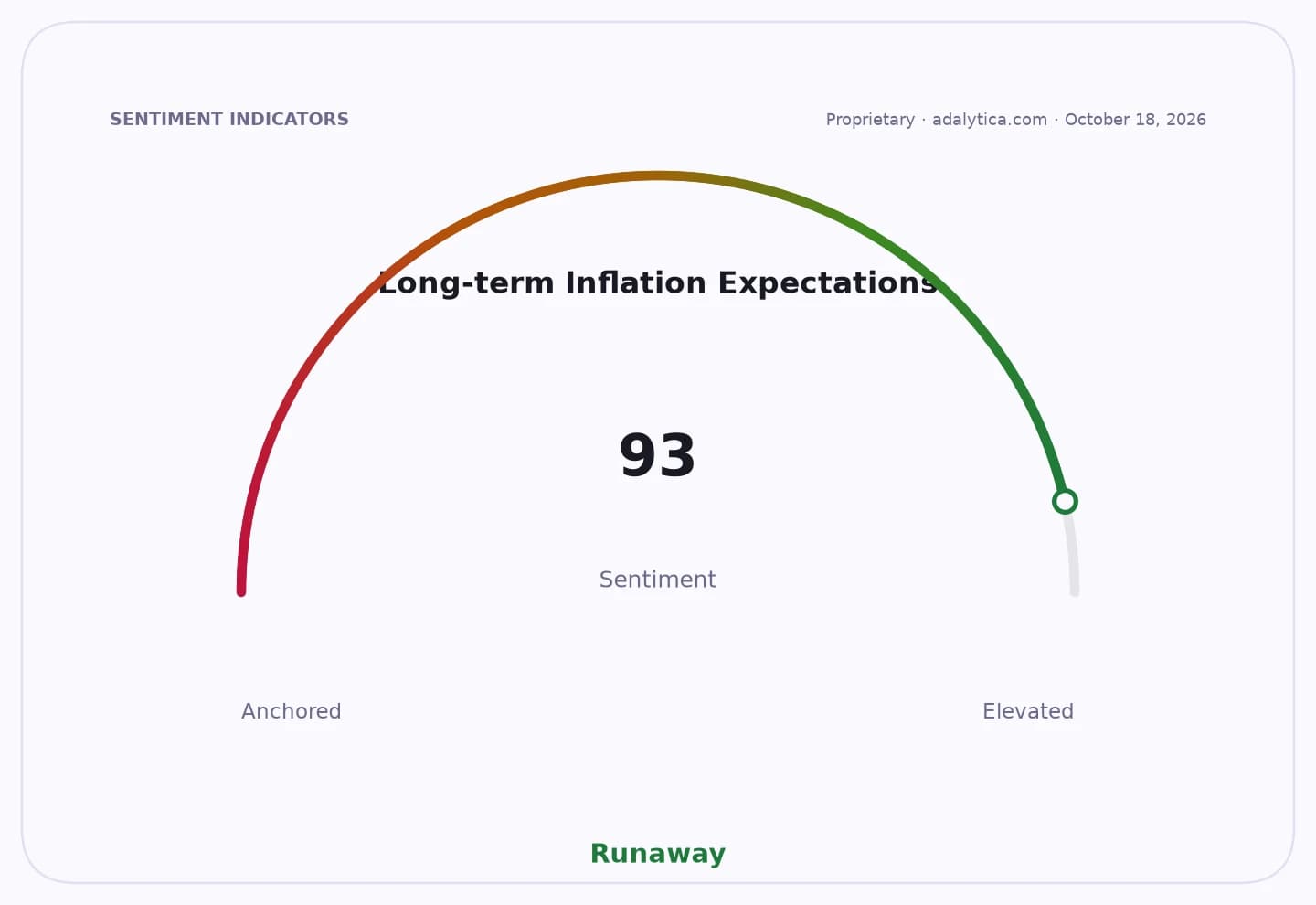
Sentiment IndicatorsⓘProprietary · adalytica.com · October 17, 2026
This is a snapshot — live sentiment, awareness and momentum for 130+ markets update continuously in the dashboard.Open AlphaPulse
That matters because Russia’s external accounts remain one of the few structural buffers available to policymakers under sanctions and volatile commodity prices. A larger current account surplus tends to support the ruble, ease pressure on the banking system’s foreign-currency liquidity and help offset the fiscal strain from higher domestic spending and debt service. It also gives the central bank more room to manage financial stability even when the economy faces tighter trade and payment channels.
The composition of the latest figures is less reassuring than the headline suggests. The services deficit widened to $33.7 billion, up $2.3 billion from a year earlier, driven largely by Russians’ higher spending on foreign travel. Export growth in services was described as modest and concentrated in transport. That indicates the surplus is still being powered more by merchandise exports than by a broadening of the country’s external earnings base.
The Central Bank also said external liabilities rose by $23.3 billion, sharply above the $5.8 billion increase a year earlier, helped by higher balances held by non-residents in accounts and deposits. Reserve assets rose by $7.5 billion, after falling by $12.8 billion a year ago, suggesting the authorities were able to add to buffers during the period.
For investors, the key question is whether the improvement in the current account can persist if energy receipts soften or import demand strengthens. The data point to a still-favorable external position, but not one that is immune to a pickup in outbound travel spending or any weakening in export values. That is particularly relevant for the ruble, sovereign risk pricing and sectors tied to imported goods and foreign-currency funding.
The broader message is that Russia’s external surplus remains intact, but it is increasingly dependent on a narrow set of trade flows. If export values hold up, the surplus can continue to cushion the economy; if they weaken, the pressures from services imports and rising liabilities will become more visible.
| Entity | Gains | Losses |
|---|---|---|
| Russia’s external accounts | ▲Larger current account buffer | ▼More exposed if exports weaken |
| Ruble | ▲Support from foreign-currency inflows | ▼Pressure from wider services deficit |
| Exporters | ▲Higher trade surplus contribution | ▼Greater dependence on commodity receipts |
| Consumers traveling abroad | ▲Access to foreign spending | ▼Domestic currency outflows |