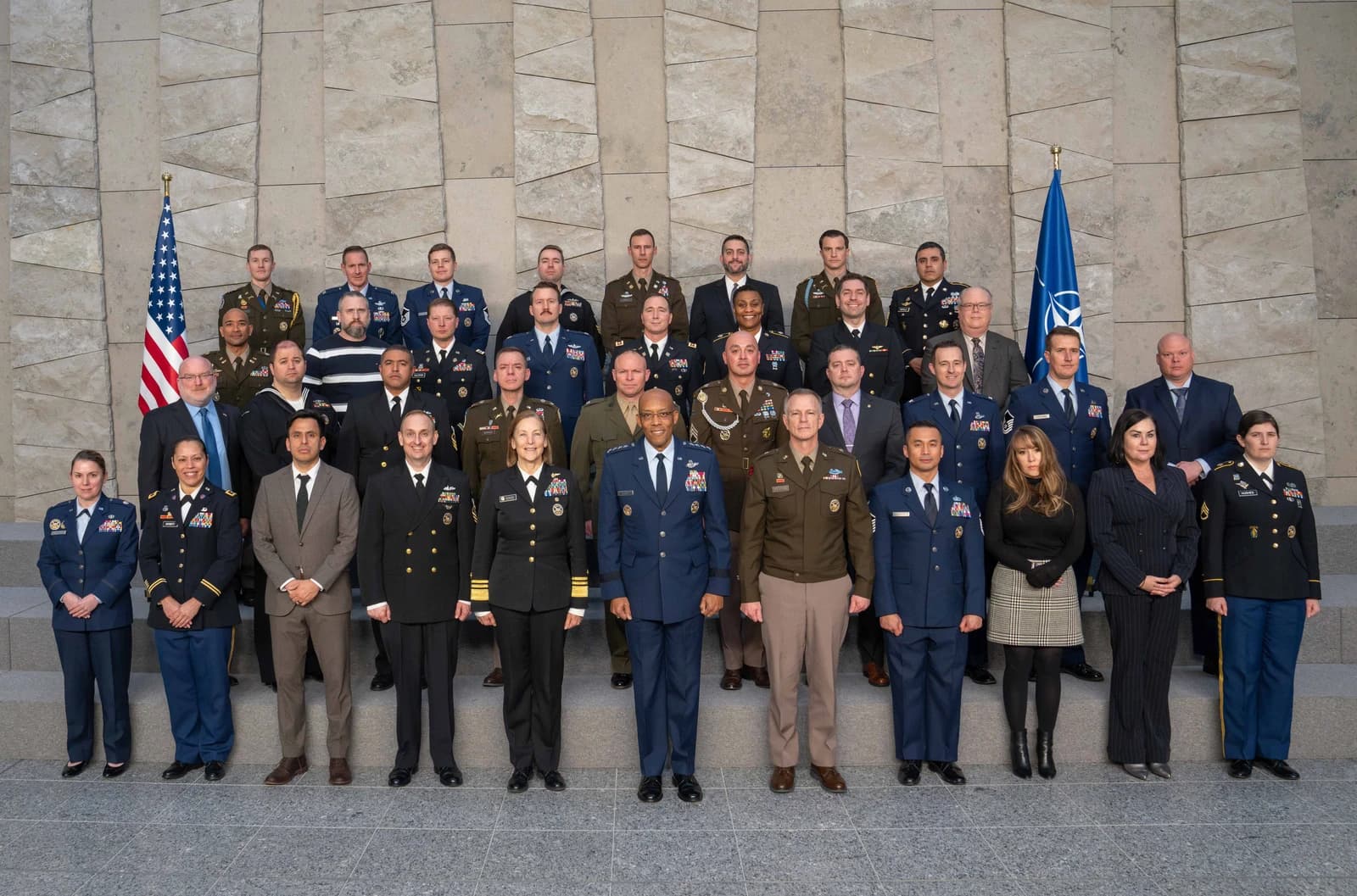
General CQ Brown Jr., Vice Admiral Shoshana Chatfield, and other military representatives at NATO Headquarters.
Russia’s rapid adaptation in drone warfare is showing up in U.S. defense stocks, as investors reassess which contractors stand to benefit from a prolonged contest of low-cost drones, counter-drone systems and electronic warfare. The broader market is treating the Russia-Ukraine battlefield less as a one-off conflict and more as a live test case for the next phase of military technology spending.
Eric Schmidt’s warning that Russia has largely neutralized Ukraine’s early drone advantage has amplified that view. He cited Russian strike drones increasingly fitted with jet engines, mesh networking built with Chinese components, a growing satellite layer and the use of Chinese AI models for military purposes, with forecasts of as many as 80,000 jet-powered Geran drones this year.
Sentiment IndicatorsⓘProprietary · adalytica.com · October 12, 2026
This is a snapshot — live sentiment, awareness and momentum for 130+ markets update continuously in the dashboard.Open AlphaPulse→
General CQ Brown Jr., Chairman of the Joint Chiefs of Staff, meets with Baltic military representatives.
That matters economically because it points to a durable rearmament cycle rather than a short-lived surge in munitions demand. The conflict is pushing NATO states and U.S. planners toward higher budgets for attritable drones, air defense, sensors and battlefield software, while also showing how quickly foreign components and software can be folded into weapons production.
The stock reaction underscores the split. Kratos Defense & Security Solutions, which has been one of the market’s drone proxies, fell to $42.36 on Oct. 9 from $63.40 in June and $118.06 in late January. Its 50-day moving average at $50.69 now sits above the stock, while RSI readings near 25.9 point to heavy technical stress.
Explore this data interactively — full history, time series and cross-market comparisons.Open AlphaPulse→
General CQ Brown, Jr. and General Carsten Breuer pose at NATO Headquarters.
Lockheed Martin, meanwhile, has held up better as investors lean on its missile defense and broader aerospace footprint. The stock traded at $509.59 on Oct. 9, above Kratos but still below its 50-day moving average of $547.50, after a volatile run that took it above $668 in March. Northrop Grumman has also been punished, closing at $480.72 versus a 50-day moving average of $530.83 and a 200-day average of $591.78.
The narrative is bigger than any one company. Reuters-style battlefield reporting and U.S. filing disclosures both point to a defense sector being pulled toward the same themes: counter-drone defenses, interceptors, autonomous systems, secure communications and space-based tracking. Northrop and Lockheed are exposed to those priorities through air defense, satellites and command-and-control programs, while Kratos is tied more directly to the lower-cost drone and target business that the war has made strategically central.
Adalytica’s Global Stability Sentiment snapshot shows “Extreme Greed” at 100, reflecting how quickly markets have priced in a world of persistent instability and elevated defense demand. For investors, the key question is not whether the war ends, but whether the technological lessons from Ukraine accelerate procurement cycles across the U.S., Europe and allies.
The next catalyst is further defense budget commentary, contract awards and any sign that battlefield drone tactics are forcing more spending into interceptors, electronic warfare and autonomous platforms rather than traditional platforms alone.