Russia’s expanding drone fleet is becoming a bigger problem for European security, not just Ukraine’s battlefield, as the mix of cheap kamikaze drones, faster jet-powered models and fiber-optic FPV systems could stretch air defenses far beyond the war zone.
Russia drone fleet raises Europe defense spending
That is the core warning from Euronews, which said Russian production of strike drones is still climbing and that the Kremlin’s arsenal is no longer built around one model. Instead, it is assembling a layered family of systems, from the low-cost Geran-2 — Russia’s version of the Iranian Shahed-136 — to newer Geran-3, Geran-4 and Geran-5 variants that can reportedly fly faster and carry larger warheads.
For investors, the significance is straightforward: Europe’s defense spending cycle is likely to stay elevated for longer. If Russia can keep mass-producing drones that are cheap enough to be used in waves, then the value of air defense, radar, interceptors, electronic warfare and battlefield surveillance only rises. That is supportive for defense contractors with exposure to missiles, sensors and counter-drone systems, including Lockheed Martin, RTX and Northrop Grumman.
The numbers help explain why. The classic Geran-2 can reportedly travel up to 2,500 kilometers, carry up to 50 kilograms of explosives and fly about 185 kilometers an hour. Newer Geran variants are said to reach 370 to 600 kilometers an hour, with some versions approaching 1,000 kilometers of range and warheads as heavy as 90 kilograms. That is enough to keep pressure on Ukrainian air defenses and raise concerns that Russia could extend the same playbook against other European targets if it ever chose to do so.
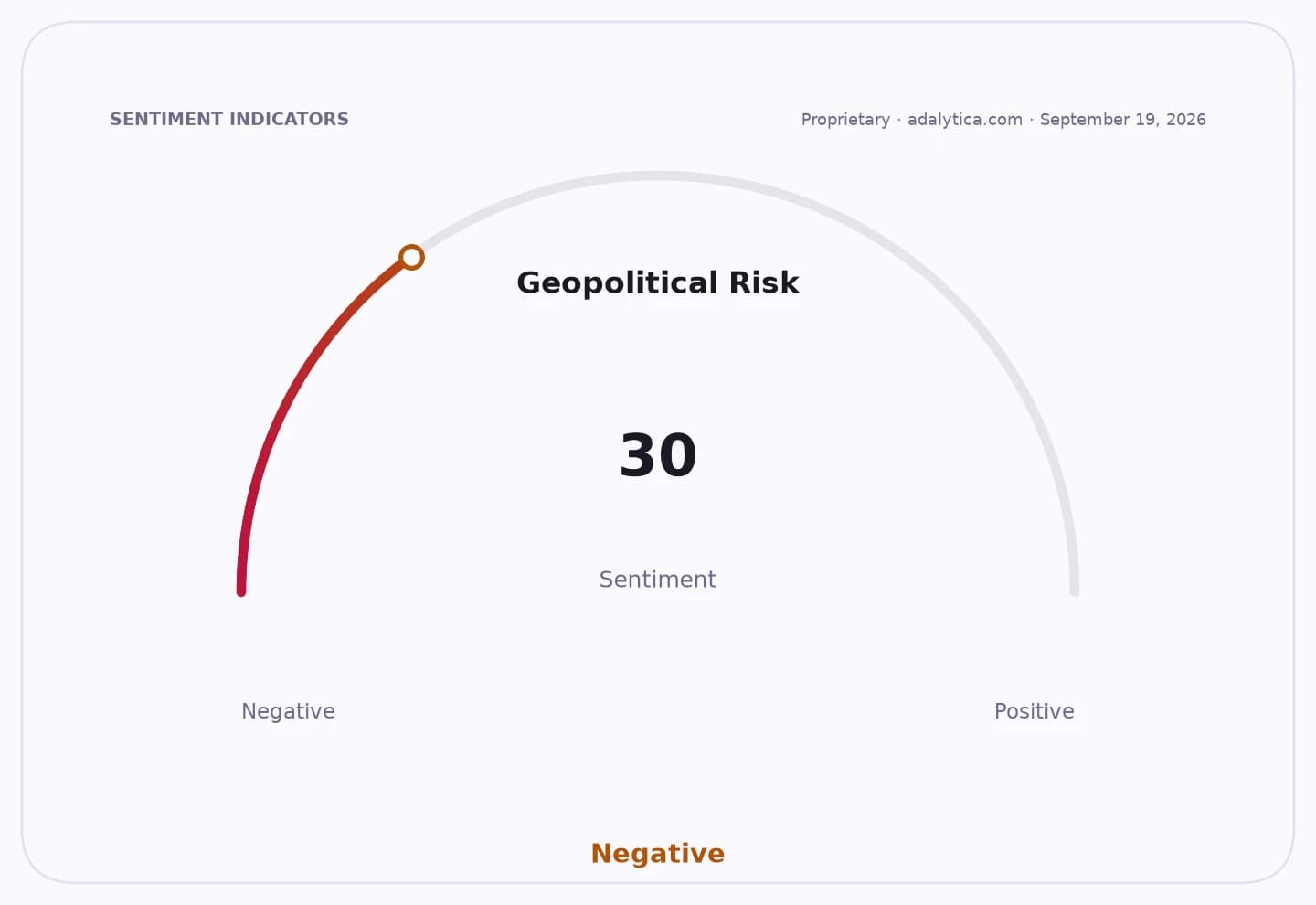
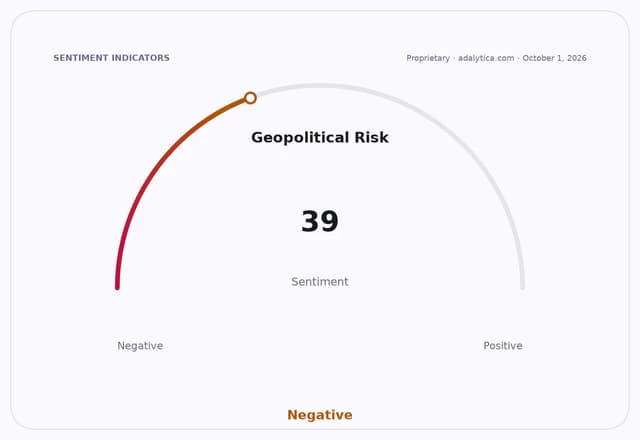
Geopolitical Risk — 30-day sentimentadalytica.com
Explore this data interactively — full history, time series and cross-market comparisons.Open AlphaPulse
The article also points to cheaper decoy drones such as the Gerbera, which were originally built to overload radars but are now reportedly being fitted with explosive warheads. At roughly $10,000 apiece, they are exactly the kind of low-cost weapon that can force defenders to spend far more than the attacker does — a classic economic asymmetry in modern warfare. The same logic applies to fiber-optic FPV drones, which are harder to jam because they do not rely on radio signals.
That is why the story matters well beyond headlines about drone strikes. Europe is being pushed toward a longer rearmament cycle, and the market is already reflecting that shift. RTX has slipped back toward $185 after earlier strength, while Northrop Grumman has fallen to about $482 from its recent highs, even as both remain positioned to benefit from sustained demand for missile defense and surveillance systems. Lockheed Martin, too, is trading below its 50-day and 200-day moving averages, a sign that the long-term investment case may be stronger than the short-term share price action suggests.
There is also a geopolitical wrinkle that could matter for NATO planners and defense buyers: Euronews said Russia could potentially use shadow-fleet vessels in the Mediterranean as launch platforms for drones. If that sounds far-fetched, it is still the kind of scenario that pushes European governments to spend more on maritime surveillance, base protection and integrated air defense.
For long-term investors, the key takeaway is not to chase the next headline, but to recognize the trend underneath it. Russia is adapting quickly, air defenses are being tested, and Europe’s response is likely to mean higher defense budgets for years. That makes the sector worth watching closely — and, for diversified investors, worth holding for the long term.
| Entity | Gains | Losses |
|---|---|---|
| European defense contractors | ▲Higher demand for air defenses | ▼Cost pressure from rearmament |
| Russia’s drone program | ▲Greater strike reach | ▼Higher sanctions risk |
| Ukraine and NATO defenses | ▲Incentive to modernize | ▼More strain on interceptors |
| Lockheed Martin, RTX, Northrop Grumman | ▲Long-term order growth | ▼Near-term share volatility |