A Kansas court’s 18-month prison sentence for U.S. citizen Kirill Buyanovsky underscores how aggressively Washington is enforcing aviation export controls tied to Russia, a compliance crackdown that raises legal and operational risk for aerospace suppliers, brokers and intermediaries moving parts through global trade channels.
Russia export controls raise aerospace compliance risk

Buyanovsky was sentenced on Sept. 16 after admitting he helped export aviation equipment to Russia without the licenses required by the U.S. Commerce Department, according to the court minutes. He was also fined $1,000, a relatively modest penalty compared with the prison term, but one that reflects the criminal exposure individuals can face when transactions breach sanctions and export-control rules.

The case lands in a sector already shaped by sanctions and counter-sanctions. U.S. aerospace companies including Boeing, RTX and Honeywell all flag export controls and trade restrictions as material risks in recent filings, and Russia remains one of the most tightly restricted destinations for aviation-related technology since the invasion of Ukraine. That makes enforcement actions like this more than a standalone criminal case: they reinforce the cost of noncompliance across a supply chain where parts can move through brokers, resellers and third countries before reaching end users.
For investors, the immediate impact is not on the shares of the major contractors, which are driven primarily by commercial aircraft demand, defense spending and production rates. But the case matters because it raises the probability of tougher diligence, more documentation and slower cross-border transactions in sensitive categories. That can increase overhead for compliant exporters while cutting off gray-market channels that may have siphoned demand from authorized distributors.
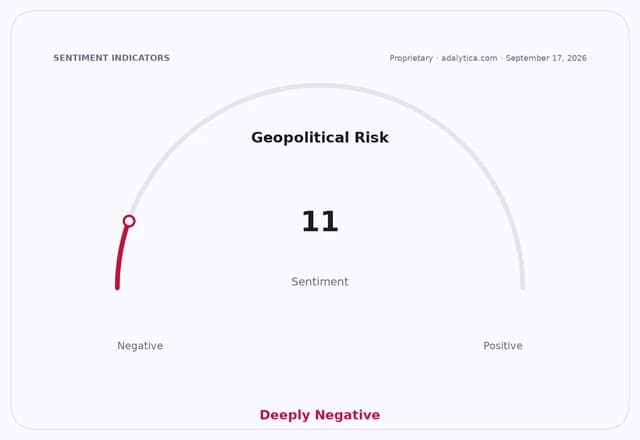
Geopolitical Risk — 30-day sentimentadalytica.com
Explore this data interactively — full history, time series and cross-market comparisons.Open AlphaPulse
It also highlights a broader geopolitical reality: even as some jurisdictions ease export procedures for small shipments, the U.S. is moving in the opposite direction on Russia-related controls. That divergence is helping create a two-speed trade environment, where companies with tight compliance systems may gain share and reputational protection, while smaller operators and intermediaries face greater legal peril.
The near-term question for investors is whether enforcement remains targeted at individuals or expands into wider corporate probes. Either way, the message to aerospace and industrial suppliers is clear: Russia exposure now carries not just revenue risk, but criminal and regulatory risk that can reverberate through contracts, dealer networks and boardroom oversight.
| Entity | Gains | Losses |
|---|---|---|
| U.S. regulators | ▲Stronger deterrence | ▼More enforcement burden |
| Compliant aerospace firms | ▲Cleaner channels | ▼Higher compliance costs |
| Gray-market exporters | ▲None | ▼Criminal exposure |
| Russia-linked buyers | ▲None | ▼Reduced access to parts |