Russia’s housing market is sliding into a dangerous imbalance: home sales have sunk to their weakest level on record, yet developers are still launching new projects at a pace that could leave the country with 832,000 unsold new apartments by early 2027. That gap matters because it points to a long, messy adjustment in prices, financing and construction employment rather than a quick market crash.
Russia housing sales hit record lows, inventory rises
The headline numbers are stark. New-home sales in 2026 are on track to be the lowest since data began in 2014, with just 21.5 million square meters expected to change hands by year-end after 16.7 million square meters sold in the first nine months, according to the briefing. At the same time, unsold inventory could nearly double from 474,000 apartments at the start of the year to 832,000 by early 2027.
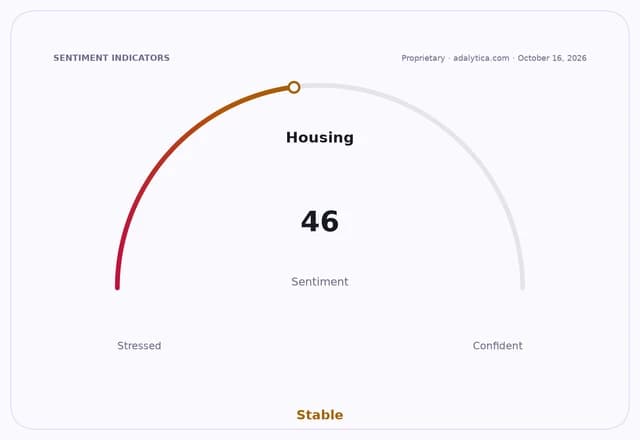
Sentiment IndicatorsⓘProprietary · adalytica.com · October 16, 2026
This is a snapshot — live sentiment, awareness and momentum for 130+ markets update continuously in the dashboard.Open AlphaPulse
For investors and policymakers, that combination is the real story. It says demand has been broken by high borrowing costs and the end of the broad housing subsidy regime, but supply is not adjusting fast enough. That can freeze cash in completed and near-completed homes, strain bank-funded project financing and force developers to lean on discounts, installment plans and subsidized mortgages instead of cutting sticker prices outright.
And yet developers are still building. In September, new project launches totaled 3.8 million square meters, only 5% below a year earlier and 40% above August, while launches in the first nine months were still 5% higher than last year. That persistence is not irrational. Real estate is a long-cycle business, and companies that stop building risk losing land, crews, permits and bank support — often at a higher cost than simply keeping the conveyor belt moving.
That is why this market is likely heading for a prolonged period of stagnation rather than an immediate collapse. The cost of construction has risen 17% year on year, which helps explain why outright price cuts are limited. Banks also have an incentive to renegotiate rather than seize projects, because a wave of distressed takeovers would only deepen the problem. In practice, that means more hidden price competition, not a dramatic markdown in list prices.
The regional picture is already diverging. The weakest coverage of escrow balances against bank loans is in Krasnodar, where buyer deposits cover only 34% of developers’ borrowing, and in Tyumen at 45%. Those are the kinds of markets where local price pressure, project delays or selective freezes are most likely to show up first.
Longer term, there is still a path to recovery if rates fall. The market is being pinned down by a 14% policy rate today, with the central bank forecasting 10% to 11% only in the second half of 2027. Until then, developers are essentially betting that the pain of building now will be rewarded later, when cheaper credit revives demand and absorbed inventory tightens supply again.
For investors, that leaves a clear takeaway: the Russian housing downturn is less a one-off shock than a drawn-out test of balance sheets, pricing power and patience. Stronger developers with access to bank funding and better land banks may come out of it with more market share, while weaker regional players face the greatest risk. For now, the story is not about a housing boom — it is about who can survive long enough to benefit when the cycle turns.
| Entity | Gains | Losses |
|---|---|---|
| Developers with strong balance sheets | ▲More share when weaker rivals stumble | ▼Lower near-term margins |
| Banks | ▲Chance to restructure loans | ▼Rising credit risk |
| Homebuyers | ▲More discounts and incentives | ▼No big price collapse |
| Regional developers in weak markets | ▲— | ▼Inventory, liquidity and default pressure |