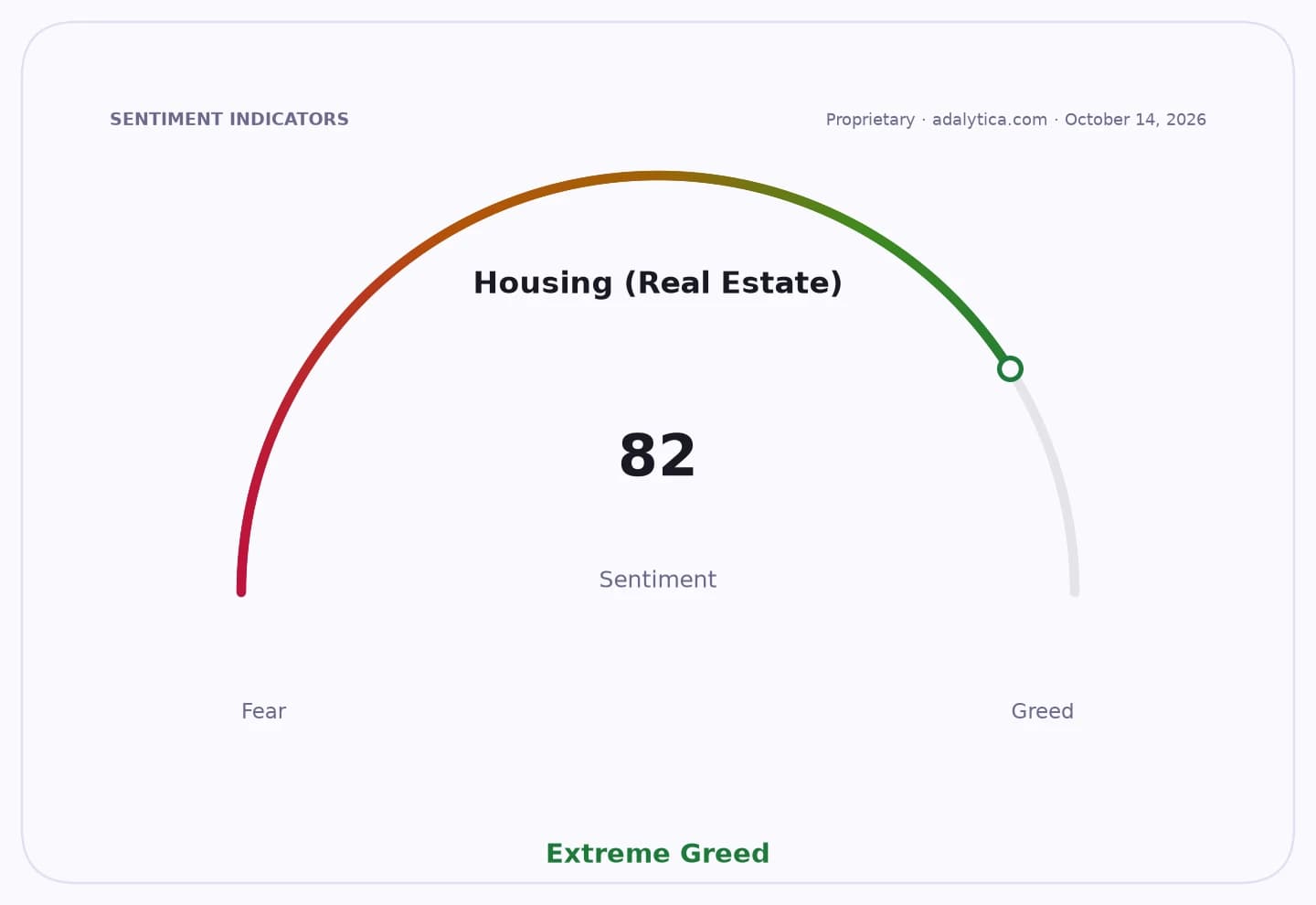
High interest rates are now doing what central banks intended: cooling demand hard enough to push housing prices lower across every major segment, and that matters because real estate is one of the clearest transmission channels from monetary policy to the broader economy.
Vietnam property prices fall across major segments
In Vietnam, Dat Xanh Services’ DXS-FERI said selling prices for apartments, low-rise homes and land plots all declined in the third quarter of 2026, with typical drops of 5% to 20% from the prior quarter. That kind of broad-based correction is not just a housing story. It is a signal that financing costs are finally overpowering the willingness of buyers to chase prices higher, while developers face a less forgiving environment for launches, inventory turnover and margins.
Sentiment IndicatorsⓘProprietary · adalytica.com · October 16, 2026
This is a snapshot — live sentiment, awareness and momentum for 130+ markets update continuously in the dashboard.Open AlphaPulse
The report shows the pressure is most acute in the apartment market, where prices fell across the country. Northern apartment prices slid 15% to 20%, while the central region lost 10% to 15% and the south and Mekong Delta fell 5% to 10%. Low-rise homes in planned urban projects saw similar weakness, especially in the north, where prices fell 15% to 20%. Land plots, once a speculative favorite, also retreated 10% to 20% depending on the region. Batdongsan’s data reinforced the trend: average asking prices nationwide fell from 101 million dong per square meter at the end of 2025 to 86 million dong in the third quarter, a decline of about 15% in nine months.
Economically, this is the market absorbing a sustained period of expensive money. DXS-FERI said high interest rates in the first nine months of 2026 raised funding costs for both developers and homebuyers, lengthening decision times and making leverage less attractive. For developers, that means tighter margins and slower project execution. For households and investors, it means less urgency, more price discipline and greater selectivity around location, legal status and financing plans.
The slowdown is showing up in activity as well as pricing. New supply and sales campaigns eased in the third quarter, with many developers choosing to push existing inventory rather than launch aggressively. Instead of big, attention-grabbing sales events, firms are relying more on broker incentives, contests and longer-term marketing. That shift suggests the sector is moving from speculative momentum to a more grind-it-out phase of absorption.
For investors, the message is that the easy money in Vietnam real estate is gone for now, but the correction is creating a sharper distinction between winners and losers. Projects with strong locations, clean legal structures and reputable sponsors should hold up better, while weaker assets and highly leveraged owners face the most pressure. On the secondary market, the biggest discounts are likely to show up where borrowing costs are highest or rental cash flow is weak.
That sets up an asymmetric opportunity, not for broad exposure to property, but for selective positioning. In public markets, housing-linked names and real estate funds such as VNQ and IYR have already started to reflect the shift, while homebuilder exposure through ITB has been far more volatile. The better trade is to favor balance-sheet strength and assets tied to long-duration demand, not momentum-driven land speculation.
The key catalyst from here is whether interest rates stay elevated into year-end. If they do, pricing discipline will deepen and distressed sellers will have less room to wait. If rates ease, the best assets may stabilize first, while the weakest inventory remains under pressure. Either way, the market is entering a selection phase, and that is where the real opportunity usually begins.
| Entity | Gains | Losses |
|---|---|---|
| Buyers with cash | ▲More negotiating power | ▼Less urgency to buy |
| Highly leveraged owners | ▲N/A | ▼Larger price cuts |
| Quality developers | ▲Better relative pricing power | ▼Slower sales cycles |
| Broad real estate exposure | ▲Selective opportunities | ▼Weak sector sentiment |