Russia’s path back to 4% inflation has been pushed out to 2029, underscoring how persistent price pressure is forcing the central bank and analysts to keep interest rates high for longer and leaving households and companies facing tighter financial conditions.
Russia inflation target pushed to 2029
A new consensus survey of 32 leading economists by the Bank of Russia showed the median forecast for year-end inflation in 2026 rising to 7.1% from 6.6%, while the 2027 outlook was lifted to 5% from 4.6% and the 2028 estimate to 4.2% from 4%. That puts the central bank’s 4% target one year later than the government and monetary authorities still project, and reflects a broader view that inflation will cool only gradually as demand remains supported by fiscal spending and credit while supply stays constrained.
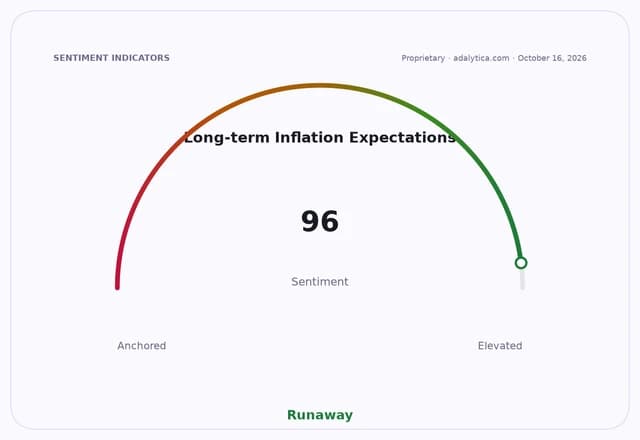
Sentiment IndicatorsⓘProprietary · adalytica.com · October 16, 2026
This is a snapshot — live sentiment, awareness and momentum for 130+ markets update continuously in the dashboard.Open AlphaPulse
The revision matters because it implies a longer period of restrictive policy at a time when growth is already uneven. The same survey nudged the expected average key rate up to 14.6% in 2026, 12.8% in 2027, 10.8% in 2028 and 9.2% in 2029. For borrowers, that means expensive credit for longer. For the economy, it means investment and consumption are likely to remain subdued even as headline growth improves marginally.
The Bank of Russia’s own October commentary points to the same tension. Its “What the Trends Say” bulletin said seasonally adjusted monthly price growth slowed in September to the equivalent of 6.5% from 7.5% in August, but underlying inflation is still running at about 5% to 6%, well above target. Regulators said demand is being supported by budget spending and a positive credit impulse, while temporary outages in production and logistics are constraining supply. In other words, the disinflation process is not being led by weak demand alone, which makes it harder to get inflation sustainably back to target.

There are signs that price momentum may be easing at the margin. The central bank’s business survey showed companies have become slightly less aggressive in their near-term price plans, with expected wholesale price increases for October to December slipping to 6.4% from 6.6% on a seasonally adjusted annualized basis. Input-cost growth has also slowed for a third straight month, according to the Telegram channel “Hard Numbers,” though that does not automatically translate into lower consumer inflation.
For markets, the message is that rate cuts are likely to come later and in smaller steps than previously hoped. Analysts at Gazprombank’s Yevgeny Susin linked the consensus upgrade in inflation to October’s jump in housing and utilities tariffs, while PSB’s Denis Popov said the numbers now imply a pause in policy easing through year-end. A longer period of elevated rates typically supports the currency and short-duration assets, but it also weighs on banks’ loan growth, corporate leverage and the pace of private investment.
The growth picture is improving only modestly. Economists raised their 2026 GDP forecast to 0.6% from 0.5%, but that is still a weak expansion for an economy that has been forced to run hot by wartime spending and sanctions-related distortions. The Bank of Russia said third-quarter output slowed after a strong second quarter, with basic industries up just 0.2% from the prior quarter, while capacity utilization fell to 76.3% from 77.3%. Companies continue to cite a lack of internal funds, uncertainty and weak demand as the main obstacles to investment.
That leaves policymakers with an uncomfortable trade-off. Cutting rates too soon risks prolonging inflation above target; holding them high for too long risks locking in weak investment and uneven growth. For investors, the key implication is that Russia’s inflation target is no longer a near-term policy anchor but a later-cycle goal, and that the market will have to price in a protracted period of tight real financial conditions before disinflation is complete.
| Entity | Gains | Losses |
|---|---|---|
| Central bank hawks | ▲Higher policy credibility | ▼Slower growth |
| Savers / ruble holders | ▲Higher real returns | ▼ |
| Borrowers / corporates | ▲ | ▼Higher funding costs |
| Government / fiscal spenders | ▲Easier demand support | ▼Longer inflation problem |