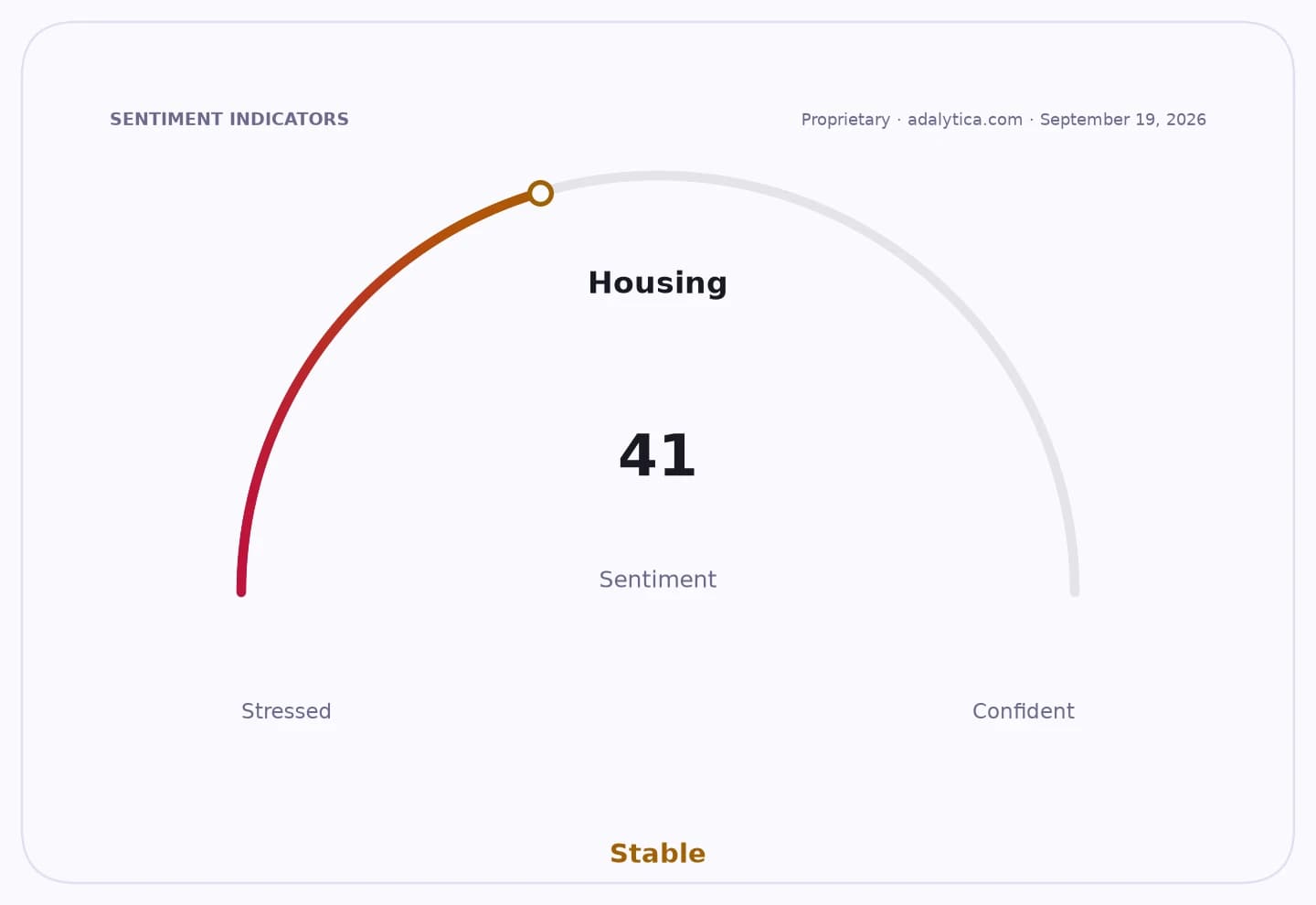
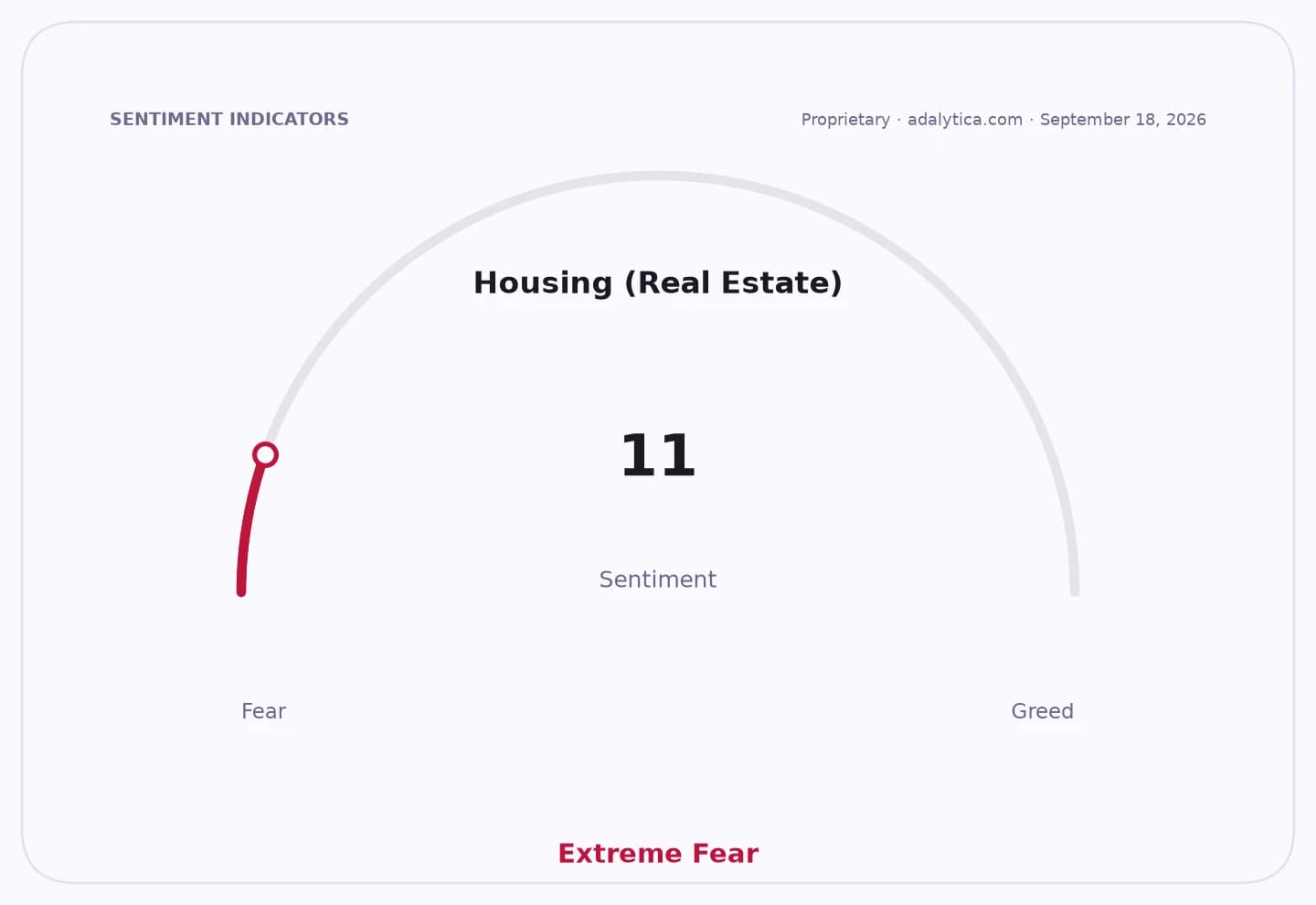
President Vladimir Putin’s support for lower mortgage rates for large families is a clear sign the Kremlin wants to keep Russia’s housing market moving even as borrowing costs stay elevated and construction weakens.
Russia Lowers Mortgage Rates for Large Families

For investors, the key point is not the narrow family policy itself, but what it says about the wider Russian economy: housing is under strain, mortgage affordability is a problem, and policymakers are prepared to subsidize demand rather than wait for market rates to do the work. That matters because housing is one of the fastest ways to transmit tighter financial conditions into the real economy.
Sentiment IndicatorsⓘProprietary · adalytica.com · September 6, 2026
This is a snapshot — live sentiment, awareness and momentum for 130+ markets update continuously in the dashboard.Open AlphaPulse
Russia’s 10-year government bond yield was around 4.8% in early September, while unemployment remains low at roughly 4.1%. That combination usually sounds supportive, but it can also mask stress in rate-sensitive sectors. Housing starts have been volatile and were forecast near 1.18 million in August after a recent slide, underscoring how quickly construction activity can cool when financing gets expensive.
The policy push also fits a broader pattern: instead of broad-based rate relief, Moscow is targeting help at specific household groups. Large families buying or building homes are politically attractive beneficiaries because the program can be framed as both social support and demographic policy. At the same time, the state can limit the budget hit compared with a wider mortgage subsidy.
That is where the investment lens gets interesting. In any economy, subsidized mortgage demand can help builders, lenders and housing-related suppliers stabilize cash flow, but it also risks delaying a normal market clearing of prices and credit demand. If the Kremlin keeps layering targeted support on top of a still-costly credit environment, the housing market may become more dependent on policy than on private-sector affordability.
The move arrives as Russia’s financial system continues to operate under sanctions, tighter domestic funding conditions and pressure to support growth without reigniting inflation. For long-term investors, the bigger lesson is that housing policy is becoming a tool of macro management, not just social welfare. That makes the sector worth watching, but it also argues for patience and selectivity rather than chasing a quick rebound.
| Entity | Gains | Losses |
|---|---|---|
| Large families | ▲Lower monthly payments | ▼Less price bargaining power |
| Russian builders | ▲Better demand support | ▼Continued policy dependence |
| Banks and mortgage lenders | ▲More loan volume | ▼Margins under subsidy pressure |
| Government | ▲Social and demographic optics | ▼Higher fiscal costs |