Russia’s business lobby is asking the government to take a slower, more gradual approach to widening the personal income tax base to include passive income, a move that would expand the state’s tax take while trying to avoid a sharper hit to households and capital owners.
Russia business lobby seeks slower passive income tax rollout
The proposal from the Russian Union of Industrialists and Entrepreneurs, led by Alexander Shokhin, comes as Moscow weighs a broader set of tax changes that could lift revenue from companies, investors and high earners. For the budget, the push to tax more forms of income would help widen the fiscal base at a time when the government is looking for durable funding sources.
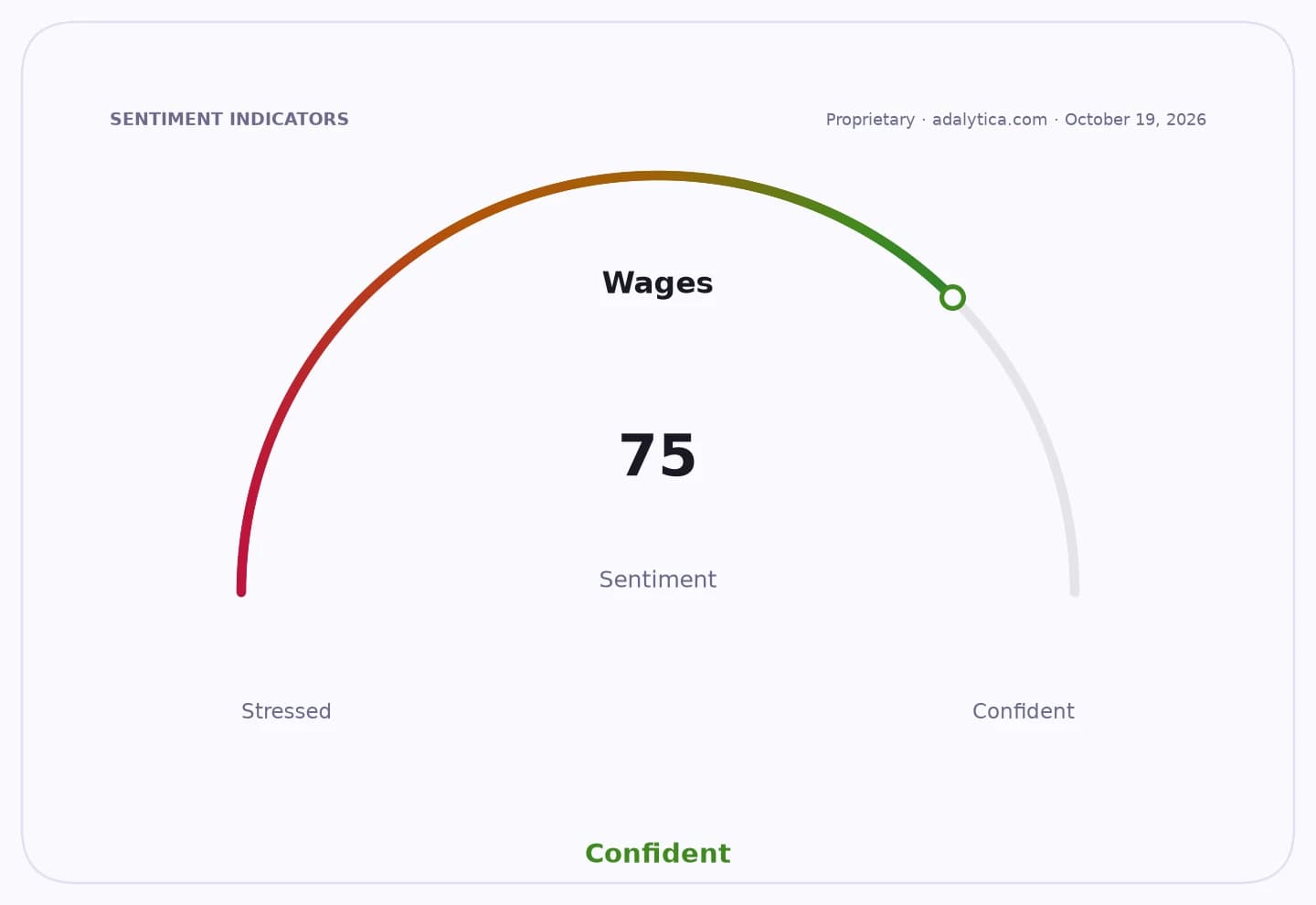
Sentiment IndicatorsⓘProprietary · adalytica.com · October 20, 2026
This is a snapshot — live sentiment, awareness and momentum for 130+ markets update continuously in the dashboard.Open AlphaPulse
For investors, the key issue is predictability. A phased approach would be less disruptive than an immediate change, but it still points to a tighter tax environment for savers, landlords and holders of financial assets, with potential knock-on effects for consumption, asset allocation and after-tax returns.
Shokhin also wants the authorities to revise the mechanism for taxing so-called excess business profits, index the income thresholds in the five-bracket personal income tax scale and postpone taxation of closed-end mutual funds. Taken together, the requests show business is not opposing tax reform outright, but is trying to reshape it to protect corporate cash flow and prevent bracket creep from biting into real incomes.
The backdrop is a still-tight Russian macro mix, with inflation running well above the central bank’s 4% target and the labor market near full employment, conditions that give the government room to lean more heavily on tax policy. That makes any change to the income tax system more than an accounting exercise: it is part of the state’s broader effort to secure revenue without destabilizing growth.
If adopted, the package would likely favor larger firms and wealthier households if implementation is delayed or thresholds are indexed, while leaving the finance ministry with a narrower immediate gain. The next focus is whether the Cabinet accepts the business lobby’s argument for gradualism or pushes ahead with a faster expansion of the tax base.
| Entity | Gains | Losses |
|---|---|---|
| Russian government | ▲Broader tax base | ▼Faster implementation risk |
| Business lobby / RSPP | ▲Softer transition | ▼Higher tax burden |
| Households with passive income | ▲Gradual rollout | ▼Lower after-tax returns |
| Closed-end mutual funds | ▲Delayed taxation | ▼Near-term uncertainty |