Saab is using its Gripen fighter jet as a live AI lab, arguing that the ability to train and test autonomous agents in real flight could give it a structural edge in next-generation air combat and future defense contracts.
Saab tests AI agents in Gripen fighter jet
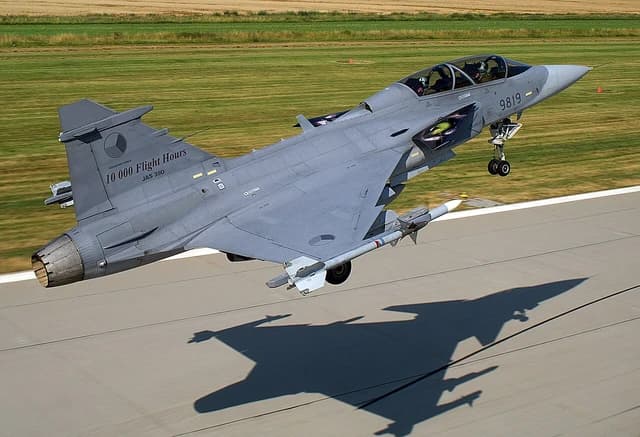
The Swedish defense group said its self-developed AI agents have already been tested in the Gripen E, where they independently controlled the aircraft in beyond-visual-range combat scenarios. Saab says the point is not just to fly with AI, but to compress the cycle between experience, learning and operational capability at a speed conventional pilot training cannot match.
Sentiment Indicators
That matters economically because defense buyers are increasingly rewarding systems that can improve faster in service, especially as air forces look for cheaper, more adaptable ways to extend the reach of manned jets with autonomous wingmen and unmanned aircraft. Saab’s pitch is that a software-driven platform such as Gripen can absorb these capabilities more quickly than more rigid legacy fleets.
Peter Nilsson, head of Advanced Programs at Saab’s Aeronautics division, said the company has built and flown its own agents, showing it can integrate AI into an operational fighter rather than only in simulation. He said the company’s “AI Fighter Jet Pilot Academy” is designed to create the infrastructure needed to “create, train and evaluate” the agents over time.
The scale of the data advantage is the core of Saab’s argument. Nilsson said an hour-long simulated exercise using Saab’s Sferical AI computing setup can generate data equivalent to a billion pilot hours, underscoring why access to high-performance computing is becoming a strategic asset in defense.
That also explains Saab’s push to keep more of the AI stack at home. The company is a founder of Sferical AI, a Swedish state-backed initiative based on Nvidia’s DGX Superpod architecture, which Saab says helps it train large language and multimodal models while maintaining control over sensitive data instead of outsourcing capacity to U.S. cloud giants.
For investors, the story is less about near-term revenue and more about whether Saab can turn AI work into a differentiation factor for Gripen against larger defense rivals such as Lockheed Martin and Northrop Grumman, which are also racing to win business around autonomous systems, missile defense and networked combat aircraft. The stock has been volatile, but the market is still likely to reward any evidence that Saab can convert software capability into future program wins and margin support.
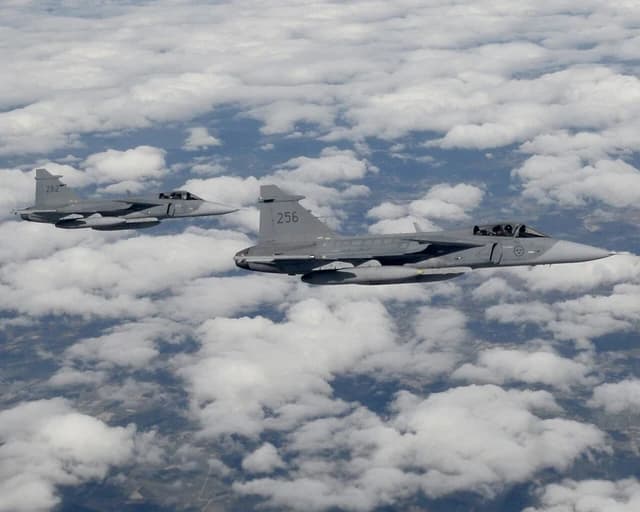
The longer-term implication is that Saab is trying to make Gripen not just a fighter jet, but a platform for continuous AI development, including the three uncrewed aircraft it is building as a step toward a loyal-wingman drone. The next catalyst will be whether Saab can show that its AI agents move from experimental flights into deployable military capability.
| Entity | Gains | Losses |
|---|---|---|
| Saab | ▲AI differentiation | ▼Development costs |
| Gripen program | ▲Faster capability upgrades | ▼Legacy-only competitors |
| Swedish defense ecosystem | ▲Local compute control | ▼Reliance on foreign cloud providers |
| Lockheed Martin, Northrop Grumman | ▲Sector momentum | ▼Relative pressure on innovation narrative |