Senegal’s amended 2026 finance bill shows a government budget under severe strain, with debt service, weaker growth and softer revenue expectations forcing a sharper fiscal reality than the original plan admitted.
Senegal 2026 Budget Shows Higher Debt Service

That matters because the numbers point to a state that is increasingly using its budget just to keep up with obligations already on the books. Barclays is now estimating debt service at 6,800 billion CFA francs for the year, above the 5,801.38 billion CFA francs in the rectifying budget bill, while the deficit is seen at 9.2% of gross domestic product versus the government’s 7.6% target. In practical terms, Senegal is being asked to finance a much larger share of its resources simply to roll over debt and pay coming due liabilities, leaving less room for growth-friendly spending.
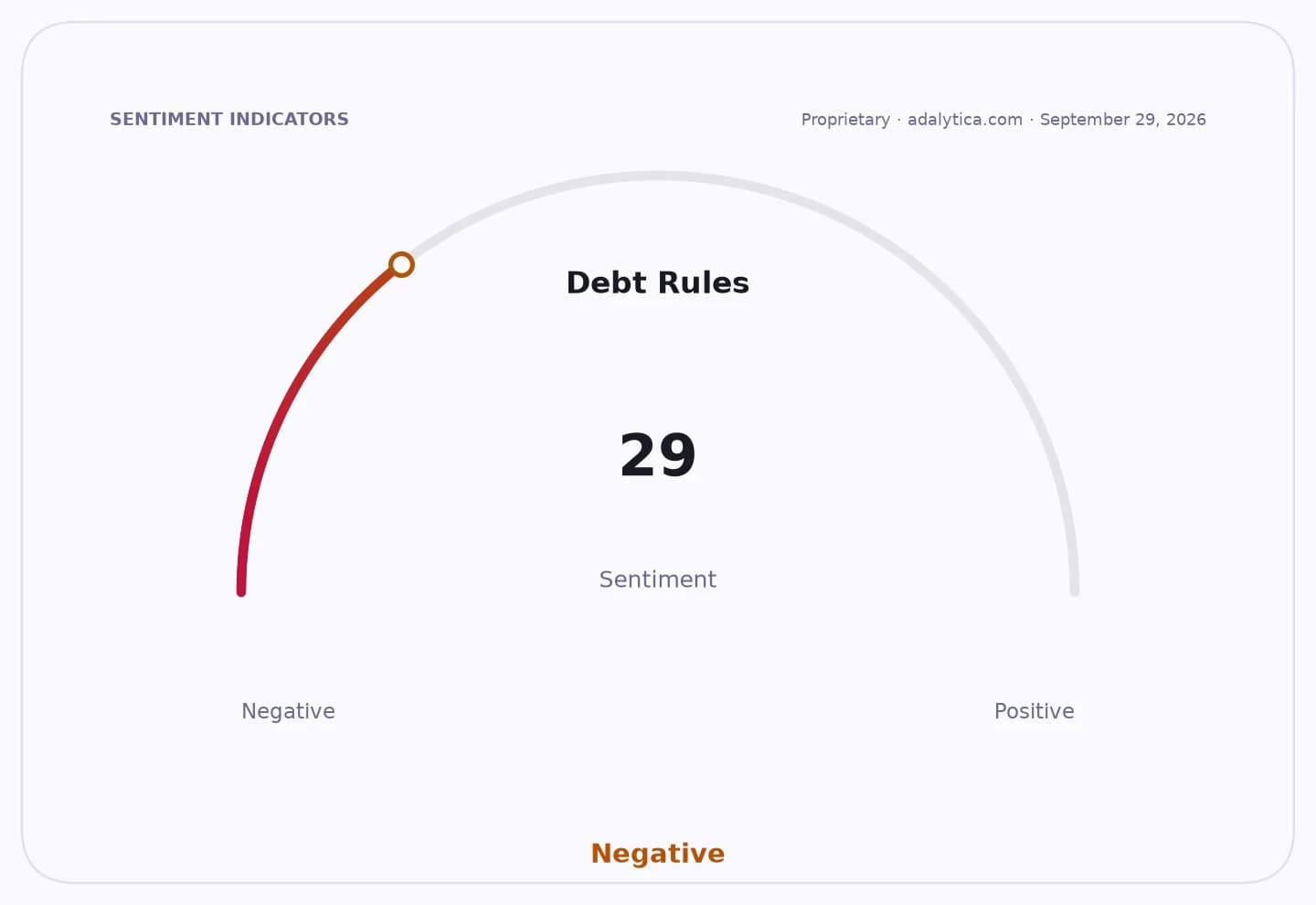
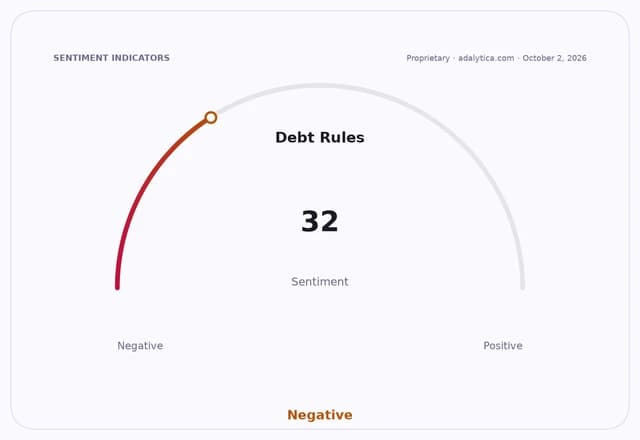
Sentiment IndicatorsⓘProprietary · adalytica.com · October 2, 2026
This is a snapshot — live sentiment, awareness and momentum for 130+ markets update continuously in the dashboard.Open AlphaPulse

The pressure is not only on the liability side. Of the state’s 5,801.38 billion CFA francs in debt service, 4,516.21 billion is principal repayment and 1,285.17 billion is interest and commissions. That is an important distinction: this is not just a higher borrowing bill, but a heavy wall of maturities that must be refinanced or repaid. Babacar Gaye, cited by L’Observateur, says principal repayment alone amounts to about 77% of annual budget revenues, a level that highlights how constrained the public finances have become.
For investors, the message is that Senegal’s fiscal flexibility is narrowing fast. The amended bill cuts expected growth to 2.7% from 5%, lifts the deficit to 1,735.2 billion CFA francs from 1,245.1 billion, and trims public investment by 555 billion CFA francs. That combination is rarely friendly to long-term credit quality: slower growth usually weakens tax collection, while reduced investment can make future growth even harder to generate. The government also now expects fiscal revenues to fall 8.4%, a much steeper drop than the 1.5% decline in nominal economic activity, suggesting the original revenue assumptions were too optimistic.
The financing side looks tougher too. Interest and commissions are said to be 94.6 billion CFA francs higher than in the original budget, reflecting more expensive market borrowing. That is the kind of dynamic that can quickly become self-reinforcing: higher rates raise debt costs, higher debt costs widen deficits, and wider deficits tend to keep financing conditions tight. In that environment, the market’s focus shifts from whether a government can borrow, to how much it must pay to keep borrowing.
A deal with the IMF could help Senegal regain some financing access and reassure other lenders, but it would not erase the underlying problem. As Gaye noted, any program would likely spread support over time and some of the money would be used to shore up foreign-exchange reserves rather than instantly relieve the coming wall of maturities. For investors, that means any external backstop would be a bridge, not a cure.
The broader narrative here is simple: Senegal is confronting a budget built on weaker growth, softer revenues and a much heavier debt burden than initially projected. If the amended bill is the more realistic map, then the path ahead likely requires tighter spending, better tax execution and outside financing support. For long-term investors, this is a situation worth watching closely, because fiscal stress can improve with policy discipline — but it can also linger if revenue credibility keeps falling short.
| Entity | Gains | Losses |
|---|---|---|
| Senegal government | ▲IMF support, financing access | ▼Fiscal room, credibility |
| Bondholders/lenders | ▲Higher yield potential | ▼Greater default risk |
| Public investment | ▲None | ▼Budget cuts |
| Taxpayers/citizens | ▲Possible reform payoff | ▼Lower spending, slower growth |