Senegal’s labor market deteriorated in the second quarter of 2026, with a rising broader unemployment rate, a falling employment rate and more than a third of young people outside work, education or training — a combination that points to weaker household incomes, slower job creation and mounting pressure on policymakers to absorb a rapidly growing labour force.
Senegal Labor Market Weakens in Q2 2026
The National Agency of Statistics and Demography said the broader unemployment rate edged up to 19.1% from 19.0% a year earlier, while the employment rate slipped to 41.4% from 41.7%. Under the International Labour Organization’s narrower definition, unemployment was 3.2%, underscoring how the headline labour picture depends heavily on which measure is used. For investors and lenders, the bigger issue is not the statistical nuance but the direction of travel: activity is easing, the labour market is not generating enough formal jobs, and the country’s youth are bearing the brunt.
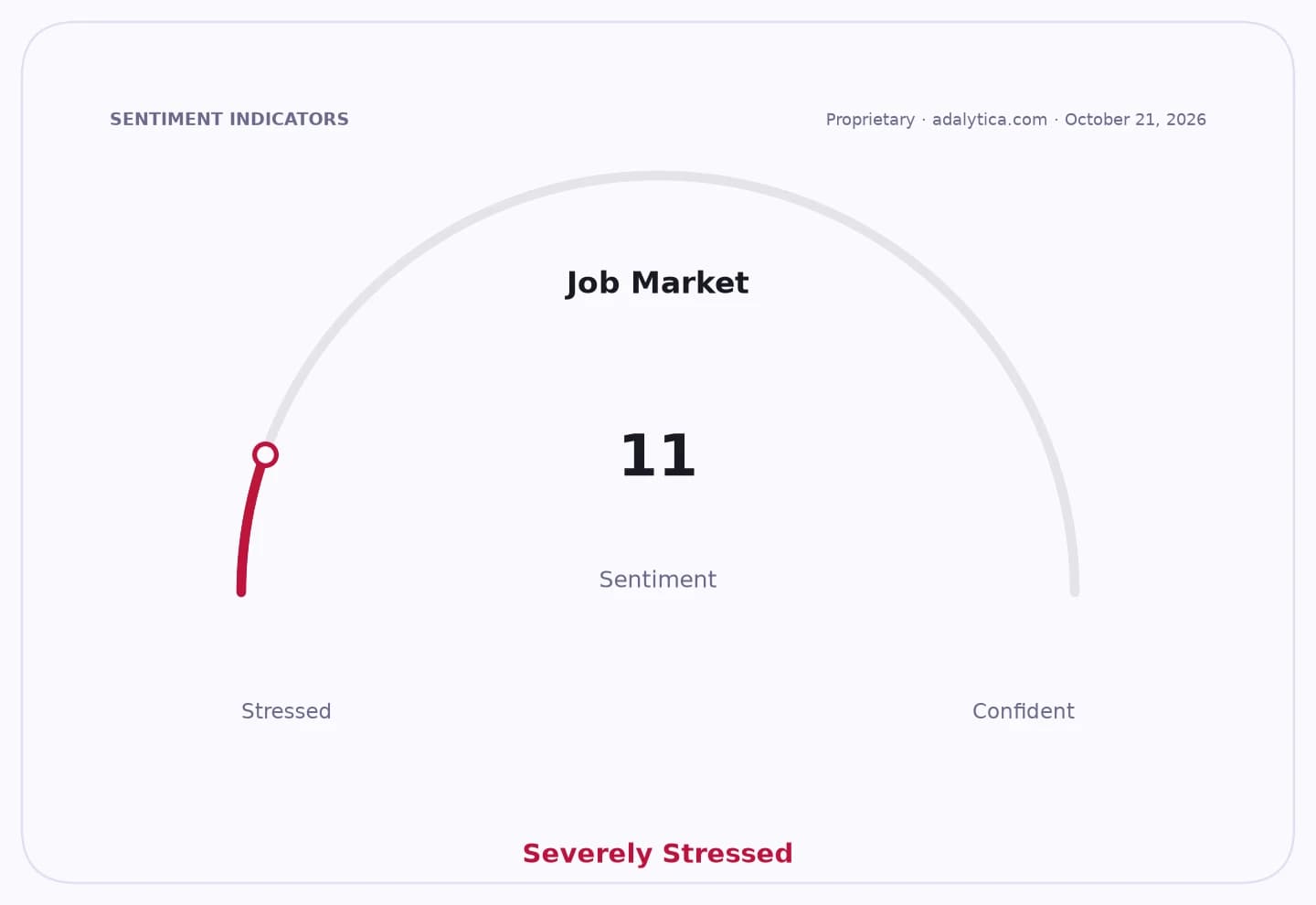
Sentiment IndicatorsⓘProprietary · adalytica.com · October 12, 2026
This is a snapshot — live sentiment, awareness and momentum for 130+ markets update continuously in the dashboard.Open AlphaPulse
The pressure is most acute among younger workers. Unemployment among those aged 15 to 24 stood at 23.5%, well above the 14.7% rate for adults, while 35.3% of young people were classified as NEET — neither in employment, education nor training — up from 32.8% a year earlier. That matters economically because NEET rates are often a leading indicator of lost productivity, lower lifetime earnings and greater social strain. In rural areas, where formal job opportunities are thinner, the unemployment rate reached 29.2%, more than double the 12.6% recorded in urban centres.
The data also point to a labour market still anchored in low-productivity work. Salaried jobs made up 41% of total employment, down from 42.6% a year earlier, while self-employment accounted for 60.8% of occupied workers. That structure limits payroll growth, tax collection and consumer purchasing power. With only 55.9% of the working-age population active in the labour market, and participation weaker among the young at 46.3%, Senegal is still struggling to convert demographic growth into broad-based formal employment.
For policymakers, the figures sharpen an already difficult balancing act. Senegal needs faster private-sector job creation, stronger vocational training and more investment in industries capable of absorbing young workers. For investors, persistent labour weakness raises questions about the durability of domestic demand, the credit quality of consumer-facing borrowers and the speed at which the economy can translate growth into social stability. The near-term risk is not a collapse in headline unemployment, but a continued drift toward underemployment and informality that keeps growth uneven and household spending fragile.
| Entity | Gains | Losses |
|---|---|---|
| Young job seekers | ▲Little immediate benefit | ▼Rising NEET and unemployment |
| Urban workers | ▲Better labour access | ▼Slower wage momentum |
| Rural households | ▲— | ▼Highest unemployment burden |
| Policymakers | ▲Pressure for reform | ▼Less room to avoid job-creation agenda |