Exterior of the National Statistics Institute building in Madrid, Spain.
Spain is still withholding the statistics needed to show how many permanent-discontinuous workers are effectively out of work, extending a data gap that makes the country's falling headline unemployment rate harder for economists and investors to read.
The delay matters because the labor market has become structurally harder to measure since the 2021 overhaul that pushed employers away from temporary contracts and toward permanent-discontinuous hiring. Those workers are not counted as unemployed when their contracts are inactive, even though they can be out of work for long stretches, leaving the official jobless figures looking stronger than the underlying flow of labor would suggest.
Sentiment IndicatorsⓘProprietary · adalytica.com · October 22, 2026
This is a snapshot — live sentiment, awareness and momentum for 130+ markets update continuously in the dashboard.Open AlphaPulse→
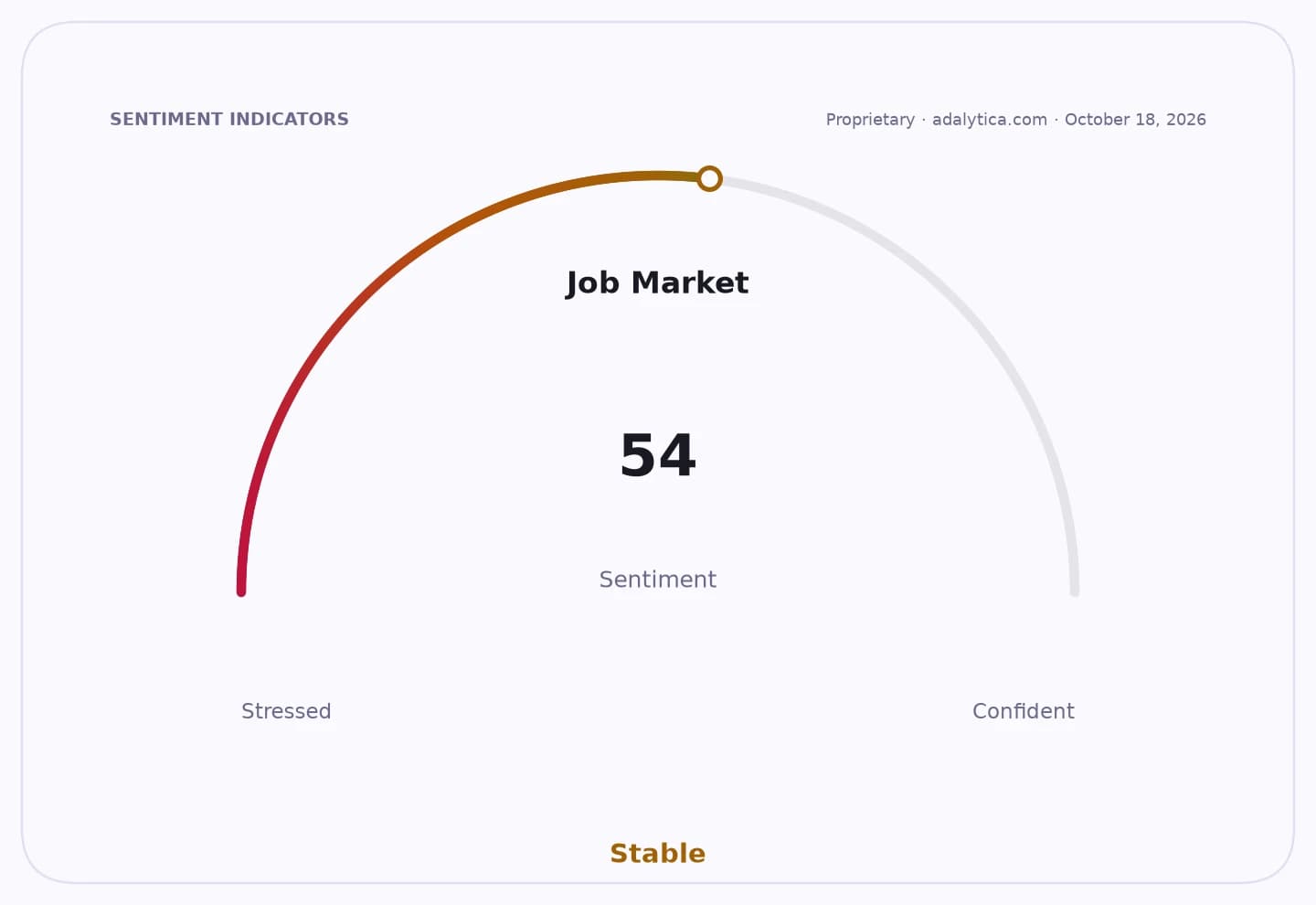
Job Market sentiment is severely stressed at a reading of 14.
Madrid had promised in 2023 to publish the number of inactive permanent-discontinuous employees, but the issue has stayed buried. The economy ministry has now delayed again the release of an INE statistic that has already slipped by more than a year, while the new annual statistics plan still lists the Erada series as "in project" and says publication depends on a technical working group.
For investors, the problem is not just statistical housekeeping. Labor data feeds expectations for consumption, wage growth and domestic demand in Spain, the euro zone's fourth-largest economy, and a cleaner read on slack could alter the market's view of how much room the labor market really has before unemployment stops falling.
Job Market awareness sits at 4, indicating 'Very Low' public attention.
The current official figures are fragmented. BBVA Research economist Miguel Cardoso said the only available number is 802,580 jobseekers with a labor relationship, a bucket that includes inactive permanent-discontinuous workers, people in ERTE and some social-work beneficiaries. Fedea researcher Florentino Felgueroso says the pool is likely closer to 800,000-900,000, while Randstad Research's Valentín Bote sees about 950,000 by end-2026.
Cardoso said the labor reform improved job stability less than the government suggests, pointing to persistent turnover and a 2.8% quarterly transition from employment to unemployment, more than double the 1.3% rate in the European Union. He also said Spain still faces a mismatch between vacancies and available workers, even as job openings sit at their highest since 2010.
The government continues to emphasize a drop in temporary employment, from 26% in 2019 to 15% now, but the unresolved data gap keeps investors, economists and opposition critics arguing over how much of Spain's labor-market improvement is real and how much is statistical.