Spain’s labor reform has generated millions of “discontinuous permanent” contracts, but the number of workers actually holding those posts has risen by just 408,000 since March 2022, underscoring how much of the apparent job creation reflects contract churn rather than a matching expansion in stable employment.
Spain labor reform adds contracts, not workers

That gap matters because Spain’s labor market has been one of Europe’s strongest on the surface, with employment at a record 22.78 million in the second quarter of 2026 and unemployment down to 9.9%. But Randstad Research says the real issue is job quality and sustainability: 10.4 million fixed-term discontinuous contracts were signed through August 2026, while only 408,000 more people were registered in that category with Social Security.
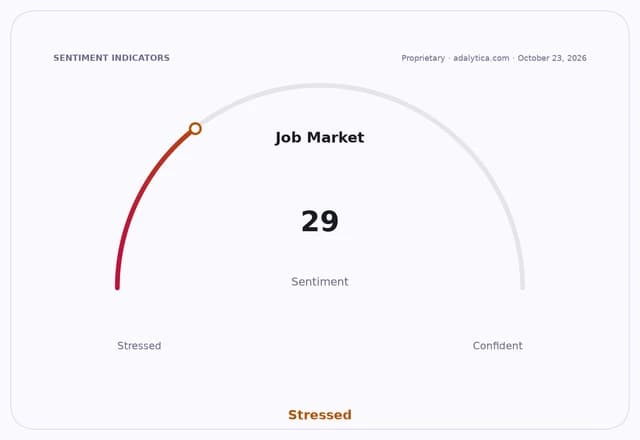
Sentiment IndicatorsⓘProprietary · adalytica.com · October 23, 2026
This is a snapshot — live sentiment, awareness and momentum for 130+ markets update continuously in the dashboard.Open AlphaPulse
For investors, the numbers help explain why Spain can post strong headline employment while still carrying structural weaknesses. The reform has pushed firms toward more permanent labels, but many of those contracts appear to be used in seasonal or part-time work, with 57.4% of permanent contracts signed in the first eight months of 2026 falling into those categories. That reduces headline flexibility for employers, but it also means earnings power for households may be less robust than the gross job figures suggest.
The labor-market mix also remains uneven. Unemployment fell by 213,000 in the quarter, but Spain still has the second-highest jobless rate in the European Union. Women remain more exposed to unemployment than men, and 35.8% of the jobless have been searching for more than a year, a sign that the recovery is not evenly translating into higher-quality, durable work.

Randstad’s read-through is that Spain’s reform has improved the appearance of stability more than the underlying composition of employment. That leaves policymakers and investors watching whether the next phase of labor-market gains comes from genuine productivity-led hiring, or from another round of contract reshuffling that flatters the data without fixing the fragility underneath.
| Entity | Gains | Losses |
|---|---|---|
| Spanish workers with stable contracts | ▲More permanent labels | ▼Limited rise in actual coverage |
| Employers | ▲Easier compliance optics | ▼Less labor flexibility |
| Spanish economy | ▲Lower headline unemployment | ▼Persistent job-quality weakness |
| Investors in Spain exposure | ▲Strong employment data | ▼Risk of softer household income growth |