Snowflake’s chief executive is arguing that AI regulation has to move beyond the frontier labs and into the software agents that companies are already deploying, a view that speaks to the next phase of the AI economy: operational use inside businesses, where compliance, liability and security risks will increasingly matter as much as model performance.
Snowflake CEO urges AI rules for enterprise agents

Sridhar Ramaswamy told ET at Snowflake’s Menlo Park headquarters that rules governing artificial intelligence “must reach every AI agent” businesses put to work, not just the companies building the largest models. The message is economically important because enterprise AI is no longer confined to experimentation. It is being embedded into data platforms, workflows and decision-making systems, which means the cost of failure shifts from theoretical model risk to real-world corporate exposure.
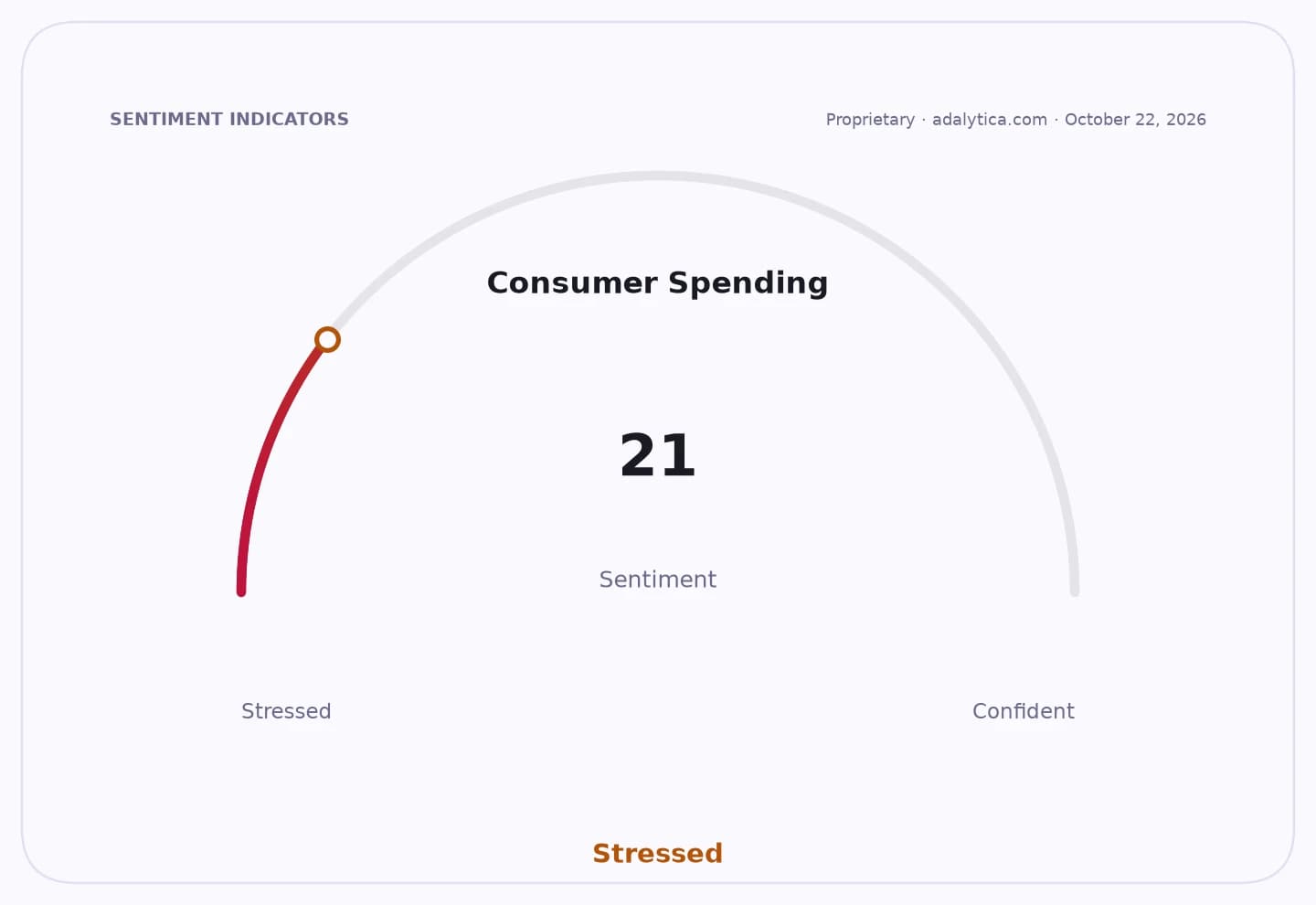
Sentiment IndicatorsⓘProprietary · adalytica.com · October 22, 2026
This is a snapshot — live sentiment, awareness and momentum for 130+ markets update continuously in the dashboard.Open AlphaPulse
That is why the debate over AI safety is turning from research labs to the companies that deploy the technology at scale. Snowflake competes with Databricks to help large customers store and analyze data and, increasingly, build AI agents on its platform. As those agents take on more tasks, regulators are likely to focus on basic governance requirements covering every model and every agent harness, rather than drawing a line only around the original developers.
For investors, that matters in two directions. On the one hand, clearer rules could favor large enterprise software vendors with the compliance infrastructure, security controls and auditability to help customers adopt AI safely. On the other, tighter oversight could raise costs, slow deployments and increase legal exposure across the sector. Snowflake’s own latest 10-Q warned that evolving AI regulation may impose “onerous obligations” and increase the risk of enforcement and litigation, underscoring that compliance is becoming part of the commercial model.
The comments also come against a market backdrop in which AI remains both a growth engine and a source of valuation fragility. Snowflake shares were trading at $313.96 on Oct. 22, well below a recent high of $368.89 earlier this month, after a sharp run-up this year. Microsoft closed at $521.08, while Nvidia finished at $212.21, both still central beneficiaries of enterprise and infrastructure spending tied to AI. The trade in these stocks increasingly depends not only on demand for AI capacity, but on how smoothly the industry can move from hype to governed deployment.
Ramaswamy also said he has “a whole lot of paranoia” about staying relevant, a reminder that even the companies trying to standardize AI risk being disrupted by the next wave of tooling. That helps explain the strategic logic behind his comments: if AI agents become the operating layer for enterprise software, the winners may be the platforms that can make them usable, auditable and regulator-ready.
The policy trajectory now matters as much as the product roadmap. Governments are moving toward AI safety frameworks, and the companies that can align with those rules early may gain trust and market share. Those that cannot may face higher compliance burdens, slower adoption and a more difficult path to monetizing AI at scale.
| Entity | Gains | Losses |
|---|---|---|
| Snowflake | ▲Enterprise trust, compliance-led sales | ▼Higher regulatory burden |
| Databricks and peers | ▲Demand for governed AI platforms | ▼Margin pressure from compliance costs |
| Regulators | ▲More oversight of AI use | ▼Slower rollout if rules tighten |
| AI adopters | ▲Safer deployment framework | ▼Higher implementation costs |