China has, for the first time, become more popular worldwide than America — and that matters because soft power is no longer just a diplomatic scoreboard, it is becoming a capital-allocation signal.
Soft Power Shift Favors Defense and Onshoring

The market should not dismiss this as a poll result. In a world already marked by extreme fear in global stability, the shift in perception underscores a deeper truth: investors are operating in a more fragmented geopolitical regime where the U.S. is increasingly seen as a source of volatility, while China is exploiting openings to build influence, trade links and strategic leverage. That changes the risk premium on everything from supply chains to defense spending, emerging-market flows and the valuation of multinationals exposed to Asia.
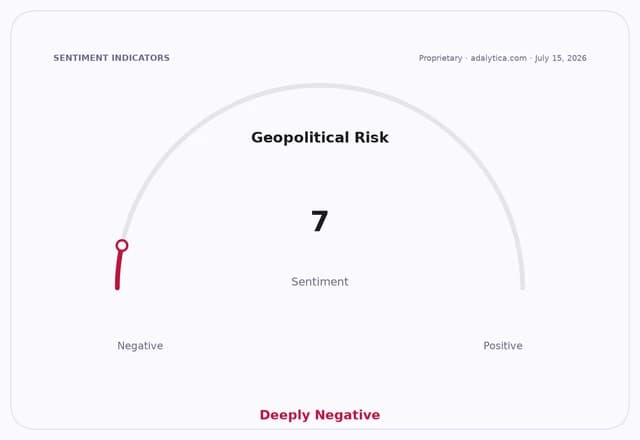
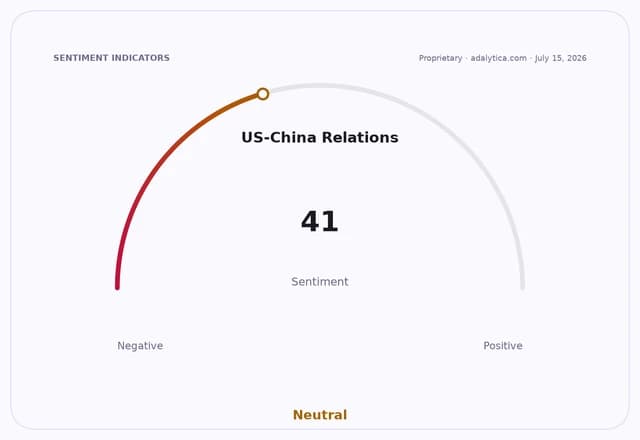
Adalytica’s Global Stability Sentiment gauge is flashing 7 out of 100, an “Extreme Fear” reading, with awareness at 89, or “Extreme Greed,” a combination that says the world is paying attention even as confidence collapses. The 30-day decline in that sentiment measure has been steep, while U.S.-China relations sentiment remains only neutral despite a recent improvement. In other words, investors and policymakers are watching the rivalry more closely than ever, but the underlying mood is still brittle.
That is the investment opportunity. When global trust shifts, the winners are rarely the loudest geopolitical names first. They are the toll roads: companies tied to re-shoring, semiconductor localization, grid and power buildout, cybersecurity, satellite communications, naval logistics, defense electronics and commodities that sit upstream of strategic competition. The market underestimates how much capital will be forced into these areas as countries hedge against dependence on either Washington or Beijing.
China’s rising popularity also has second-order implications for revenue mix and market access. Multinationals with deep exposure to China, Southeast Asia and the broader Belt and Road sphere may find local political acceptance easier than investors assume, while U.S.-centric firms could face a higher cost of doing business in markets where public opinion now looks less aligned with America. That matters for consumer brands, industrial exporters, cloud providers, EV supply chains and anyone relying on cross-border goodwill to secure permits, contracts or distribution.
The more important point is that perception often leads policy. If Beijing’s influence is strengthening abroad while U.S. credibility softens, expect more aggressive Chinese diplomacy, more regional hedging, and a larger push by Western governments to fund strategic resilience at home. That is bullish for defense contractors, energy infrastructure, industrial automation and domestic manufacturing — the sectors that benefit when geopolitics forces governments to spend regardless of the cycle.
This is why the headline should not be read as a moral judgment. It is a market signal. A world that is less inclined to trust America and more willing to entertain China’s role is a world where capital rotates toward security, redundancy and strategic capacity. For investors, that means leaning into the businesses that get paid when globalization stops being seamless.
The actionable takeaway is clear: own the picks-and-shovels of geopolitical competition, not the most exposed narrative names. The next leg of outperformance is likely to come from defense, energy infrastructure, semis equipment, cybersecurity and industrial onshoring — the assets that benefit whether the U.S. or China wins the argument.
| Entity | Gains | Losses |
|---|---|---|
| China | ▲Soft-power leverage | ▼None in the near term |
| United States | ▲Strategic urgency | ▼Global credibility |
| Defense and security stocks | ▲Higher spending tailwind | ▼Peace dividend |
| Multinationals with China exposure | ▲Easier market access | ▼Higher geopolitical risk |