South Africa is telling the United States it has leverage, and investors are underestimating how quickly that message can reshape trade flows, currency moves and sentiment around South African assets.
South Africa Leverage Spurs ETF Volatility

The immediate economic stakes are bigger than a diplomatic headline. South Africa is one of the West’s most important sources of critical minerals, and any hardening in its stance toward Washington raises the odds of friction around market access, industrial policy and supply-chain security. That matters for a country trying to protect export earnings, preserve foreign investment and avoid a deeper squeeze on growth.
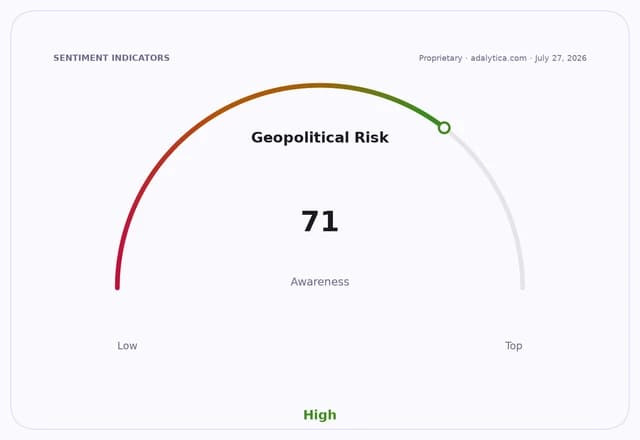
Sentiment IndicatorsⓘProprietary · adalytica.com · July 27, 2026
This is a snapshot — live sentiment, awareness and momentum for 130+ markets update continuously in the dashboard.Open AlphaPulse
For markets, the signal lands at a sensitive moment. The iShares MSCI South Africa ETF has rebounded sharply from its spring lows, but the rally is already showing signs of fatigue: the fund closed at 61.07 on July 24, below its 50-day average of 64.72 and under its 200-day average of 66.54, while its MACD remains negative. That tells me the market is no longer pricing a clean, one-way recovery. It is pricing uncertainty, and uncertainty is where asymmetry appears.
The bigger read-through is to the commodities complex and the exporters tied to it. South Africa’s leverage comes from the assets Washington needs most: minerals, energy inputs and industrial supply lines. If trade relations tighten, the winners are likely to be the groups with hard physical exposure to South African resource flows and the infrastructure that moves them. The losers are the policy-sensitive importers, global manufacturers dependent on stable South African access, and any companies whose margins rely on frictionless cross-border commerce.
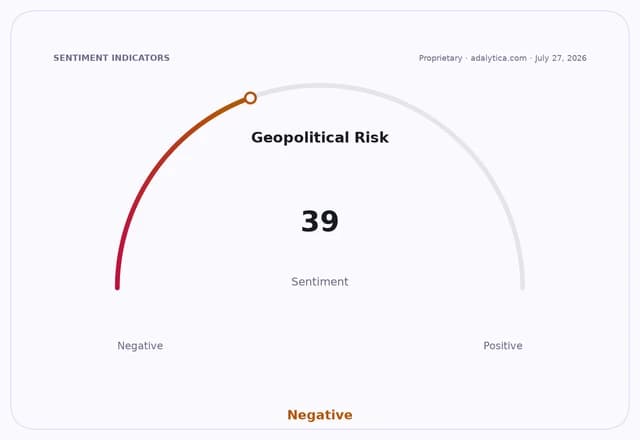
The message also comes against a softer U.S. dollar backdrop. Adalytica’s US Dollar Trade Signals snapshot shows sentiment at 0, labeled “Extreme Fear,” even as awareness remains neutral. A weaker dollar typically lifts emerging-market assets and commodity pricing power, which is exactly why South Africa’s geopolitical positioning matters now: it can amplify or blunt the benefits of a softer greenback.
That creates an investable setup. I believe the market underestimates how quickly geopolitical signaling can turn into a valuation catalyst for South African assets, especially the miners and export-linked names already benefiting from global demand for strategic materials. The U.S. may want deeper commercial ties with Africa, but South Africa’s willingness to push back tells investors to focus less on broad diplomacy and more on who controls the bottlenecks.
If the dispute stays rhetorical, the upside remains in resource leverage and exporters. If it hardens into trade tension, investors should expect more volatility in the rand, stronger relative demand for minerals with strategic value, and renewed attention on South Africa-listed resource producers and the broader EZA ETF as a geopolitical trade rather than a simple macro bet. This is the kind of setup where early positioning matters.
| Entity | Gains | Losses |
|---|---|---|
| South African miners | ▲Strategic leverage | ▼Policy uncertainty |
| U.S. importers | ▲Lower input stability | ▼Supply risk |
| EZA ETF holders | ▲Geopolitical re-rating | ▼Near-term volatility |
| Commodity bulls | ▲Export pricing power | ▼Friction-heavy trade |