The South African rand’s next move may hinge less on global dollar strength than on whether Pretoria can convince investors its fiscal repair is real.
South African rand outlook hinges on fiscal credibility

UBS has kept its USD/ZAR forecasts unchanged at 16.20 for December 2026 and 16.00 by March 2027, betting that South Africa’s improving public finances, stronger export earnings and a yield advantage over the dollar will outweigh the pressure from US rates. But the bank said Wednesday’s medium-term budget statement is a key test of whether the government can reinforce a reform narrative that has already helped push South African credit spreads near their tightest levels in a decade.
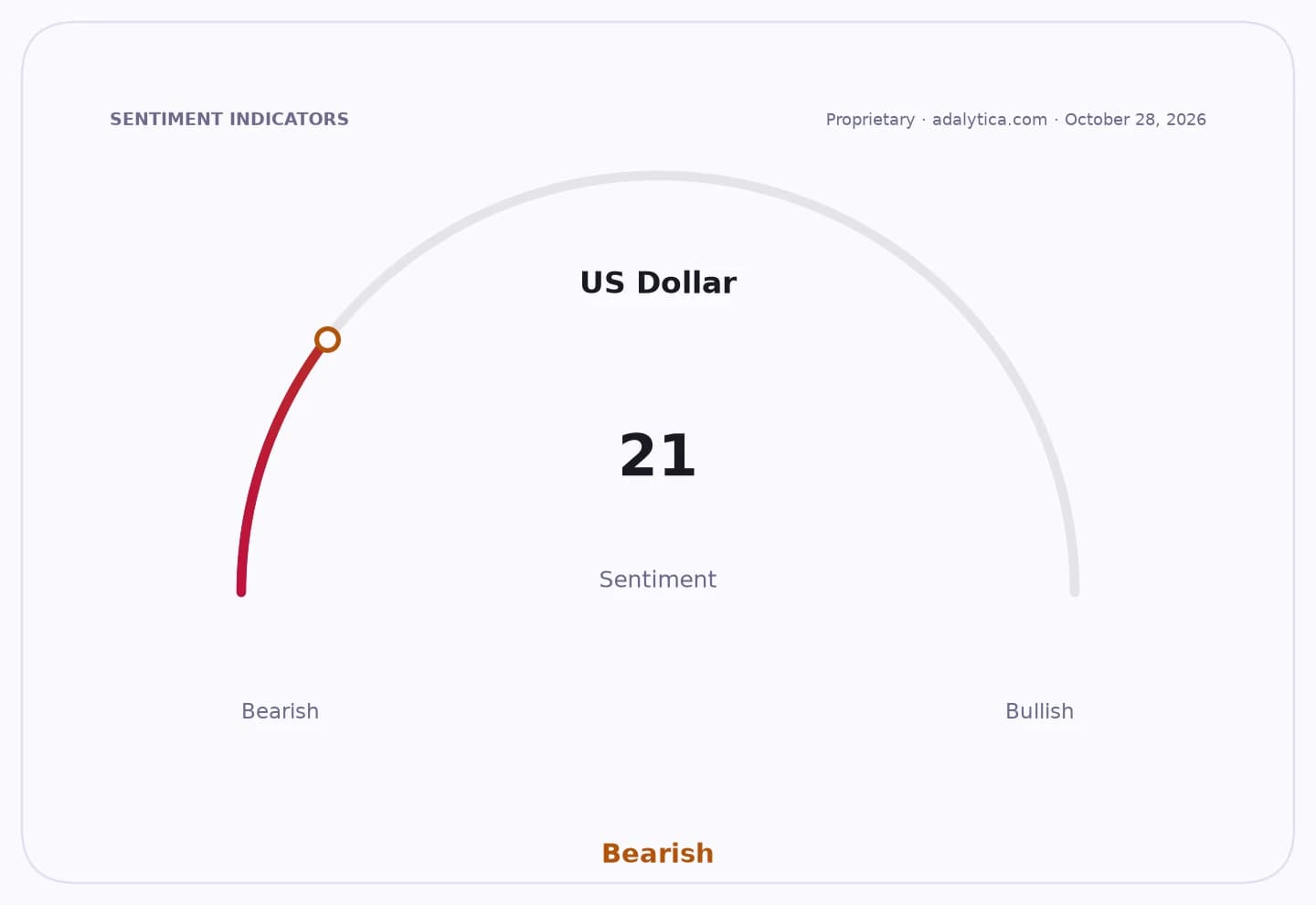
Sentiment IndicatorsⓘProprietary · adalytica.com · October 28, 2026
This is a snapshot — live sentiment, awareness and momentum for 130+ markets update continuously in the dashboard.Open AlphaPulse
The rand was trading around 16.65 per dollar on Wednesday, little changed on the day but weaker than UBS’s forecast path. That gap matters because the currency’s performance is increasingly tied to domestic credibility, not just commodity prices or the Federal Reserve. A budget that shows firmer fiscal consolidation, more credible debt stabilization and perhaps a formal fiscal anchor could extend the recent improvement in South Africa’s external financing conditions. A spending-heavy statement without clear funding, by contrast, would risk undoing that progress.
UBS strategists Pietro Santin and Tilmann Kolb said South Africa has already made “key” gains in primary surpluses, revenue collection and contingent liability risks. They also pointed to improving profitability at some state-owned enterprises, a meaningful development in a country where those companies have been a drag on the sovereign balance sheet for years. In their view, those trends could help the rand recover if the budget confirms the government is still on a path toward lower borrowing and a more stable debt ratio.
That is the economic core of the call. South Africa does not need a dramatic growth boom for the rand to strengthen; it needs enough evidence that fiscal slippage will not dominate the investment case. UBS sees growth of 1.3% next year and 2.0% in 2027, with structural reforms and a resilient global backdrop helping offset weak household spending and tighter monetary policy. The bank also expects precious metals, especially gold, to support export receipts, with bullion forecast above $5,000 an ounce next year. For a commodity exporter with a large external financing need, that combination can be powerful.
Investors, however, know the support is conditional. The rand’s carry advantage over the dollar is only about 2.5% a year, which helps but does not compensate for a sharp FX loss if confidence breaks. UBS said it expects the South African Reserve Bank to stay cautious rather than tighten aggressively, and it thinks two Fed hikes over the next six months are already largely priced in. That leaves the budget as the immediate domestic catalyst — a document that can either validate a tighter fiscal spread story or raise questions about whether the improvement is durable.
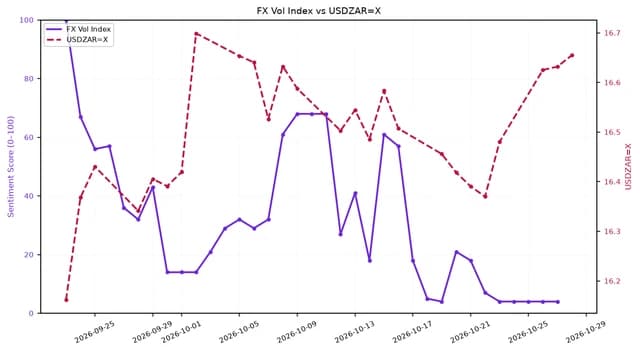
Market action suggests the issue is still live. USD/ZAR has been hovering above 16.6, while the pair remains above its 50-day and 200-day moving averages, with RSI readings around neutral territory and momentum flattening. That points to a market waiting for confirmation rather than pricing in a decisive rand break higher. The broader risk backdrop is also mixed: a stronger dollar or weaker metals would make South Africa’s external position look less comfortable, while a reassuring budget could help the currency absorb some of that pressure.
For investors, the message is straightforward: the rand’s upside now depends on fiscal credibility as much as on carry and commodities. If Wednesday’s budget strengthens confidence in debt control, UBS’s 16.00 target starts to look plausible. If it does not, South Africa’s recent credit gains may prove harder to defend.
| Entity | Gains | Losses |
|---|---|---|
| South African rand | ▲Fiscal credibility boost | ▼Loose budget stance |
| South African bonds | ▲Tighter spreads | ▼Higher borrowing risk |
| Exporters / gold producers | ▲Stronger metals support | ▼Softer global demand |
| USD longs | ▲Higher US yields | ▼Improved risk sentiment |