Spain’s inflation problem is not hitting every household the same way, and that matters for growth, policy and consumer stocks. The country’s consumer prices rose 4.9% overall, but the gap between regions is wide enough to change how much pain families feel, how hard businesses can pass through costs and how policymakers should think about the inflation outlook.
Spain Inflation Varies Sharply by Region
The sharpest increases are concentrated in places where energy carries more weight in the family budget, or where services such as hospitality are running hotter. Galicia and Castilla-La Mancha both posted 5.5% inflation, while Castilla y León and Navarra were close behind at 5.4%. By contrast, Canary Islands and Aragón were running at 4.4%, showing that the same national shock can produce very different local outcomes.
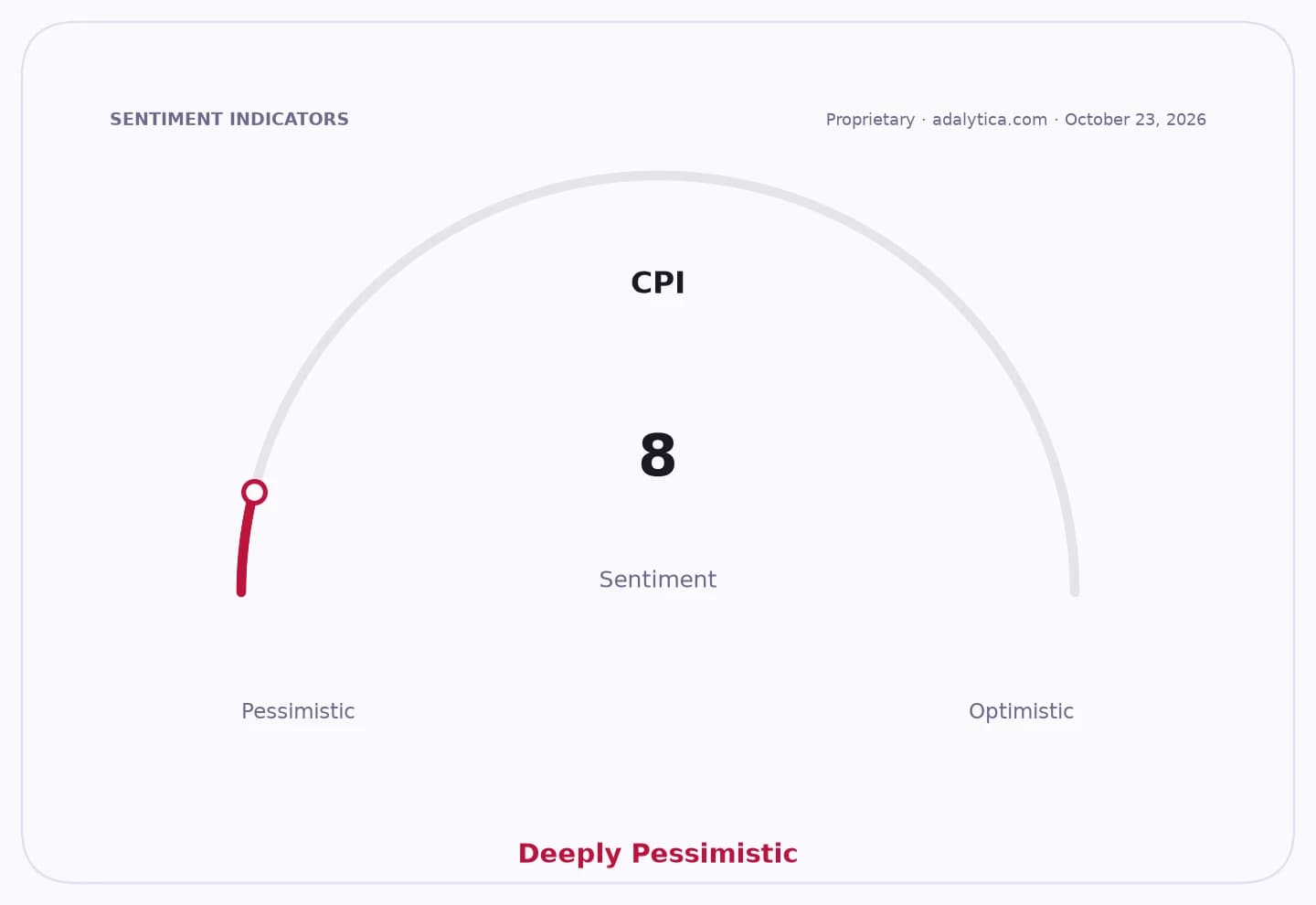
Sentiment IndicatorsⓘProprietary · adalytica.com · October 23, 2026
This is a snapshot — live sentiment, awareness and momentum for 130+ markets update continuously in the dashboard.Open AlphaPulse
That divergence is economically important because it points to a price shock that is still being driven by essentials. Energy is doing a lot of the work, especially in regions where households spend more on fuel, electricity and heating. In Castilla-La Mancha, 52% of the inflation rate is linked to energy, compared with a national average of 39%. In Castilla y León, energy accounts for 45%. Madrid and Extremadura also stand out, with energy explaining roughly three quarters of the gap versus the national rate, largely because gasoline is taking a bigger bite out of commuting costs.
For investors, that means the inflation story is not just about Spain’s headline rate. It is about who absorbs the shock and where corporate pricing power can hold up. Airlines, fuel retailers, utilities, hotel operators and consumer-facing businesses in high-inflation regions may face more pressure from squeezed spending power, while firms tied to travel and dining in lower-inflation regions could find demand relatively steadier. Regional dispersion also complicates the outlook for consumer sentiment and discretionary spending, two variables that matter for Spanish equities and domestic lenders.
There is also a clear lesson in the areas where inflation is softer. Canary Islands, with the lowest rate at 4.4%, benefit from a smaller energy burden and relatively calmer services inflation. Aragón is also subdued because tourism and hospitality prices are rising more slowly than elsewhere. Catalonia’s lower reading reflects cheaper fuel inflation, while Valencia is being helped by a lighter energy contribution. In other words, Spain’s inflation map is being shaped by local consumption patterns as much as by the national shock.
That makes the current episode more than a short-term cost-of-living squeeze. If energy prices remain elevated, the regions that depend most on cars and imported fuel will continue to feel the most pressure, while tourism-heavy areas may stay relatively insulated if services inflation cools. For long-term investors, the takeaway is simple: Spain’s inflation trend is uneven, regionally sensitive and still closely tied to energy. That argues for patience, diversification and a close look at which businesses can protect margins when households are under strain.
| Entity | Gains | Losses |
|---|---|---|
| Energy producers and suppliers | ▲Higher pricing power | ▼Consumers in high-energy regions |
| Fuel-dependent households | ▲No clear gains | ▼Larger cost-of-living squeeze |
| Tourism and hospitality firms in slower-inflation regions | ▲Better demand resilience | ▼Operators in hotter regions |
| Spanish policymakers | ▲Clearer map of inflation drivers | ▼Simpler national inflation story |