Spain’s next minimum-wage increase is now politically locked in, with both major camps committed to lifting it and keeping the lowest-paid workers out of the income-tax net.
Spain minimum wage rise and tax exemption
That matters because the debate has shifted from whether the salario mínimo will rise to how far it will go, who captures the benefit and how much it adds to labor costs at a time when Spain’s jobless rate has climbed back above 10%. For businesses, especially labor-intensive sectors, the issue is no longer just the headline wage floor but the full cost stack that comes with it — higher payroll bills, social contributions and, potentially, further pressure on margins if wage gains spread beyond the statutory minimum.
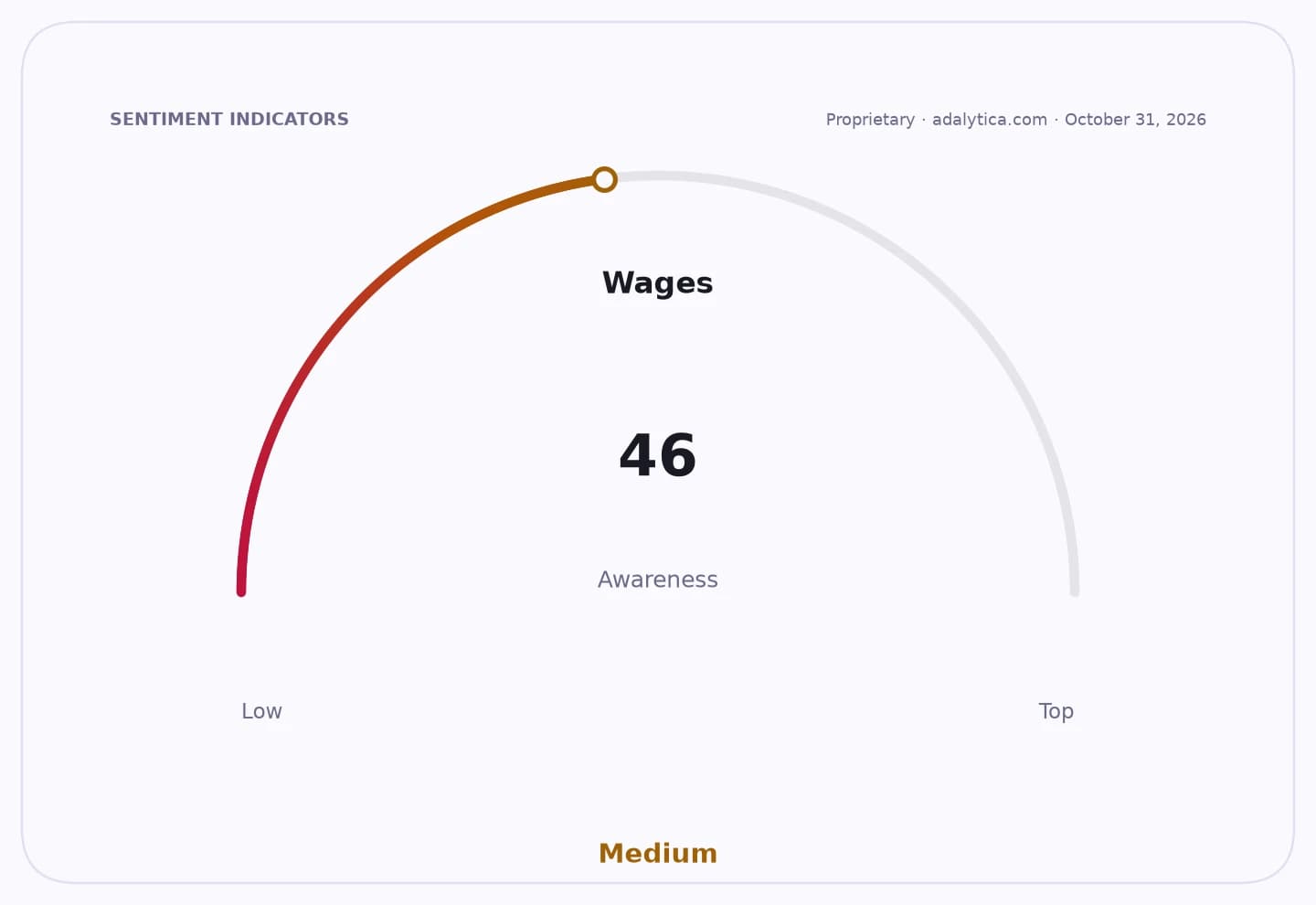
Sentiment Indicators
Opposition leader Alberto Núñez Feijóo said the Partido Popular would raise the minimum wage in 2027 and keep it exempt from personal income tax, after previously questioning the government’s approach. Yolanda Díaz, the labor minister and deputy prime minister, is already preparing the next increase for January, with a recommendation from experts due before month-end and a target of pushing it through social dialogue before the election campaign fully intensifies. The government is considering an increase of about 5%, extending a sequence of rises that has become a core political message for the left.
The tax treatment is almost as important as the wage itself. Feijóo’s promise to preserve the exemption removes one of the few areas where the left and right could differentiate themselves on low-income workers’ take-home pay. It also underscores a broader reality: once the minimum wage reaches a certain level, the political cost of allowing it to be taxed rises sharply. The PP leader’s misstep in accusing the government of failing to “deflate” the tax brackets only reinforced how central the issue has become in the election narrative.
Economically, the move suggests wage policy will remain supportive of household income even if Spain’s labor market softens. Spain’s unemployment rate rose to 10.18% in the third quarter, with 95,900 more people unemployed over the summer, the sharpest seasonal jump since the pandemic. That makes the minimum wage a more sensitive policy lever: it can help low earners offset inflation and support consumption, but it also risks aggravating concerns from employers that pay floors are rising faster than productivity, especially in sectors with thin margins and high entry-level employment.
For investors, the direct market impact is limited but not irrelevant. A higher wage floor can squeeze profits in retail, hospitality, agriculture and other labor-intensive businesses, while supporting consumer spending among lower-income households. In equities, that tends to favor domestic demand plays over employers with heavy low-wage exposure. In credit, it is another small but cumulative pressure point for companies already facing a higher cost base, and for banks with exposure to small businesses that may struggle to absorb rising labor costs.
The larger narrative is that Spain’s minimum wage has become a durable feature of the political economy rather than a temporary policy tool. Whoever wins power, the floor will probably keep rising, and the real fight is over distribution — whether gains show up in gross wages, net pay or both. That makes the next round of wage-setting less a question of ideology than of how much labor policy can be pushed before it starts colliding with employment and corporate profitability.
| Entity | Gains | Losses |
|---|---|---|
| Low-wage workers | ▲Higher take-home pay | ▼Limited if taxes or jobs weaken |
| PSOE / Sumar government | ▲Electoral support | ▼Employer backlash |
| PP / Feijóo | ▲Policy credibility on wages | ▼Less room to oppose hikes |
| Labor-intensive firms | ▲None | ▼Higher payroll costs |