Global purchasing managers' indices are due this week and, together with U.S. labor data, trade figures and quarterly earnings, will offer the clearest read yet on whether the economy is slowing just enough to ease inflation without tipping into a sharper downturn.
SPY at 747.03 as PMI, jobs data loom

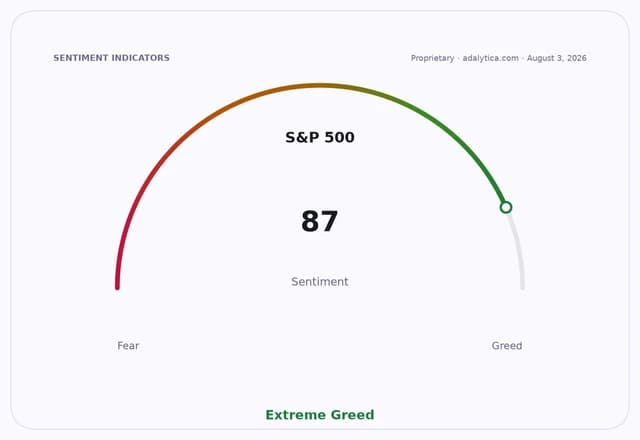
That matters because markets are trying to price a soft landing at a time when growth data are losing momentum and investors are still carrying elevated risk appetite. The S&P 500, tracked by SPY, has rallied back to 747.03 from a March low of 646.90, while Adalytica's trade-signal snapshot shows extreme greed at 87, leaving equities vulnerable if the macro data disappoint.
The labor market remains the key swing factor. The U.S. unemployment rate is forecast at 4.18% for July, essentially flat from 4.2% in June, suggesting joblessness is still subdued even as payroll growth cools. Job openings, measured by the JOLTS report, are expected to edge up to 7.6569 million from 7.594 million in May, a sign that demand for workers is softening only gradually.
Industrial activity is also grinding higher rather than surging. U.S. industrial production is projected to rise 0.3% in July after increasing 0.08% in June, consistent with a factory sector that has stabilized but not accelerated. For investors, that mix points to slower but still positive growth — enough to support corporate earnings, but not enough to rule out margin pressure if demand weakens.
PMIs will matter most because they are the fastest global gauges of new orders, output and hiring. A stronger-than-expected print would support cyclicals, commodity names and exporters, while weak readings would reinforce the case for defensives, duration and rate-sensitive sectors. Trade data will add another layer, showing whether supply chains and cross-border demand are improving or stalling.
Quarterly earnings will test whether companies can defend guidance in a less buoyant macro backdrop. Markets are especially focused on whether revenue growth can hold up as cost cuts fade and whether management teams lean more cautious on capex, hiring and inventories. That is critical for sectors tied to manufacturing, logistics, semiconductors and consumer demand.
For now, the narrative is one of deceleration, not breakdown. The question for traders is whether this week's PMI, labor and earnings batch confirms a stable slowdown that keeps the Federal Reserve on hold — or starts to expose the first cracks in demand that would challenge the market's recent optimism.
| Entity | Gains | Losses |
|---|---|---|
| Equities bulls | ▲Soft-landing confirmation | ▼Disappointing PMI or jobs data |
| Defensives and duration assets | ▲Slower growth backdrop | ▼Risk-on rotation |
| Exporters and cyclical stocks | ▲Stronger global PMIs | ▼Weak trade and factory data |
| Federal Reserve | ▲Cooler inflation pressure | ▼Reacceleration in labor demand |