Missing a handful of the stock market’s strongest sessions can do more damage to long-term returns than many investors expect, and the latest swing in U.S. equities is a reminder that staying invested often matters more than calling the turn.
Staying Invested Beats Missing Rebound Days

The lesson lands as the S&P 500 trades near record territory after a sharp spring rebound, even as short-term sentiment has weakened. SPY closed at 742.09 on July 20, above its 200-day moving average of 693.85 and roughly in line with its 50-day average of 743.44, while QQQ ended at 696.06 and VTI at 366.25. The technical picture suggests a market that has recovered from a deep correction but remains vulnerable to another pullback, which is exactly the kind of environment that tempts investors to get too defensive and miss the rebound days that often drive performance.
Sentiment IndicatorsⓘProprietary · adalytica.com · July 21, 2026
This is a snapshot — live sentiment, awareness and momentum for 130+ markets update continuously in the dashboard.Open AlphaPulse
That risk is not hypothetical. SPY had fallen to 646.90 on March 20, with its 14-day RSI sinking to 25.8, before surging to 746.25 by May 14. A similar pattern showed up in QQQ, which rebounded from 598.34 in early March to 743.18 by mid-June. Those moves happened quickly, and not necessarily when macro headlines looked calm or when positioning felt comfortable. The market’s biggest gains often arrive during periods of uncertainty, which is why an investor sitting in cash waiting for perfect clarity can end up buying back in after the lift has already happened.
Macro conditions underscore why market timing is so difficult. The Federal Reserve’s policy rate has eased to about 3.63% from 3.64% in April, with a further small decline expected in July, while the 10-year Treasury yield sits around 4.53%, implying still-restrictive but stabilizing financial conditions. Unemployment is forecast at 4.18%, suggesting a labor market that is cooling only gradually rather than rolling over. That combination leaves plenty of room for shifting rate expectations and sudden equity swings, but not enough certainty to make repeated all-in, all-out calls a reliable strategy.
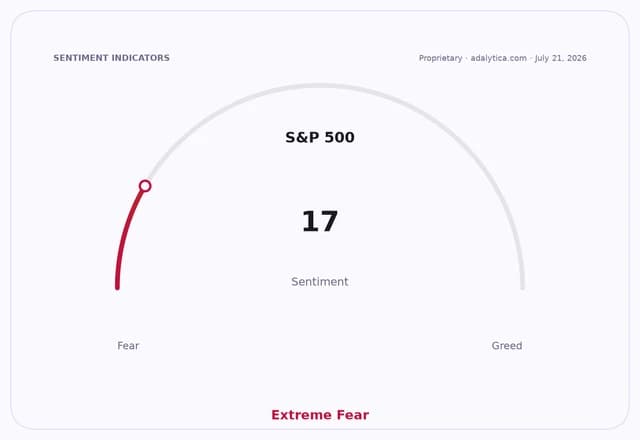
Investor behavior is also telling. Adalytica’s S&P 500 trade signals show sentiment at 17, labeled fear, after dropping 60 points over the past month. Yet the index itself has held up far better than the mood. That divergence is often where timing mistakes are made: fear pushes investors to cut exposure after volatility has already done much of its damage, then optimism returns after the rebound is underway. Treasury-bond signals, meanwhile, show fear as well, highlighting a broader caution across asset classes rather than a clean rotation out of equities and into safety.
The bull case for staying invested is straightforward: over long horizons, equity compounding depends heavily on capturing a relatively small number of outsized up days, and those days frequently cluster around periods of stress. The bear case is that valuations and momentum can unravel quickly if growth weakens or rates stay higher for longer, leaving buy-and-hold investors exposed to drawdowns. But even in that scenario, repeated attempts to dodge volatility can be more damaging than the volatility itself if they result in missing the market’s best sessions.
For investors, the practical implication is not to ignore risk, but to recognize that timing needs to be right twice — once when exiting and again when re-entering. In a market that can recover hundreds of points in a matter of weeks, the cost of being too cautious can be permanent. The better question is less whether to be in or out, and more how much exposure to maintain through the cycle while using diversification and rebalancing to control risk.
| Entity | Gains | Losses |
|---|---|---|
| Long-term equity investors | ▲Capture rebound days | ▼None if patient |
| Market timers | ▲Avoid some drawdowns | ▼Miss sharp rallies |
| Cash holders | ▲Dry powder | ▼Lower compounding |
| Volatility sellers | ▲Mean reversion trades | ▼Sharp trend reversals |