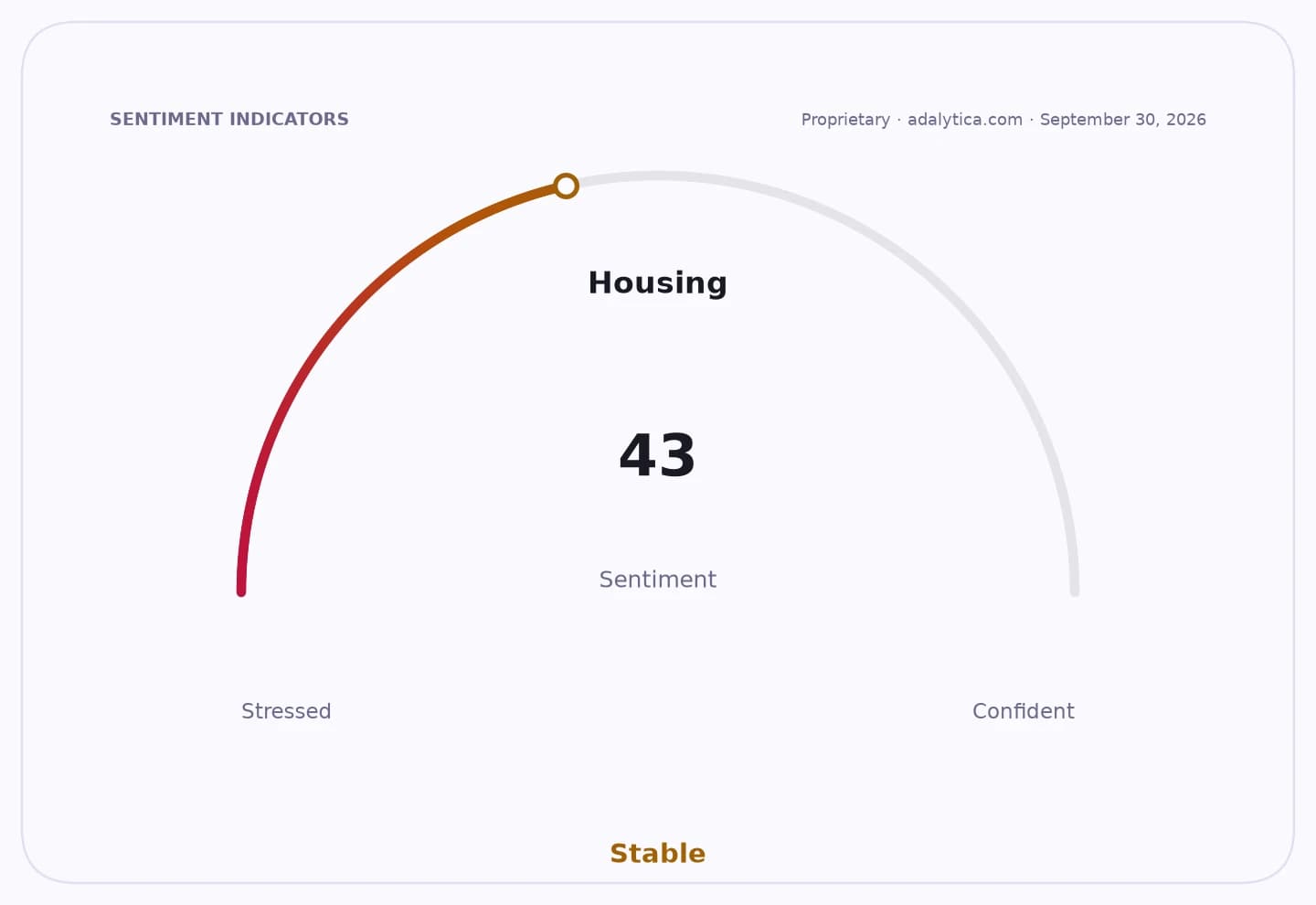
More Swedish households are still betting on higher house prices, even as borrowing costs start to climb again — a sign that tight supply and resilient purchasing power are still overpowering rate anxiety in one of Europe’s most rate-sensitive housing markets.
Sweden House Price Expectations Rise in October

SEB’s October housing-price indicator showed 53% of respondents expect prices to rise over the next year, up 2 percentage points from the previous month, while just 10% see declines. That is economically important because housing expectations can become self-fulfilling: when buyers believe prices will keep rising, demand tends to hold up, transaction volumes improve and sellers become less willing to cut.
Sentiment IndicatorsⓘProprietary · adalytica.com · October 5, 2026
This is a snapshot — live sentiment, awareness and momentum for 130+ markets update continuously in the dashboard.Open AlphaPulse
For investors, the message is that the market may be underestimating how sticky housing demand remains in the face of higher rates. The backdrop is not speculative froth so much as affordability resilience. SEB private economist Américo Fernández said stronger growth, solid household purchasing power and eased mortgage rules are giving households room to keep buying even as rates edge higher. That matters because it suggests Sweden’s housing market is being supported by income and credit conditions rather than simply by cheap money.
The read-through is broader than one survey. Housing sentiment is often an early indicator for banks, builders and consumer spending because homes are both a balance-sheet asset and a channel for wealth effects. If more households expect prices to rise, owners feel less pressure to sell and would-be buyers are more likely to step in now rather than wait. That can slow the downside in prices even before it shows up in hard data.
The market backdrop also suggests investors are seeing the same tension. The iShares U.S. Home Construction ETF, ITB, has slipped below both its 50-day and 200-day moving averages, reflecting recent pressure on U.S. builders. Yet broader housing exposure, such as the iShares U.S. Real Estate ETF, IYR, has held up better even after a pullback, underscoring that this remains a selective, not uniform, housing trade. Adalytica’s housing and rent inflation signal also shows extreme greed, reinforcing the view that the market is looking through near-term rate noise and focusing on persistent scarcity.
The bigger narrative is that housing is shifting from a rate story back to a supply story. When households keep expecting higher prices despite rising borrowing costs, the dominant force is no longer financing alone — it is constrained supply, resilient wages and the reluctance of owners to part with assets that may keep appreciating. That is the setup investors should watch: not a broad housing boom, but a market where price support stays firmer than consensus expects.
For investors, that argues for staying constructive on the parts of the housing complex tied to durable demand and structural undersupply, while being cautious on lenders and rate-sensitive builder names if borrowing costs keep moving higher. The opportunity is in the mismatch between sentiment and the market’s still-pessimistic pricing of housing resilience.
| Entity | Gains | Losses |
|---|---|---|
| Homeowners | ▲Higher asset values | ▼Slower affordability |
| Swedish builders | ▲Firmer demand | ▼Higher financing costs |
| Banks with mortgage books | ▲Steady loan demand | ▼More rate pressure |
| House buyers | ▲More urgency to buy | ▼Fewer bargains |