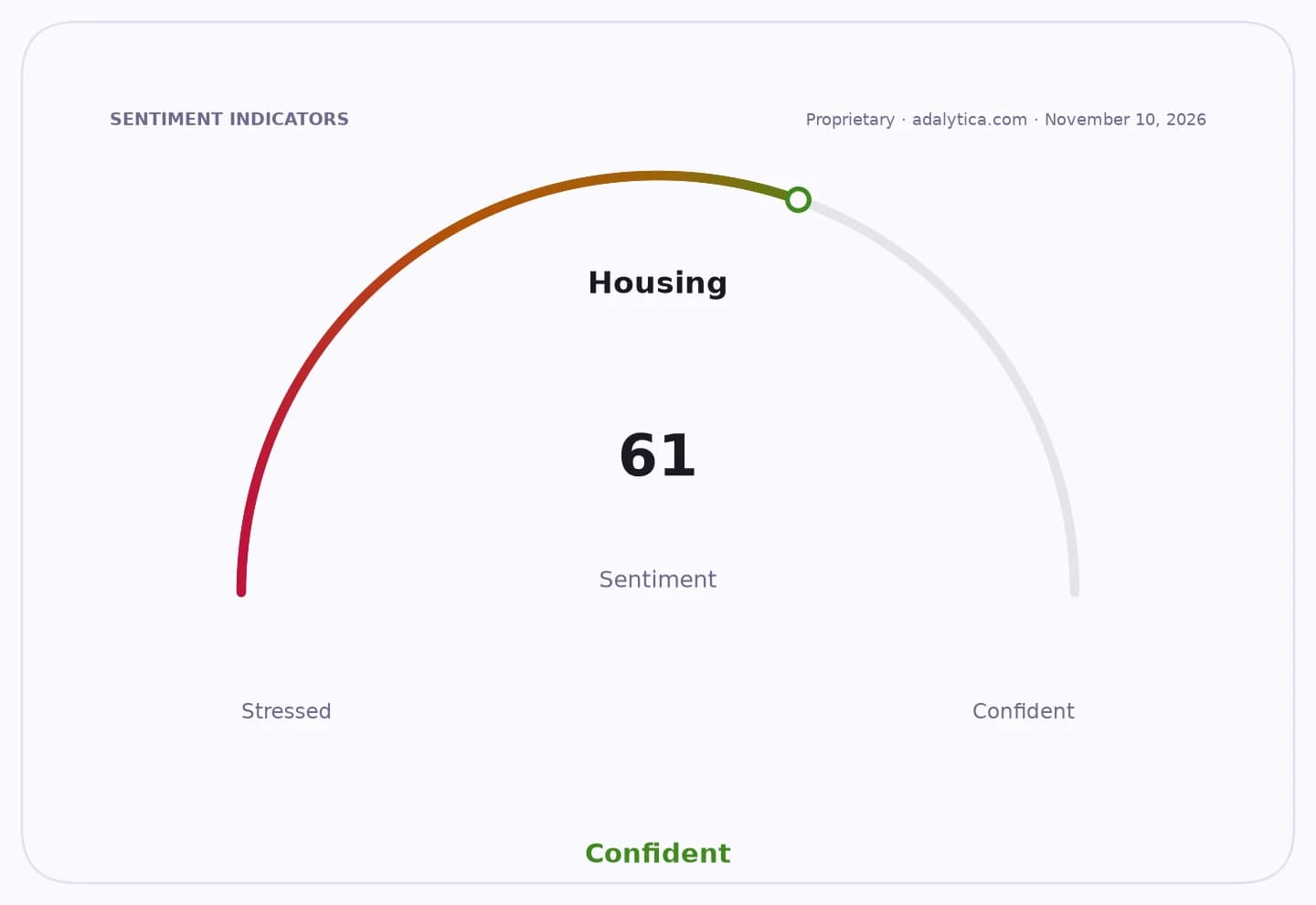
Higher borrowing costs are becoming embedded in housing markets rather than treated as a passing shock, with mortgage rates likely to settle well above the ultra-low levels that defined the past decade.
Sweden mortgage rates stay high as housing resets
Housing
That shift matters because it changes household affordability, slows transaction volumes and forces lenders, builders and home-search platforms to operate in a lower-turnover market. In Sweden, the Riksbank’s move this week to 2% is filtering through to floating mortgages, while bank forecasts cited by Swedish economists point to home-loan rates of more than 3% and in some cases close to 4% in the coming years. For borrowers who spent years adjusting to near-zero policy rates, that is a structural reset.
Sentiment Indicators
Robert Boije, chief economist at SBAB, said mortgage rates will likely average around 3.5% to 4%, depending on the fixation period, well above the roughly 1% borrowing costs many households became accustomed to during the era of negative rates. Over the longer sweep of history, that is still not extreme: SBAB said the average floating mortgage rate between 1998 and 2025 was 3.2%, with five-year fixed loans averaging 4.1%. But the return to those levels is painful because it follows an unusually long period of cheap money that inflated home prices, debt levels and household expectations.
The economic implications are straightforward. Every 1 percentage point increase in interest on a 2 million kronor mortgage adds a little more than 1,000 kronor a month in costs, a hit that quickly squeezes consumption and reduces room for discretionary spending. For policymakers, the risk is that higher debt-service burdens slow demand just as inflation pressure is meant to be contained. For households, the practical lesson is that the housing budget must be built around a higher-rate environment, not a hope that rates snap back to the old floor.
The message from economists is not that rates will spiral to the 8% to 10% levels seen in earlier inflation episodes. Boije and SEB chief economist Jens Magnusson both argued that Sweden’s 2% inflation target and relatively sound public finances should keep such outcomes unlikely. But they also said the old regime of mortgage rates around 1% is unlikely to return. Magnusson said the inflation shock from 2022 marked a clear regime change, and that large private and public debt loads, together with still-elevated price levels, argue for a higher rate floor.
That is already showing up in financial markets and in the housing chain. U.S. 30-year mortgage rates have remained above 7%, near levels that are still constraining affordability, while U.S. homebuilding activity remains subdued after a long period of rate shock. In the public markets, mortgage and housing-related stocks have become more sensitive to each move in bond yields and policy expectations. Rocket Companies, United Wholesale Mortgage and Zillow have all signaled in recent filings that persistently high mortgage rates are weighing on transactions and revenue visibility. Rocket’s shares have rallied sharply from earlier lows, but the volatility underscores how dependent the sector remains on rate expectations rather than on a clean recovery in housing demand.
For investors, the key issue is that a higher-rate world alters the economics of the entire housing ecosystem. Originators may benefit from wider pricing or servicing income if rates stay elevated, but lower turnover reduces loan volumes and limits the refinancing boom that once padded earnings. Homebuilders can gain market share if they target affordability-constrained buyers, but margins are harder to protect when financing costs remain high. Sellers and homeowners looking to trade up, by contrast, face the most direct squeeze.
The broader narrative is not simply that rates are higher. It is that the market is being forced to digest a new baseline in which cheap mortgage money is no longer the default assumption. That changes how households borrow, how banks underwrite, how builders plan inventory and how investors value housing-linked earnings. The uncertain part is not whether mortgage rates have moved higher. It is how long this new normal lasts.
| Entity | Gains | Losses |
|---|---|---|
| Banks and lenders | ▲Higher pricing power | ▼Lower refinancing volumes |
| Homebuyers | ▲More caution in planning | ▼Worse affordability |
| Homebuilders | ▲Focus on value segments | ▼Slower transaction demand |
| Mortgage platforms | ▲Servicing income tailwind | ▼Fewer origination opportunities |